A Review of Palmer’s Tarot: Voice of the Inner Light, a Reference Manual

palmer-tarot

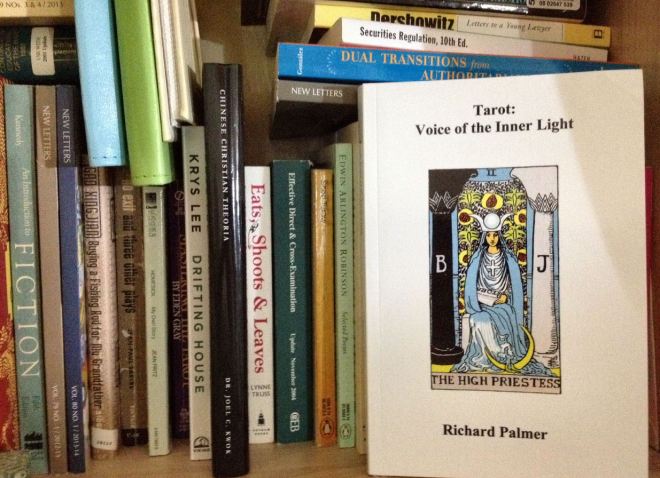
I’ve got a new amazing addition to my personal library: Richard Palmer’s Tarot: Voice of the Inner Light (Custom Book Publishing, 2008). If this book had existed in the 90s, I would have advanced in my tarot practice so much faster. When I started out in tarot, there weren’t limitless online references and glossaries on card meanings, which by the way I still do not find all that useful, as much of it is the blind leading the blind, with no indication of the source of the card meanings provided or no identification of the tradition used.

(Oh and please do not mind the unorganized bookshelf. Hubby and I are preparing to move to a new house, so I figured I’d wait until we settled in to organize a library. Right now I have literary fiction next to books on law next to classical poetry next to Christian theology next to Buddhist philosophy next to my little collection of stuff on the esoteric and the occult. Anyway.)

The first lines of the Introduction tells you exactly what you’ll get: “There are many complex and profound books written on the subject of the Tarot. This isn’t one of them. The aim of this work is to bring the practical knowledge of how to use the Tarot into the life of anyone who is willing to put forth the minimum effort necessary to understand this remarkable gift.” Voice of the Inner Light is give or take a 240 page reference book, about 60,000 words if I had to guestimate. In essentially 10 pages upfront, the book teaches you how to begin using your tarot deck. There is no longwinded research on history, origins, philosophy, or theosophy. I understand that most advanced practitioners are looking for theory, but this book is not targeted at that kind of reader. This book is targeted at that starting practitioner who may have read 1 or 2 more comprehensive books on tarot and is now looking for a go-to reference manual to keep on the desk for readings.

Per my own analysis of Palmer’s book, his card meaning interpretations are based heavily on Hermetic Qabalah. Palmer is also a renowned astrologer, and so Voice of the Inner Light is going to be indispensable to tarot practitioners who integrate Western astrology with tarot.

Each card is covered in 2-3 pages. A card description and key symbolism is provided, then the card’s astrological association, and then the practical application of the card when upright and when reversed. Then a concluding remark is offered on Qabalistic correspondences. Such concise coverage of card meanings is the primary purpose of the book. Other than how to read a single card or perform a simple 3-card reading, Voice of the Inner Light is not for teaching spreads or how to intuitively read multi-card spreads. The book’s purpose is for the foundational understanding of each and every card.

Thus, I consider it an intermediate reference manual. If you have read a few beginner books on tarot, this book is a useful supplemental next step. However, for advanced practitioners who want to begin building a repertoire of spreads and how to use the tarot in complex reading techniques, this won’t be the right book for that. Voice of the Inner Light will be an integral supplement to such goals. As you learn complex reading techniques, you will need a book that provides in-depth interpretation of each card, in which case Voice is one of the best. Also, those with a particular leaning for the GD interpretive method, Voice will be highly appealing as opposed to the more what I call New-Agey-keyed reference manuals.

The First Operation: Adapting a Traditional Method in the “Opening of the Key” to Contemporary Tarot Applications

The First Operation is the first step to an extensive divination method called the “Opening of the Key,” a method associated with the Golden Dawn approach to tarot reading. Paul Foster Case’s book, Oracle of the Tarot (1933) provides a great instructional on the First Operation. A PDF of the book can be downloaded HEREFor a recent publication on “Opening of the Key,” read “The Golden Dawn Opening of the Key Method” by Marcus Katz of Tarot Professionals, linked HERE.

Now I’ve extracted the First Operation method from the Opening of the Key to use contemporaneously with modern approaches to tarot reading.

Selecting the Signifier

There are many ways of selecting a signifier card, also known as the significator. A classic “old school” Golden Dawn approach is to use The Magician for a male and The High Priestess for a female. However, I was taught to use court cards. The following is my court card approach to selecting the signifier:

Astrol. Signs, Sun Sign Dates

Suit

Court Card Signifier
Aries, MAR 21 – APR 19

WANDS

PAGE for young female
Leo, JUL 23 – AUG 22 KNIGHT for young male
Sagittarius, NOV 22 – DEC 21 QUEEN for adult female
KING for adult male
Cancer, JUN 21 – JUL 22

CUPS

PAGE for young female
Scorpio, OCT 23 – NOV 21 KNIGHT for young male
Pisces, FEB 19 – MAR 20 QUEEN for adult female
KING for adult male
Libra, SEPT 23 – OCT 22

SWORDS

PAGE for young female
Aquarius, JAN 20 – FEB 18 KNIGHT for young male
Gemini, MAY 21 – JUN 20 QUEEN for adult female
KING for adult male
Capricorn, DEC 22 – JAN 19

PENTACLES

PAGE for young female
Taurus, APR 20 – MAY 20 KNIGHT for young male
Virgo, AUG 23 – SEPT 22 QUEEN for adult female
KING for adult male

Continue reading “The First Operation: Adapting a Traditional Method in the “Opening of the Key” to Contemporary Tarot Applications”

A 10-Week Independent Study Course with Paul Foster Case: A Review of Oracle of the Tarot (1933).

Paul_Foster_CasePaul Foster Case (1884 – 1954) is one of the most influential American occultists on modern tarot studies. His approach to tarot is influenced heavily by Western astrology and the Hermetic Qabalah, as evidenced in his tarot divination course, Oracle of the Tarot, and other writings, such as An Introduction to the Study of Tarot (1920) or The Tarot: A Key to the Wisdom of the Ages (1947). Oracle is keyed to the Knapp-Hall Tarot, which was first published by J. Augustus Knapp and Manly P. Hall in 1929. The Knapp-Hall Tarot differs significantly from the Marseille, Rider-Waite-Smith, or Thoth interpretive traditions, so the card meanings in Oracle, in particular from the Minor Arcana, are not readily transferrable to the Marseille, Rider-Waite-Smith, or Thoth systems. Nonetheless, Oracle offers the beginner and intermediate student a strong foundation in the basics and anatomy of tarot.

Case opens the book with a strong statement: “TAROT divination is not fortune-telling. The practice of fortune-telling is based on the false notion that human life is governed by luck, chance, or fate–by obscure powers at work outside the personality. True divination rests upon the occult truth that the causes of all events in human life are really internal.” He thus begins by distinguishing divination from fortune-telling. Divination is an inward reflection process of using tarot to tap into the superconscious. The tarot utilizes imagery and symbols that communicate in the language of the superconscious and thus understanding tarot is in its essence the learning of a new language.

The introductory Lesson 1 warns the tarot practitioner to take tarot divination seriously and reviews a few ethical guidelines, in particular the practitioner’s duty of confidentiality and impartiality. Practitioners must remain non-judgmental when conducting tarot readings. Lesson 1 also subdivides tarot decks into exoteric and esoteric decks. Case provides the Knapp-Hall Tarot as an example of an exoteric deck, or one that operates in the realm of public knowledge, with imagery that more closely resembles the tarot deck originally used for playing games, and contrasts that with the Rider Tarot (or Rider-Waite-Smith), which he refers to as an esoteric deck. Esoteric tarot decks are the versions of tarot re-interpreted by occultists and used specifically for divination or other spiritual exercises.

Note that it is unclear and somewhat contradictory as to why Case expends the first half of the Introduction to describe tarot divination as an internalized process, but then applies an exoteric deck to teach divination, rather than an esoteric deck, which would seem to be more aligned with the internalized process of tarot divination. What’s more, the subsequent lessons in Oracle repeatedly reference esoteric tarot traditions.

The 10 lessons of Oracle are meant to be studied over a course of 10 weeks.

Lesson 1 then proceeds to describe the anatomy of the Major and Minor Arcana (referred to as the Major Trumps and Minor Trumps in Oracle). Case claims that his Hebrew letter attributions for the Major Arcana are the “correct” attributions and that preceding claims by such authors as Papus were wrong. Case sources his attributions from Eliphas Levi (1810 – 1875), a French occultist and influential writer on tarot. Case claims that his Hebrew letter attributions are better aligned with the standard astrological attributions of the Major Arcana, which he provides as follows:

Case’s Hebrew and Astrological Attributions in the Major Arcana

Key

Major Arcana Hebrew Attribution Astrological Attribution

0

Le Fou (The Fool) Aleph (A) Air; Uranus

1

Le Bateleur (The Magician) Beth (B) Mercury

2

La Papesse (The High Priestess) Gimel (G) The Moon

3

L’imperatrice (The Empress) Daleth (D) Venus

4

L’empereur (The Emperor) Heh (H) Aries

5

Le Pape (The Hierophant) Vau (V) Taurus

6

L’amoureux (The Lovers) Zain (Z) Gemini

7

Le Chariot (The Chariot) Cheth (Ch) Cancer

8

La Justice (Justice) Lamed (L) Libra

9

L’ermite (The Hermit) Yod (I) Virgo

10

La Roue de la Fortune (Wheel of Fortune) Kaph (K) Jupiter

11

La Force (Strength) Teth (T) Leo

12

Le Pendu (The Hanged Man) Mem (M) Water; Neptune

13

La Mort (Death) Nun (N) Scorpio

14

La Temperance (Temperance) Samekh (S) Sagittarius

15

La Diable (The Devil) Ayin (O) Capricorn

16

Le Feu Du Ciel (The Tower) Peh (P) Mars

17

Les Etoiles (The Star) Tzaddi (Tz) Aquarius

18

La Lune (The Moon) Qoph (Q) Pisces

19

Le Soleil (The Sun) Resh (R) The Sun

20

Le Jugement (Judgement) Shin (Sh) Fire; Pluto; Vulcan

21

Le Monde (The World) Tau (Th) Saturn; Earth

He attributes the Minor Arcana as follows:

Attributions in the Minor Arcana

Suit Divinatory Representation

Elemental Attribution

WANDS Work, enterprise, ideas; the energies of the spiritual plane or archetypal world (Plato’s world of ideas)

FIRE

CUPS Desires, hopes, wishes; emotional activities; the states and forces of the mental plane, the creative world in which mental patterns are formulated

WATER

SWORDS Action, and therefore conflict of forces; the states and activities of the astral plane; the formative world of unseen forces, which build the conditions of the physical plane

AIR

COINS orPENTACLES Things, possessions; the concrete objects and bodies of the physical plane; the objectification of the energies and forces of the higher worlds or planes represented by Wands, Cups, and Swords

EARTH

As for significator cards, Case’s approach is to simply use Key 1: The Magician for male seekers and Key 2: The High Priestess for female seekers. That differs from the more popular modern approach of using the court cards as significators.

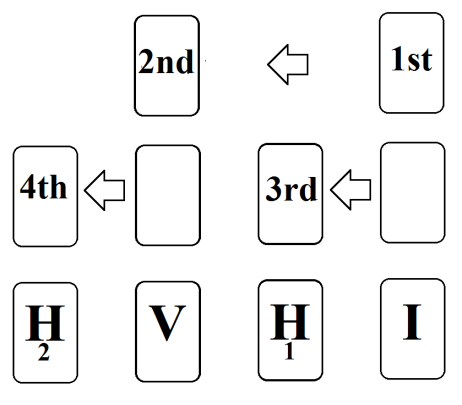
Oracle also teaches an initial divinatory method called the First Operation, which seems to be an antiquated practice now, as few modern tarot practitioners adopt the First Operation. It is nonetheless a method that the serious tarot practitioner should be familiar with. The First Operation is to be performed prior to a question. The significator card is shuffled in with the full tarot deck and then cut into four piles as follows:
case4

The tarot practitioner then proceeds to locate the pile that the significator card is in. That pile, be it I, H1, V, or H2 (reading right to left respectively), will indicate the nature of the seeker’s question. The four piles correspond with the Hebrew letters Yod (I), Heh (H), Vau (V), Heh (H), which is a transliteration of the four constants forming the Hebrew name of the Supreme Being, again showing the strong influence of Qabalistic tenets on Case.

The four piles of the First Operation correspond as follows:

I

Personal Development; Health & Wellness. Seeker is asking about matters of personal development, such as work or career. Could indicate an interest in beginning a new venture or carrying out a new idea. Pile is also associated with the physical, such as body, health, or wellness issues.

H 1

Love, Marriage, Family. Seeker is asking about emotions, feelings, personal relationships, or desires. This pile pertains to the domestic sphere and interpersonal matters.

V

Politics, Ambitions, Social, Intellectual. Seeker is asking about ambitions and high aspirations. This pile could also pertain to conflict resolution, imbalances or disappointments. This is also the pile that corresponds with the Seeker’s intellectual faculties.

H 2

Money, Business, Property. Seeker is asking about a material matter, finances, property, or wealth.

If the significator card is in a corresponding pile that is consistent with the seeker’s question topic, then the First Operation has confirmed that the subsequent tarot reading will be accurate as applied to the question at hand. If, however, the significator card appears in a pile during the First Operation that is not consistent with the seeker’s question topic, then it shows that right now is not an appropriate time for the tarot to answer such a question.

Lessons 2, 3, 4, and 5 deconstruct the Suit of Wands, Cups, Swords, and Coins (Pentacles) respectively, keyed to the Knapp-Hall Tarot. Contained in the lessons are also simple 3-card spreads for divining past, present, and probable future influences.

Lesson 6 on the Major Trumps (Major Arcana) can be applicable to the prevailing tarot interpretive systems used today, though note that the Key 8 referenced in Case’s Oracle is “La Justice” (Justice) and Key 11 in Oracle is “La Force” (Strength), which is similar to the Marseille, but the reverse of the Rider-Waite-Smith (Key 8 is Strength and Key 11 is Justice).

Case claims that the timing of events can be revealed by looking at the astrological attributions of the cards, and the lessons in Oracle set about explaining how the 12 astrological houses can be used to divine the timing of events. From there, Lessons 7, 8, 9, and 10 teach complex tarot spreads, most notably combining astrology, the Tree of Life, and tarot, and further provides an overview of elemental dignities. Lesson 10 also provides an overview of numerology and its application to tarot.

Though some of the historic references in the book have since been disproved as myth, Oracle of the Tarot is still a work that every serious tarot student should have read. Not having read Paul Foster Case if you are a tarot practitioner is like not having read Anton Chekhov if you are serious about writing literary fiction. Though written over 80 years ago and keyed to a tarot deck that is, as of this writing, long out of print, Oracle nonetheless holds relevance today and every practitioner, no matter how advanced, will find at least one nugget of new information from Oracle.

So. Can Oracle teach tarot in 10 weeks? An operable foundation in tarot, yes, probably, though generally I am doubtful of any program that claims it can teach tarot in anything under 10 years. Learning tarot is nothing like learning to ride a bike. It’s really more like learning to play violin. In 10 weeks time you can probably learn no more than just how to properly hold the bow.

NOTE. You can download a PDF copy of OracleOracle of the Tarot by Paul Foster Case (1933). Download by CLICKING HERE (Source Credit: TarotWorks).

UPDATE (6/2/13). Read more about the First Operation: The First Operation: Adapting a Traditional Method in the “Opening of the Key” to Contemporary Tarot Applications.

Tarot: The Path to Wisdom by Joseph D’Agostino – A Review

Tarot: The Path to Wisdom

Author: Joseph D’Agostino

York Beach, Maine: Samuel Weiser, Inc., 1994

ISBN: 0-87728-819-4

117 pages

tarot-path-to-wisdom-dagostino

D’Agostino’s Tarot: The Path to Wisdom is a book that I have owned since the 90s when it was first published. As a beginner’s book, it leaves a lot to be desired, and that would be my fault since Path is not intended as a beginner’s book. The intermediate tarot practitioner who has a strong foundation of the card meanings and can read with several card spreads will find Path to be an excellent companion for studying the Major Arcana. Path focuses on the Majors and provides a comprehensive overview of symbolism and interpretation of each major arcanum. D’Agostino draws from psychological sciences, historical context, esoteric philosophies, and general Western symbology to interpret the Majors. The book is keyed to the Rider-Waite deck and offers practical applications for using tarot.

An entire chapter is devoted to each of the twenty-two cards and at the end of each section are exercises for meditation. A table on the following page briefly summarizes D’Agostino’s suggested meditation exercises for each Major Arcanum. The meditation exercises can be further developed as creative writing exercises. One could conceivably use the meditation purpose concepts proffered by D’Agostino to free-write, e.g., meditate on The High Priestess to free-write about memory, use The Chariot to write on the theme of willpower, The Devil card to write on the theme of adversity, etc.

D’Agostino’s Meditative Applications of the Major Arcana

Major Arcanum Meditative Purpose
Key 0 The Fool To dispel frustration or depression
Key I The Magician For attention to detail; Power of concentration
Key II The High Priestess To improve memory
Key III The Empress To improve powers of imagination
Key IV The Emperor To increase ability to see reality
Key V The Hierophant To amplify receptivity to inner self
Key VI The Lovers To increase ability of discrimination
Key VII The Chariot To expand willpower
Key VIII Strength To expand influence and power of suggestion
Key IX The Hermit To enhance confidence
Key X Wheel of Fortune To accelerate synchronization of the person with the universe
Key XI Justice To establish greater degree of equilibrium
Key XII The Hanged Man To reverse undesirable habits, thoughts, or action
Key XIII Death To gain insight into emotional and reproductive instincts
Key XIV Temperance To accelerate the transformation of the personality
Key XV The Devil To understand adversity
Key XVI The Tower To dispel undesirable personality patterns
Key XVII The Star To improve powers of meditation
Key XVIII The Moon To reorganize the subconscious aspect of personality
Key XIX The Sun To regenerate the mind
Key XX Judgement To inspire a great awakening
Key XXI The World To know thyself

What is most compelling about Path is the insight and detail D’Agostino offers for each Major Arcanum. He writes on the planetary influences on each card, Biblical references, angelic depictions, and describes each card’s imagery in detail. The reader will surely pick up on elements of the Rider-Waite that he or she might not have noticed before.

The latter half of the book explains how tarot is used for divination. The book also provides concise divinatory interpretations of all 78 cards, although the glossary is too basic for an intermediate or advanced student, but too sparse for the beginner. Thus I found that particular section generally unhelpful.

As D’Agostino writes, “Each tarot card is constructed to evoke only positive states of consciousness, therefore daily meditation upon its symbol will stimulate your consciousness with the most creative aspects of your being.” So consider the above table and try a few of the suggested meditation exercises. Jot down your impressions in your tarot journal.

For an intermediate level text that focuses on the Major Arcana, the tarot practitioner can reach for Path. It is a welcomed addition to my reference library, but I would not recommend it to the beginner and much of the text may be seen as too simplified to the advanced practitioner.

——–

Joseph D’Agostino is classically trained as a musician, having graduated from Julliard in Clarinet and Composition. He worked with the Mascagni Opera and toured the U.S. and Europe.

Eden Gray’s Mastering the Tarot

edengray

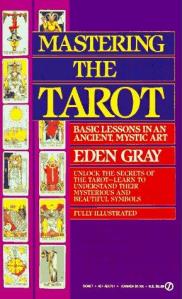
Mastering the Tarot: Basic Lessons in an Ancient Mystic Art

Author: Eden Gray

New York: Signet, 1971

ISBN: 0-451-16781-3

221 pages

My first books on cartomancy came from the public library, which segued into my introduction to tarot, but after acquiring the Rider Waite to begin my serious study, the book I picked up was Eden Gray’s Mastering the Tarot. Mastering, Gray’s fourth publication, is now considered one of the seminal modern works on the tarot. Concise, comprehensive, and timeless, Mastering has remained one of my go-to references from my personal tarot library. In spite of my many new book acquisitions over the last fifteen years, I find myself returning repeatedly to Gray’s book.

Mastering is subdivided into lessons. Lesson 1, Preliminary Steps, will help familiarize the reader with the cards. Basic structure is explained, as are logistical matters, such as caring for the cards. Lesson 2 sets forth general observations and patterns in the Minor Arcana. An overview of suit associations is provided. Then the subsequent Lessons 3, 4, and 5 provide interpretations for the pip cards, or Aces through Tens, in the Minor Arcana. A one page profile is devoted to each card, with a description of the card’s symbolism, a standard interpretation of the card upright, and a standard interpretation of the card in reverse. Gray’s interpretations seem heavily influenced by the Golden Dawn school of thought. The card lessons are organized in sets, by number (e.g., all four Aces side by side, all four Twos, all four Threes, etc.), deviating from the majority of tarot reference books, which group the cards by suits (e.g., the suit of Wands, Ace through King, then the suit of Cups, suit of Swords, suit of Pentacles). Gray’s organization worked for me because like Gray, I integrate numerology into my approach and thus chapters sectioned off by numbers helped to reinforce into my memory the numerological attributions of the cards. Lesson 6 reviews the court cards, Pages through Kings, and then Lessons 7 through 10 provides the interpretations for the Major Arcana, grouped in thirds. Gray seems to maintain a substantially literal interpretation of court cards, though she does gloss through a few figurative interpretations. Overall, card interpretations take up about 56% of the book, so in terms of reference manuals keyed to the Rider-Waite-Smith system, Mastering is the book to have.

However, for the beginner tarot practitioner with no prior experience, Mastering may leave a lot to be desired. As mentioned, the book comprises mostly of card interpretation. The basic learning steps from new tarot deck to reading spreads is rather sparse in Mastering. Lesson 11 does offer a chapter on how to read cards, shuffling, selecting significators, and synthesizing card meanings, but all of that is consolidated into a single chapter. For the intermediate practitioner or even the quick learner, that won’t be a problem; but it does make Mastering an ill fit for the true beginner.

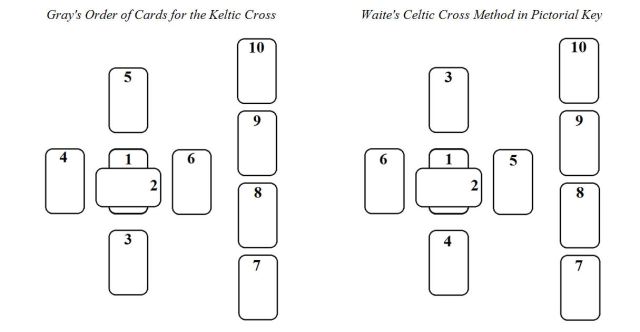
The main tarot spread that the book teaches is the Keltic Cross Method, which Gray devotes an entire chapter to. Although Gray’s card interpretations are rooted in the Golden Dawn system, her order of the cards in the Keltic Cross spread differs from the Celtic Cross Method suggested by A. E. Waite, an adept from the Golden Dawn. The diagram on the following page of Waite’s Celtic Cross Method is from his book Pictorial Key to the Tarot (1911). It is provided here to compare with Gray’s Keltic Cross. I have adopted Gray’s ordering of the cards.

grayvswaite

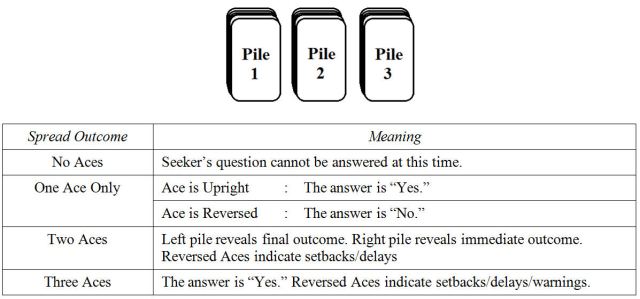
Waite’s order of cards in the Celtic Cross spread seems to be inspired by the Catholic sign of the cross while Gray’s Keltic Cross approach makes more chronological sense, i.e., lay down the foundation and past first. Gray also provides sample readings with the Keltic Cross, which help the reader understand the spread’s practical application. A few more spreads are explained in a subsequent lesson, though they seem to be added as an afterthought. One spread from Lesson 14 struck my fancy, though: the Three Aces spread. For yes or no inquiries, after shuffling, turn the cards over one by one facing up and stop when either an Ace is turned or the 13th card, whichever comes first. Once an Ace or the 13th card is drawn, move on to start a second pile to the right of the first pile. Again, stop at either an Ace or, if no Ace is drawn before the 13th card, then up to the 13th card. Continue until three piles are formed. If no Aces are drawn, the question cannot be answered. One upright Ace indicates a “Yes.” One reversed Ace indicates a “No.” If there are two Aces, the one to the left reveals the final outcome; the one to the right reveals the immediate outcome. Three Aces mean “Yes,” though reversed Aces suggest setbacks or delays. Gray’s Three Aces spread is one of my favorites for quick questions.

3acesspread

Most tarot practitioners integrate an esoteric or philosophical paradigm with their approach to tarot and for Eden Gray, her approach is influenced heavily by astrology. The ending lessons in Mastering associate tarot and astrology, applying astrological concepts to tarot divination theory and additional spreads. The astrology enthusiast will find Lessons 15, 16, and 17 highly informative.

The final lesson of the book, Lesson 18, covers tarot ethics, “The Use and Misuse of the Tarot.” Her chapter on ethics, however, can be summarized into one rule: don’t read the tarot in a way that fills other people’s heads with negative ideas about themselves or their futures. She dedicates an entire chapter to convey that singular message, though indeed it is an important one.

My only negative criticism of the book is not even a fair critique. The opening pages present tarot as an ancient mystical art passed down to us from the Egyptians and gypsies, which most of us now understand to be an unverifiable myth. The tarot was conceived as a card game, one played predominantly by the wealthy, and though cartomancy generally endured throughout history, using the tarot for divination only became popularized in the 1900s, most notably by the Hermetic Order of the Golden Dawn. However at the time of the book’s publication, the 1970s, portraying tarot as an ancient mystical art was the trend. It is not clear that Ms. Gray would have had access to any kind of information or research that ran counter to that presupposition. Thus, the “historical” introductory overview of tarot in Mastering that frames it as having “ancient mystical origins” is more of a reflection of the times than it is of Gray’s work.

Mastering the Tarot has had a considerable influence over the formative years of my tarot education. As important as the works of Papus, Paul Foster Case, and A. E. Waite’s card interpretations are to tarot studies today, Eden Gray will undoubtedly join their ranks in 50 years time, if she hasn’t already.