
“Wrath of Wisdom and Buddhist Magic: The Rites of Yamantaka”
This is an open informational mini-course on a closed esoteric practice, and builds on what was covered in the preceding course on Kuan Yin (Avalokitesvara) and the Six Syllable Mantra.
Yamantaka will be our entry point into doctrinal medieval Buddhist magic as we explore ritual practices around mandalas, mantras, mudras, and empowerment rites. Which is a bit like throwing you in the deep end of the pool to teach you how to swim. But hey, that’s how I was taught how to swim, so you’re welcome. What’s that species where the mama bird throws the babies off the edge of a cliff and the baby birds either learn how to fly or they die?
I kid. Think of this as just a witchy social studies class. But for those who want to go down the rabbit hole, this write-up will provide you with a well-rounded starter pack.

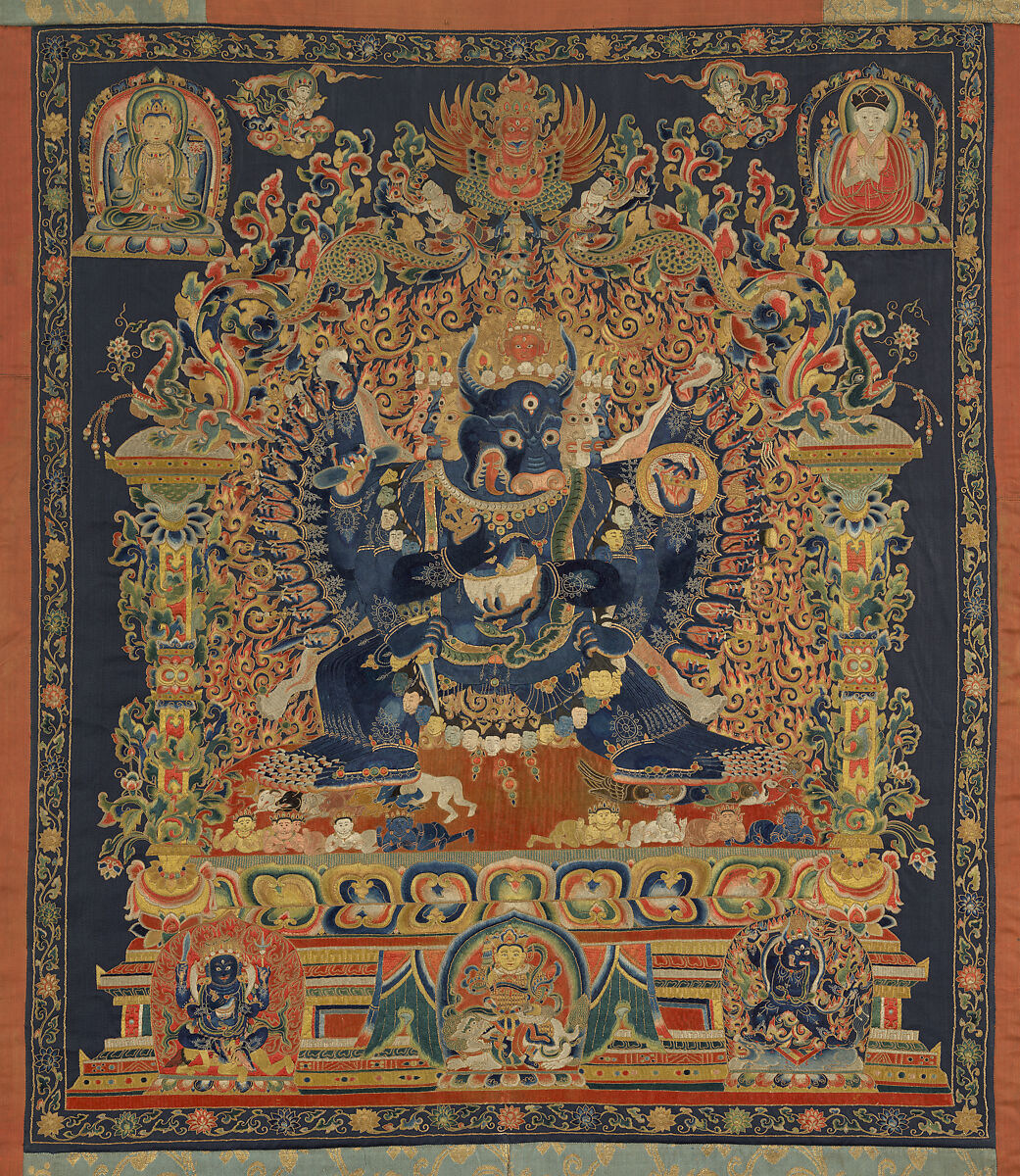
Yamantaka, Wrath of Wisdom, Destroyer of Death
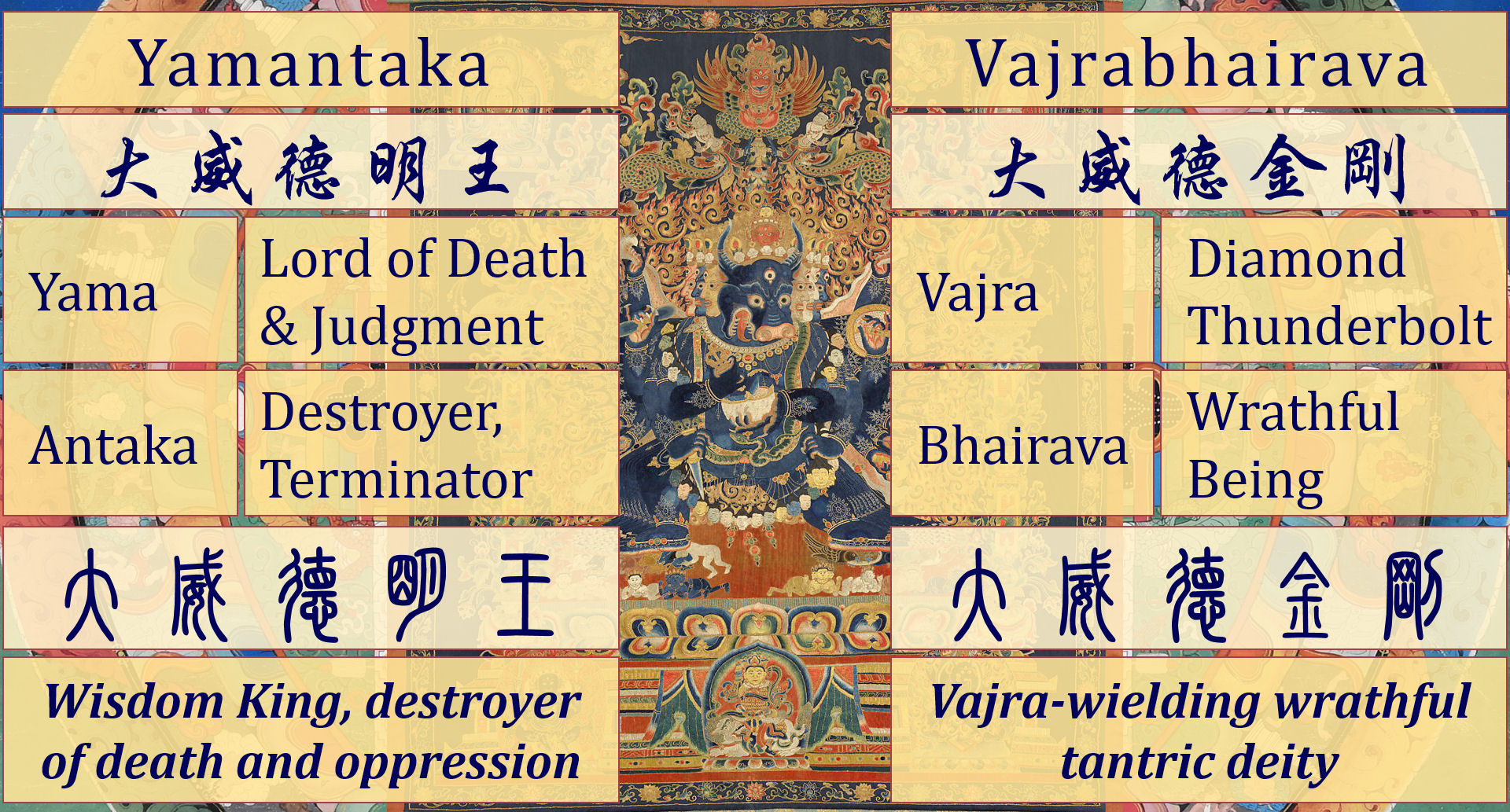
Yamantaka (大威德明王, daweidemingwang) refers to the Destroyer, the Terminator, or ender, Antaka, of Yama, the Lord of Death, judgment of our afterlife, and ruler of the Hell Realms. Which is to say Yamantaka is the nemesis of Death itself. The focus here is on Yamantaka’s role as a Wisdom King (明王, mingwang), who possesses the power to keep death at bay and also, to combat and defeat oppression. In Japanese Shingon Buddhism, he is Daiitoku Myōō.
Let’s go on a quick side quest to talk about Yama. Yama was mortal, and described as the first human to die and go to the netherworlds (Hell Realms, underworld…) and then eventually became the immortalized King of the Hell Realms. Yama thus became both the god of Death and the god of the Hell Realms.
Alternatively Yamantaka’s referred to as Vajrabhairava (大威德金剛, daweidejingang), vajra meaning a diamond thunderbolt, or a ritual scepter that signifies indestructible force and power, and bhairava, meaning a wrathful and fierce manifestation of a divine force and power, is another name for Yamantaka. Here, the Chinese name 金剛 (jingang) means Vajra, emphasizing this divinity’s role in tantra.
Per the Manjushri Vajra Nama Sutra, “Yamantaka bestows great fear… can subdue demons, for he is the Supremely Powerful One, and he protects the virtuous, therefore he is also the Supremely Virtuous One.” He is considered the most wrathful of the wrathful deities, and while he’s terrifying, he’s deeply compassionate.
As the nemesis to the King of Hell, Yamantaka force is wielded to combat the four demons 四魔: Mara 天魔, demons of disease 病魔 (meaning, Yamantaka in the role of healer of severe illnesses, particularly the unexplained and fatal kind), demons of disaster 煩惱魔, and the demon Death 死魔.
As the Great and Terrifying Vajrabhairava, his most important spiritual role is as an executioner of evil oppressors.
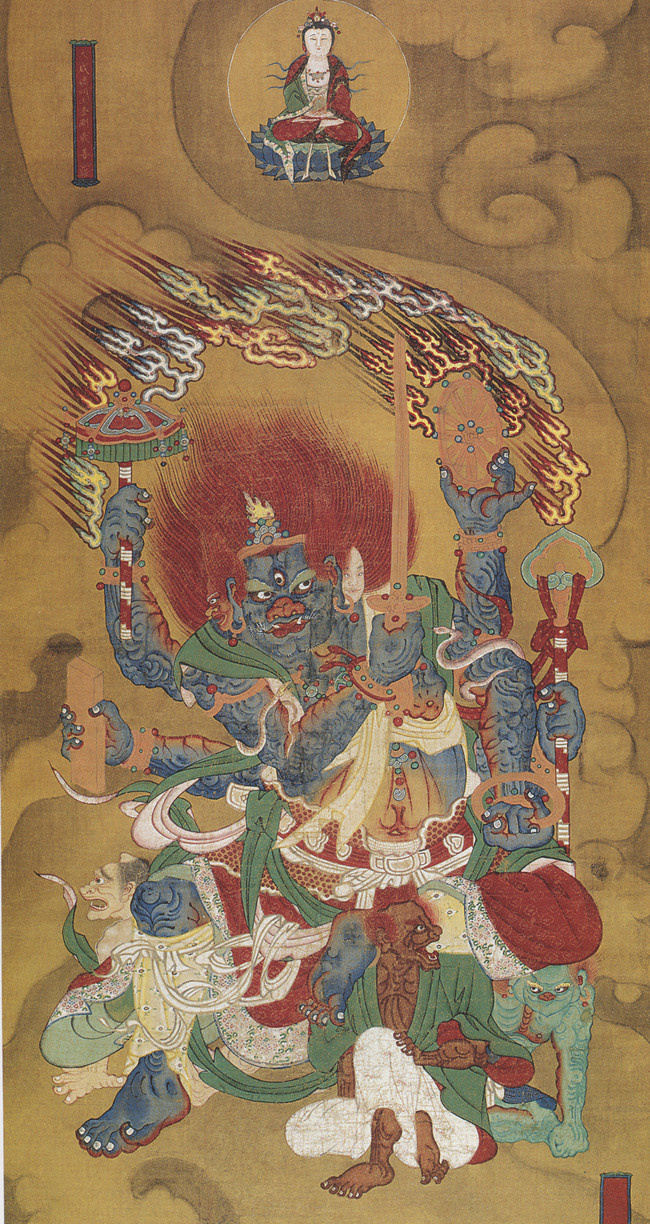
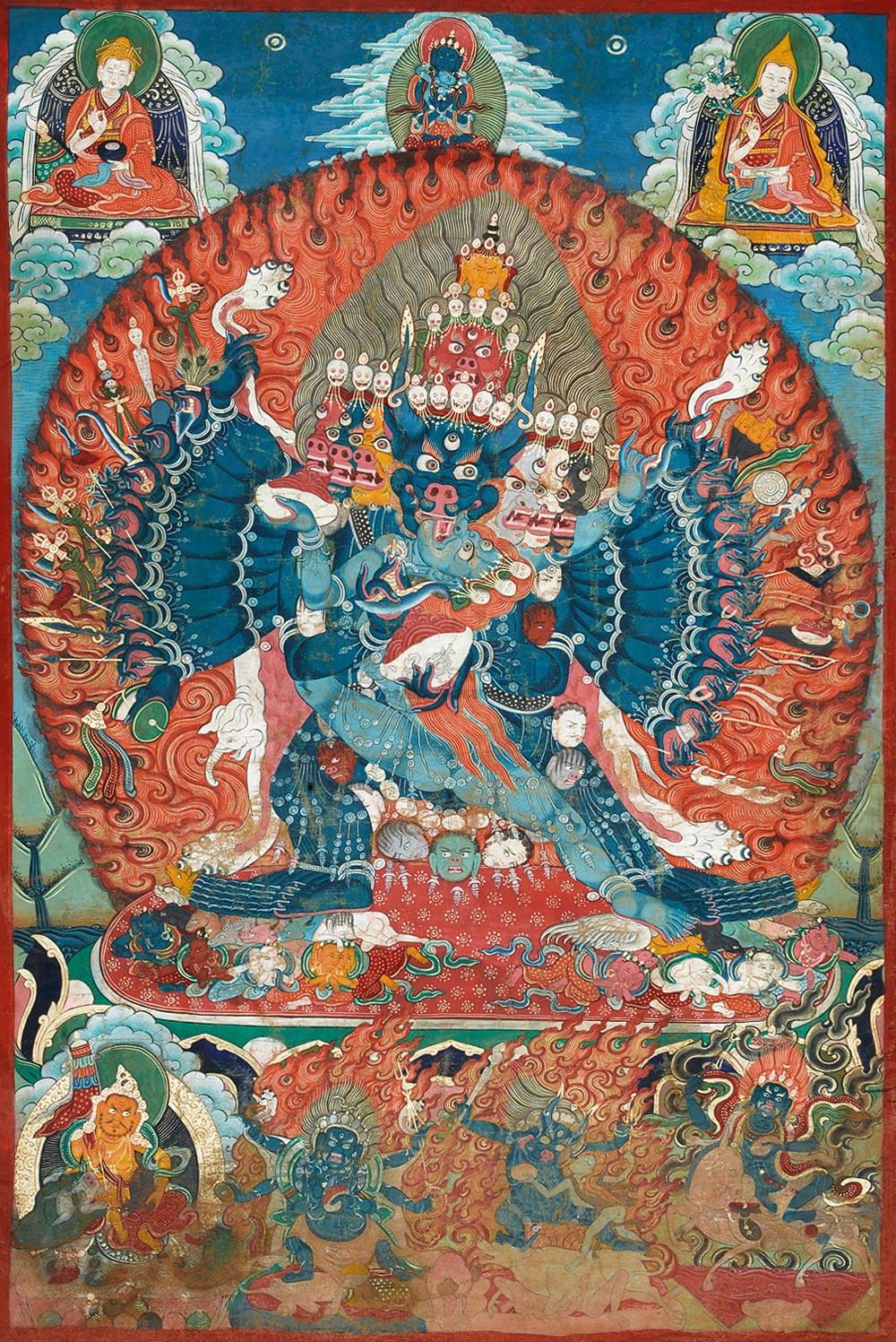
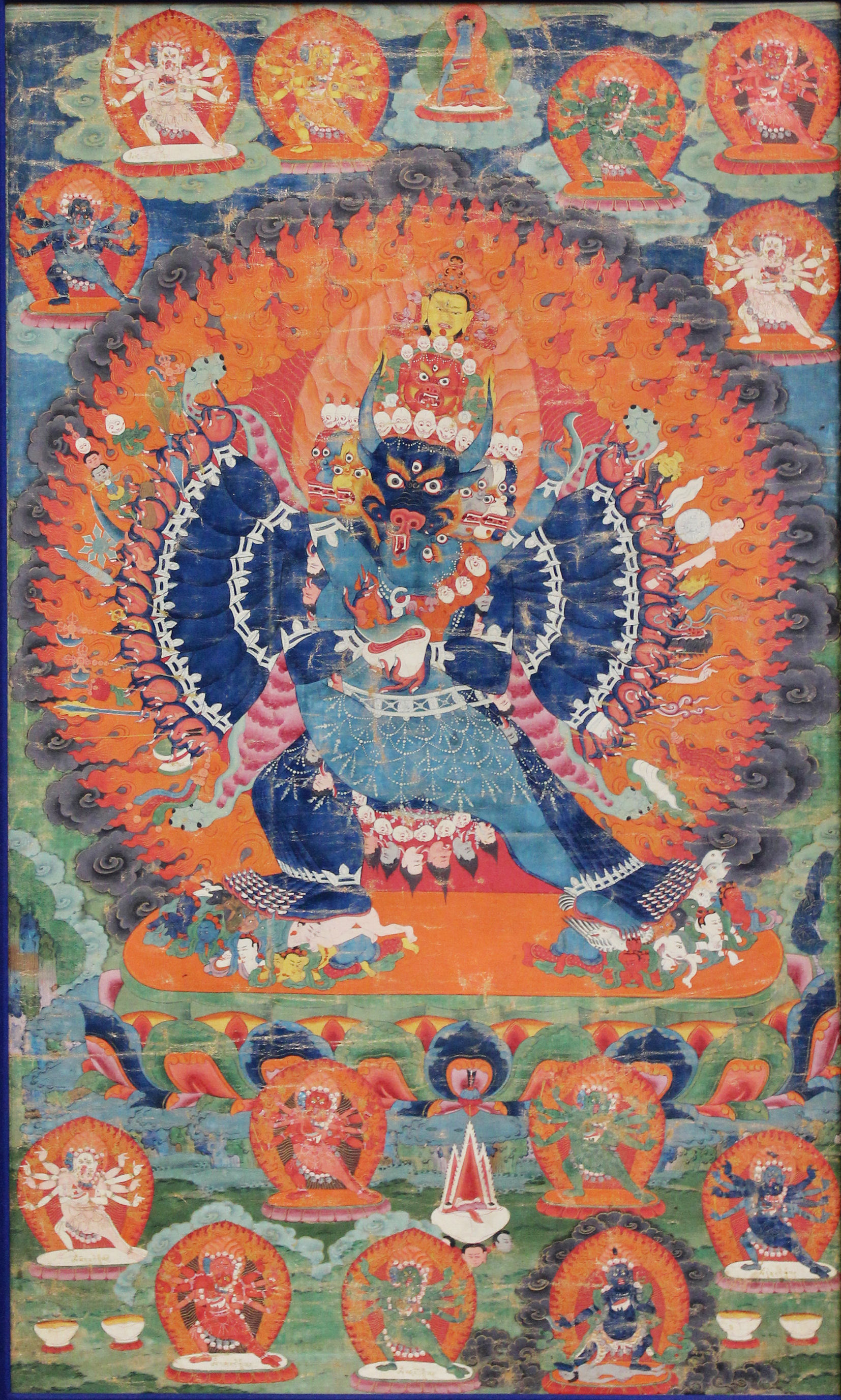
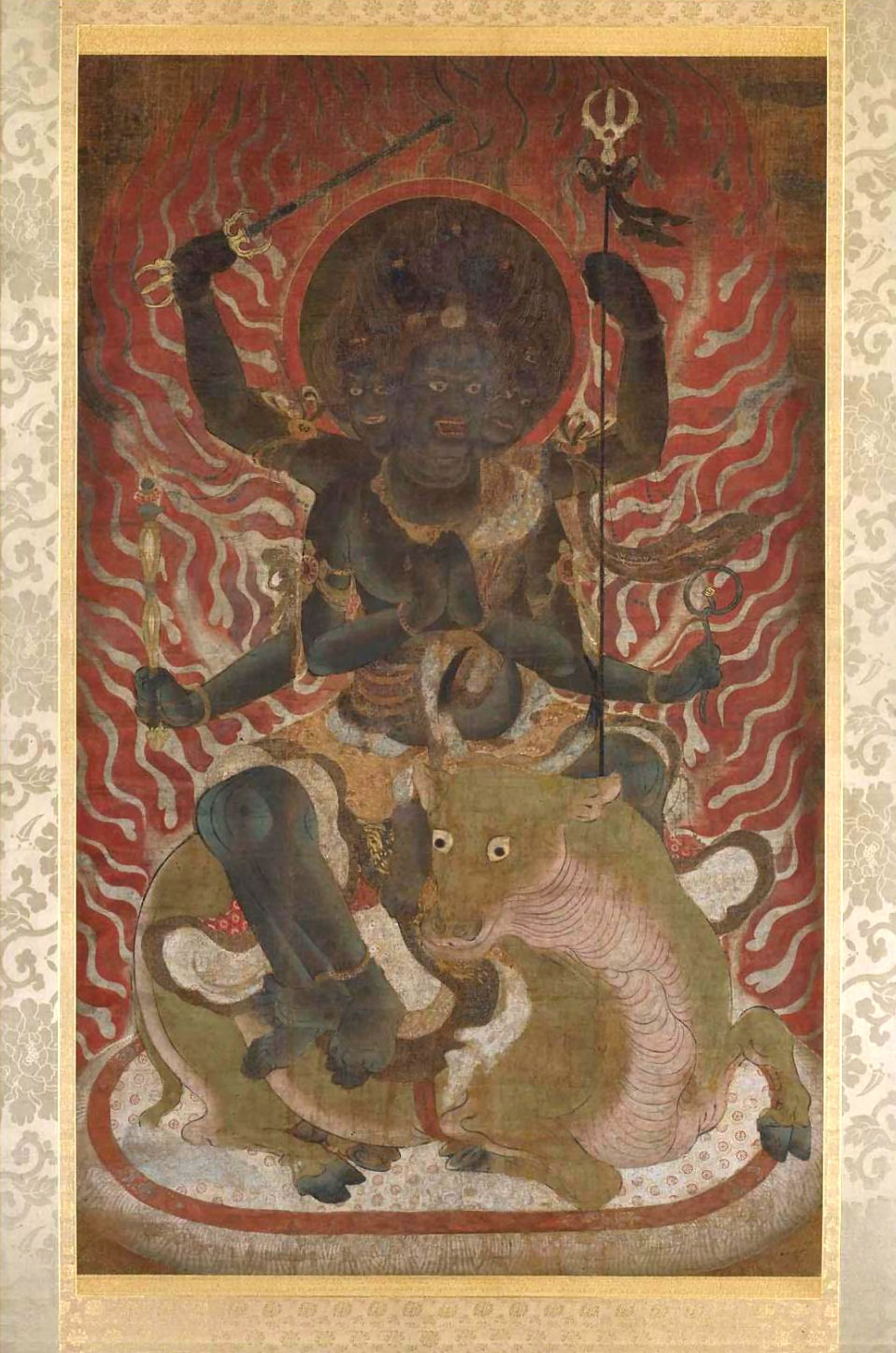
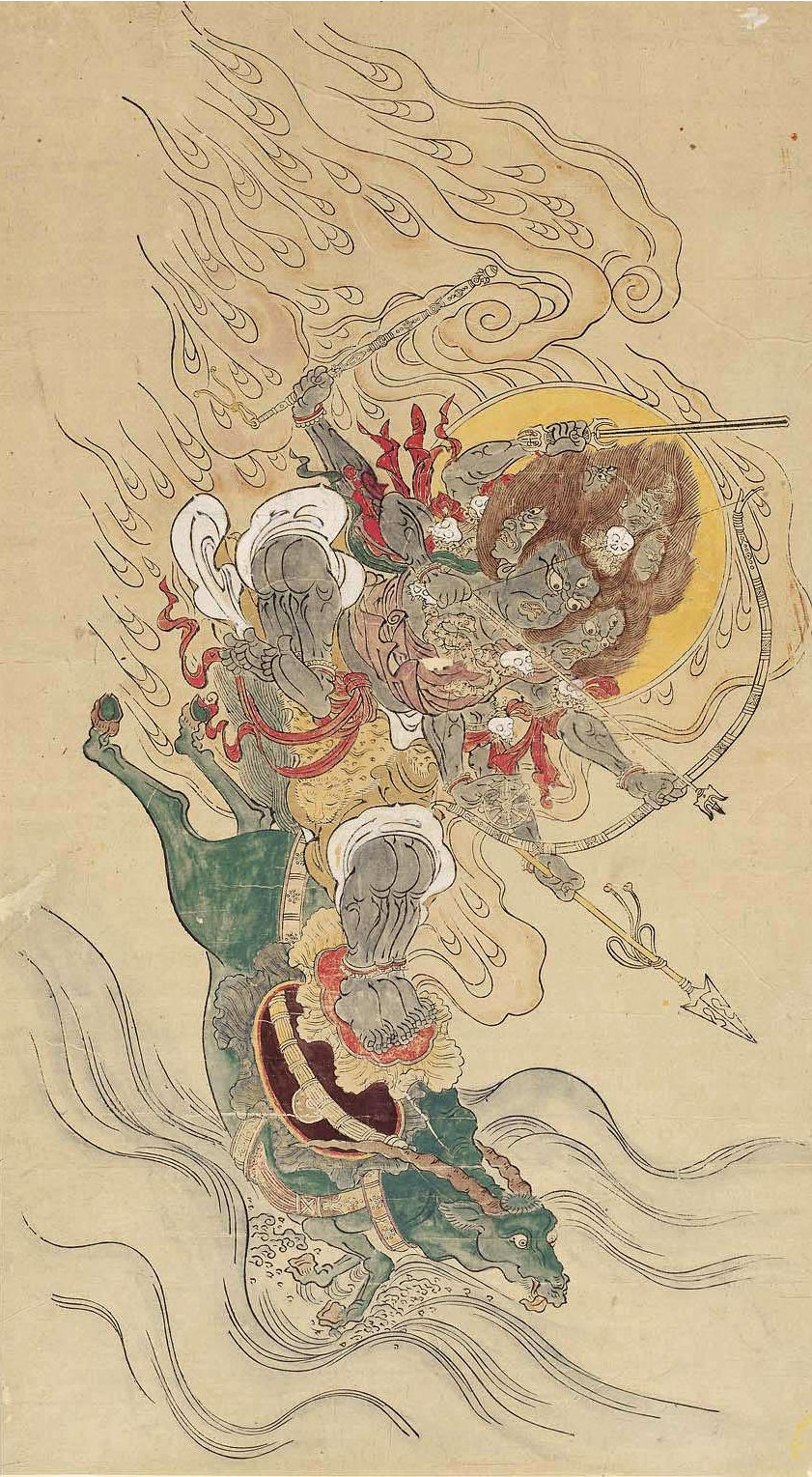
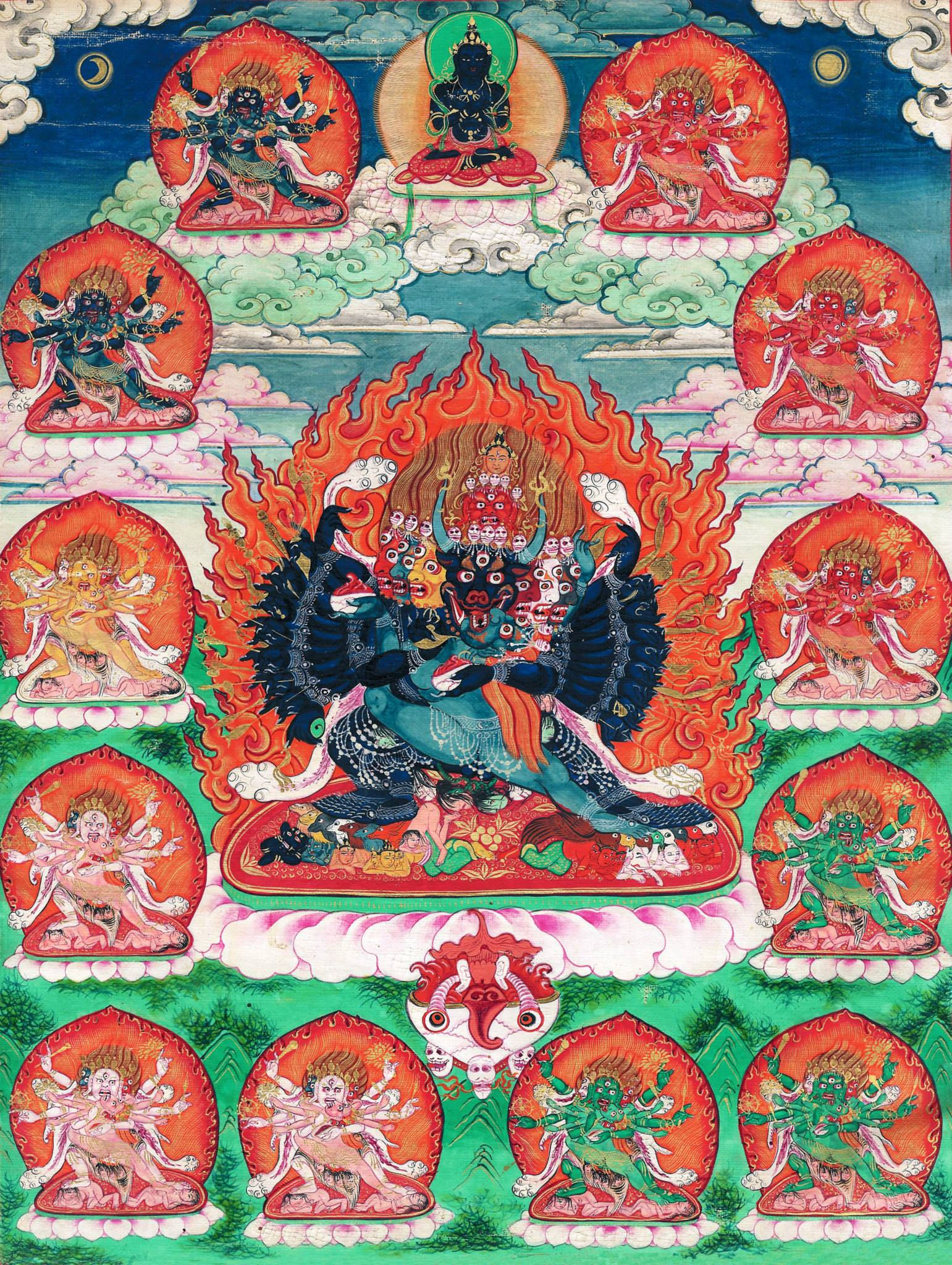
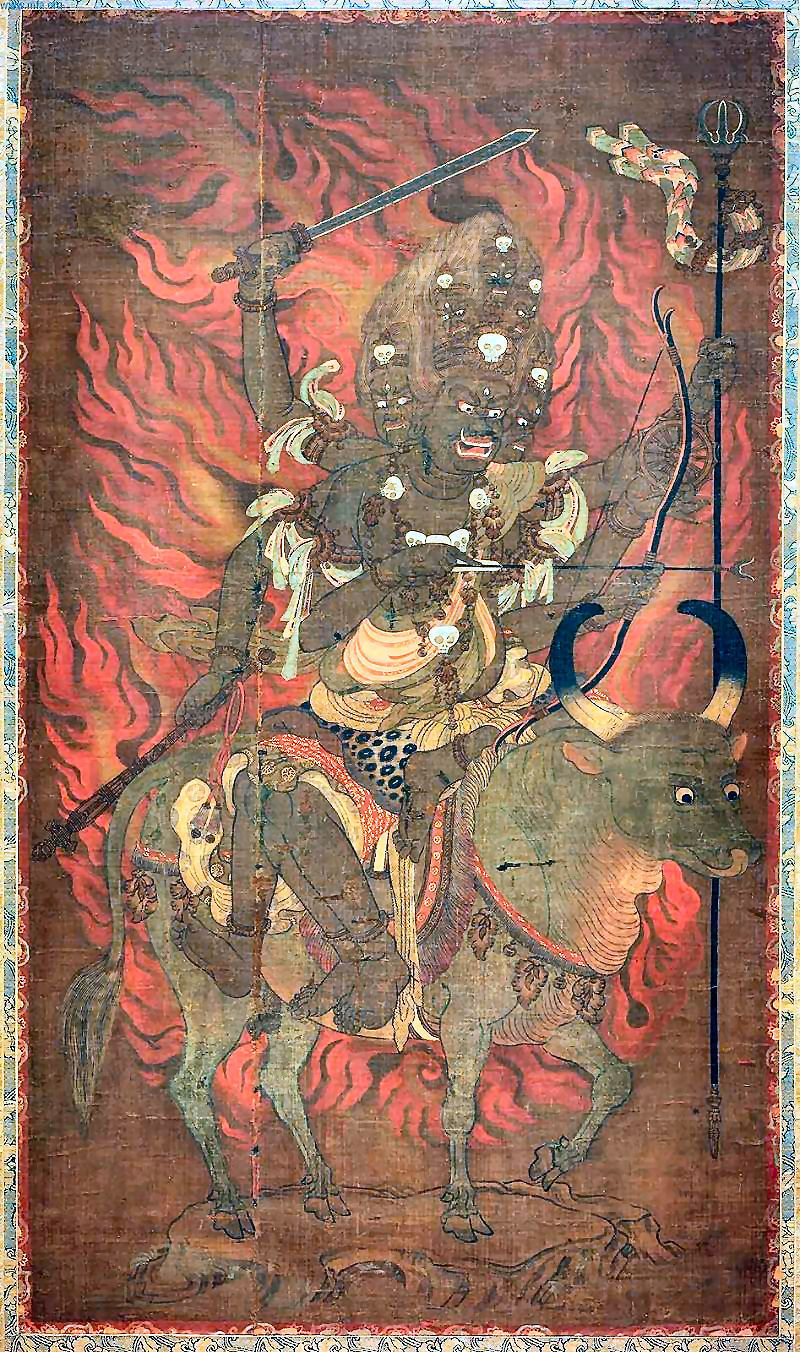
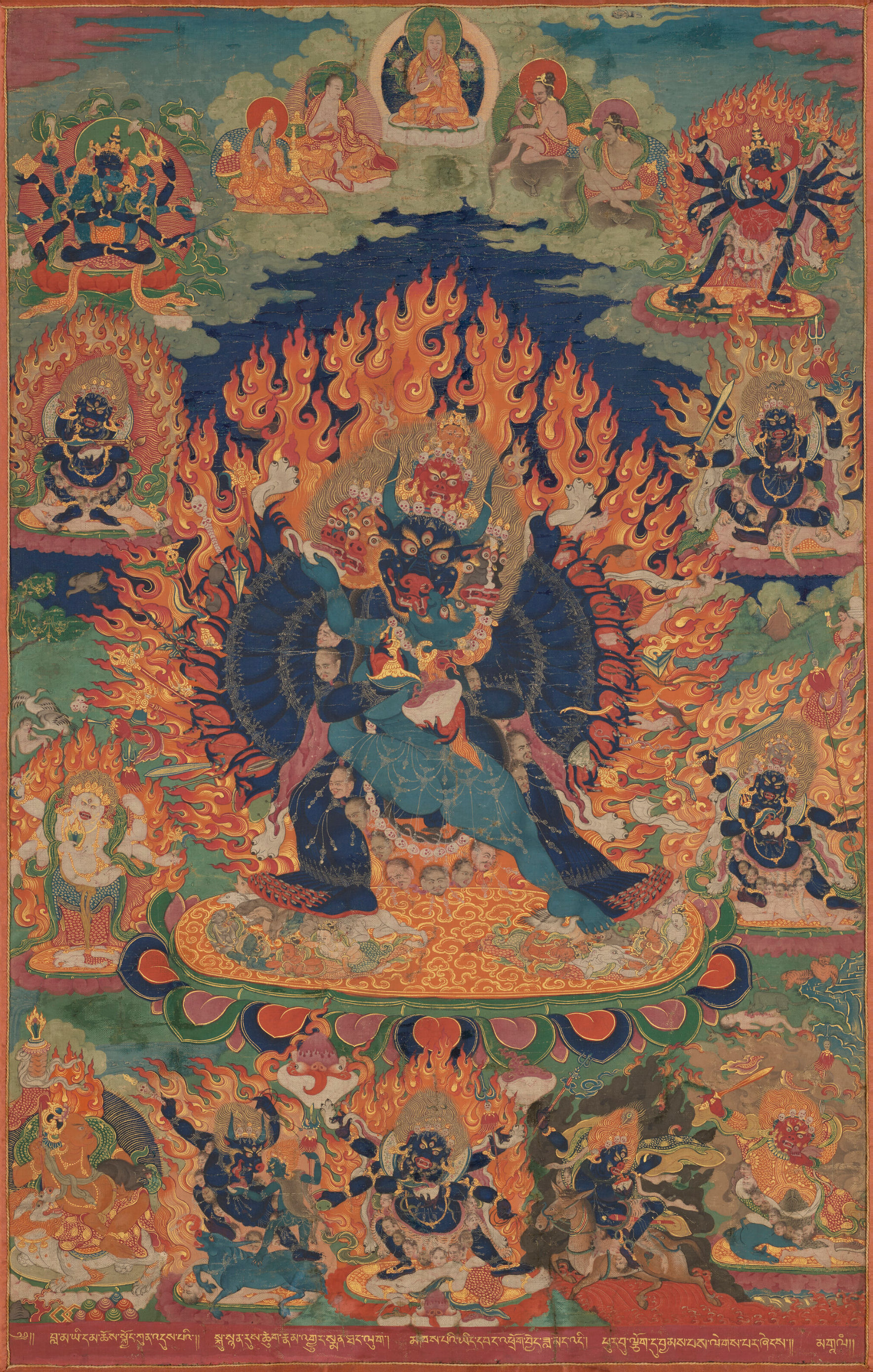
Depictions of Yamantaka are commonly of him as dark-skinned, be that blue, black, or dark brown. While he’s more frequently rendered with many arms, many legs, and maybe even many faces, also, not always. Sometimes it’s nine faces, sometimes four but only three showing, or eight faces with only seven showing.
In Rites, he’s described as having six faces, six arms, and six legs. Either he’s depicted with the face of a water buffalo or he’s a wrath king riding a water buffalo. He’s also adorned with skulls and bones, wielding an array of weapons, or drinking blood out of a skull turned into a bowl.
“Yamantaka” seems to be the more conventional name referenced by practitioners, particularly in the context of Buddhist magic. “Vajrabhairava” feels very formal, like you’re up in an ivory tower studying the texts rather than at the cemetery at midnight smearing your face with incense ash and rattling bones.
Ritual tools associated with Yamantaka include the vajra 金剛杵, bell 鈴, a ritual kartika or crescent-shaped flaying knife 彎刀, rope forming a noose 索 for binding demons, drums 鼓, The Spear Mudra is replicates the sword 劍 associated with Manjusri, and there’s a variation on the Root Mantra instructed in the Rites grimoire that replicates a trident, or trisula 三叉戟.
In many of the depictions, he’s holding a skull cup, or kapala 顱器 filled with blood and organs or an iron dharma wheel, both to represent how he defeats death.
Personal spiritual cultivation practices with Yamantaka are also about overcoming our fears. The kartika as a ritual and meditaiton tool helps us to cut away ignorance. These practices are also a form of strength training, which then empowers you to navigate mortal and spirit realms more fearlessly and confidently. That fearlessness and confidence amplifies and helps you to set right everything else in your life.
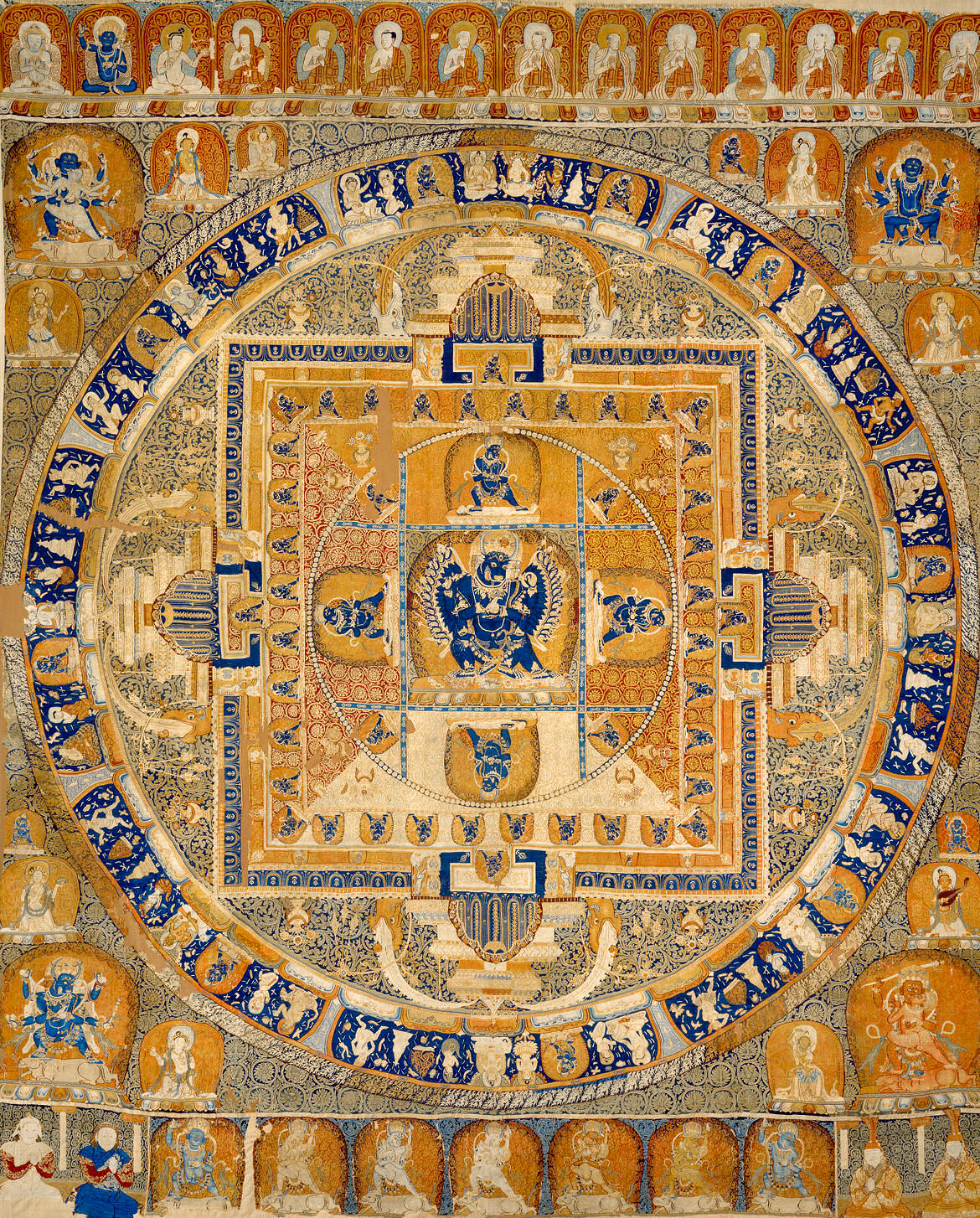
Rites and Rituals of Yamantaka (8th century)
When we say “Rites and Rituals of Yamantaka,” we’re referring to this text: 聖閻曼德迦威怒王立成大神驗念誦法 (“The Method of Recitation for the Holy Yamantaka, the Wrathful King, to Manifest Great Miraculous Efficacy”), Translation from Sanskrit to Medieval Chinese by Amoghavajra 不空 (705 AD – 774 AD). (“Rites“).
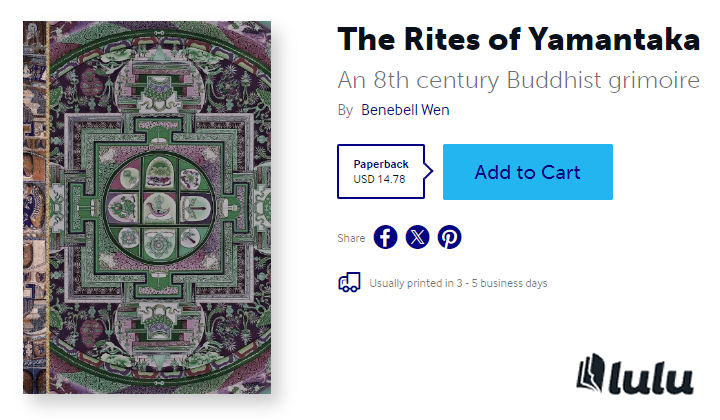
Order a Print Copy of Yamantaka Rites
This is an English translation, with my practitioner annotations, of an 8th century Buddhist grimoire on Yamantaka rites. The 8th century text I’m translating from is in Chinese, first translated from Sanskrit to medieval Chinese by the renowned Buddhist master and scholar, Amoghavajra (705 – 774 AD) around 750s AD.
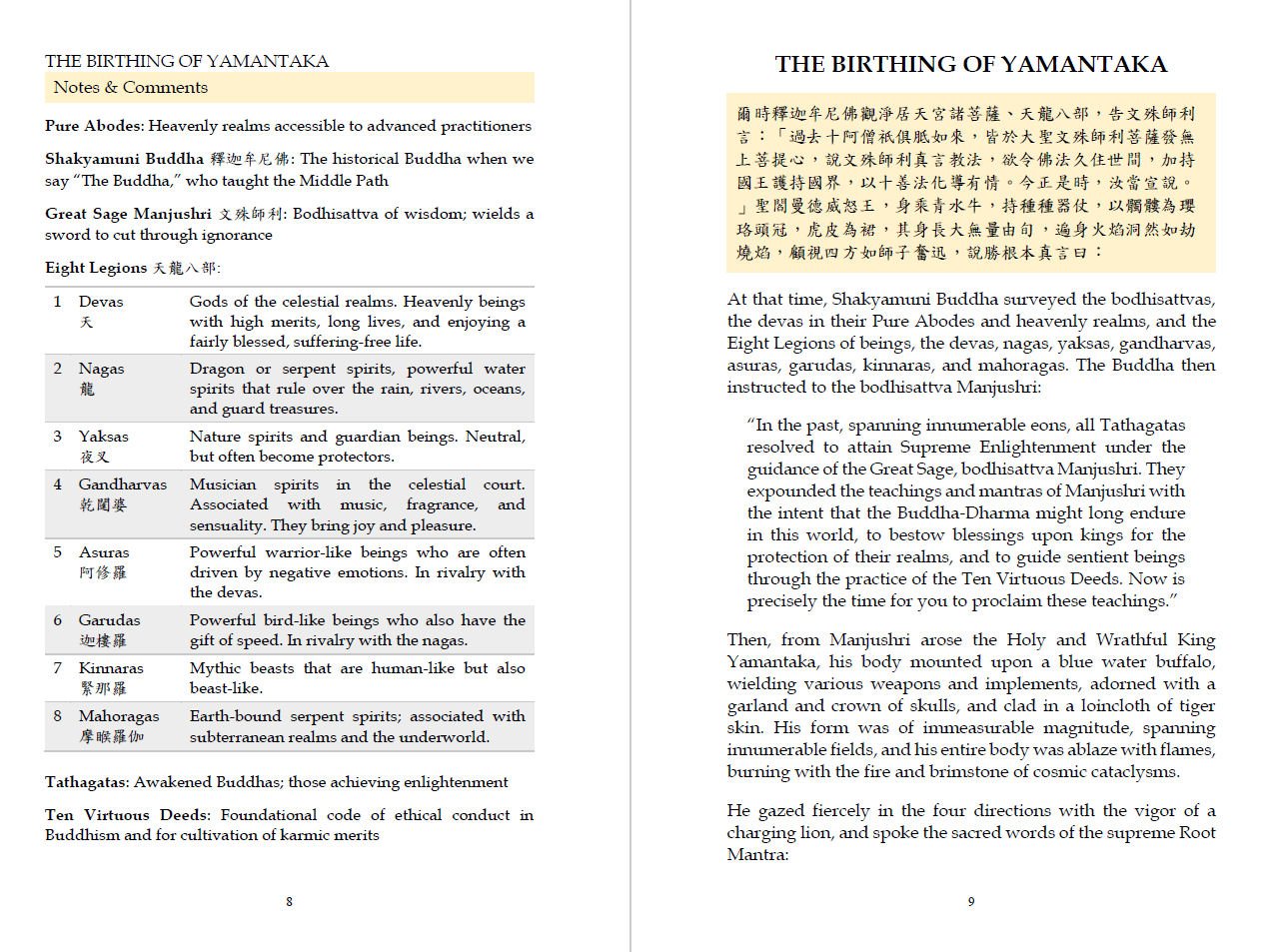
I started working on English translations and annotations of this grimoire around the time of The Tao of Craft, but then ended up setting it aside on the back burner. I was reminded of it again years later when I was deliberating whether to reference Yamantaka directly in I Ching, The Oracle (ultimately I opted not to, though I did sneak in a fun easter egg by including a Yamantaka/Vajrabhairava mandala).
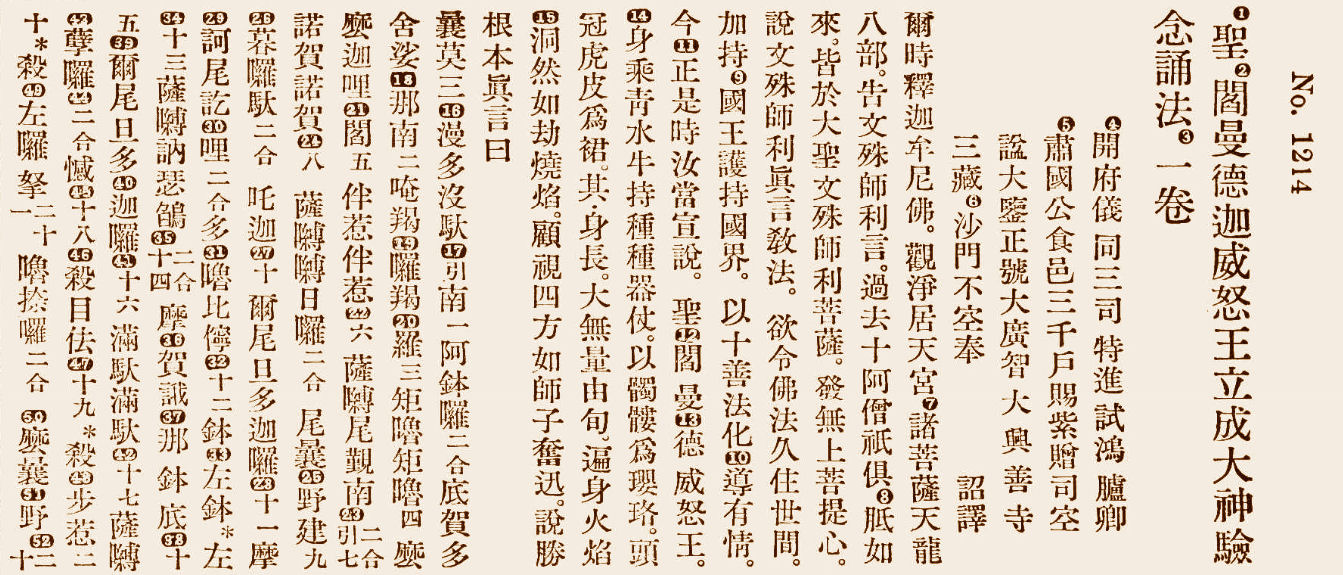
The version I’m working from is the one archived by the Chinese Buddhist Electronic Text Association (CBETA) in Taipei, Taiwan, funded by the Dharma Drum Institute of Liberal Arts. The Taisho Tripitaka catalogue numbering system was added between 1924 and 1934. For more information about the archive, see The Catalogue of CBETA Taisho Tripitaka. Direct link to the Chinese version: 歡迎使用, Taishō Tripiṭaka No. 1214 (T1214).
The Taisho Tripitaka is considered definitive Chinese Buddhist canon. Rites and Rituals of Yamantaka is categorized as Esoteric Buddhism (Secret School tradition).
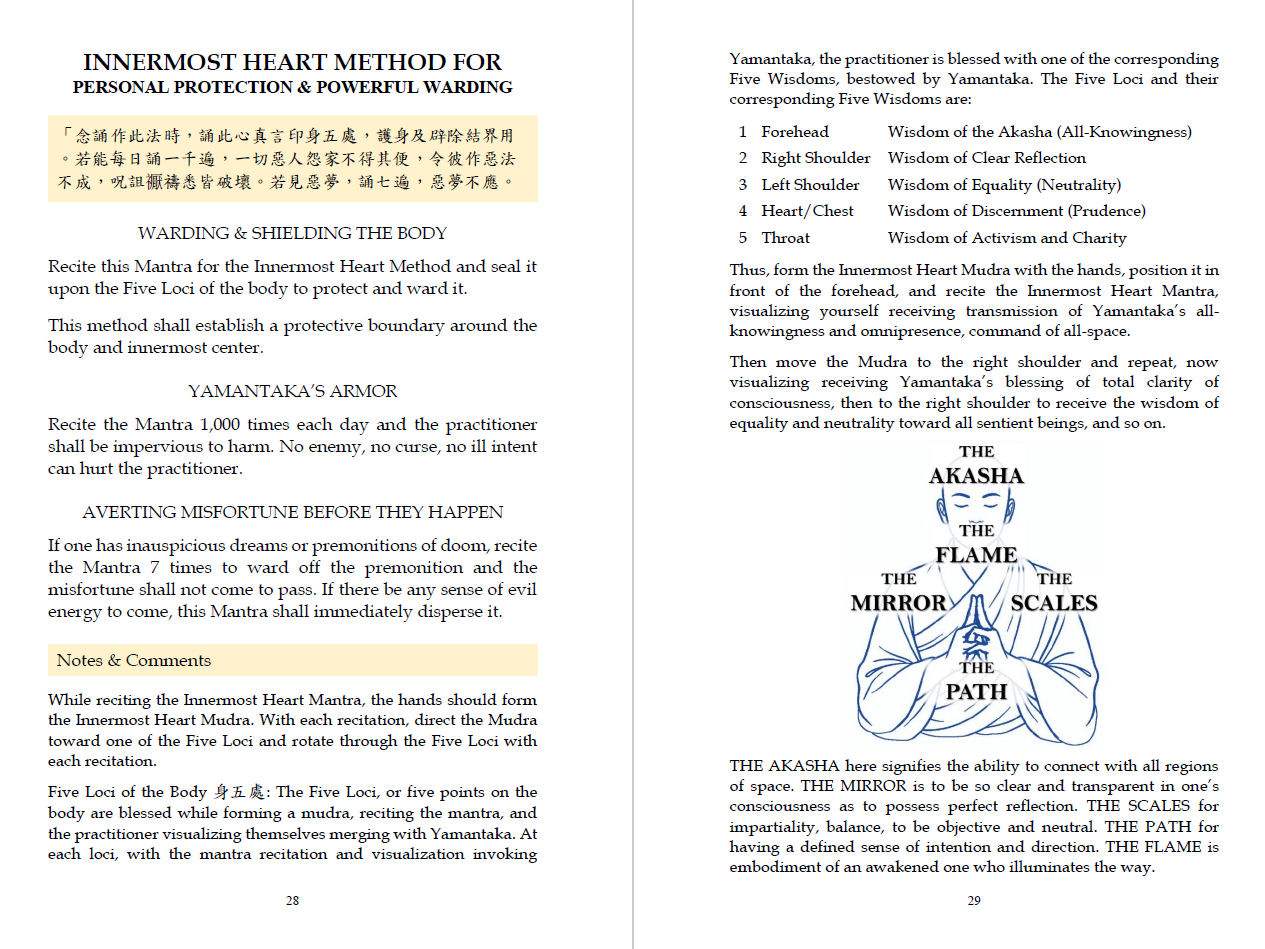
Rites is considered a “念誦法” (nian song fa), meaning methods for mantra and dharani recitations that are in effect magical incantations, typically combined with hand mudras, specific visualizations or emotions, and sometimes specific ritual tools to better generate and direct force.
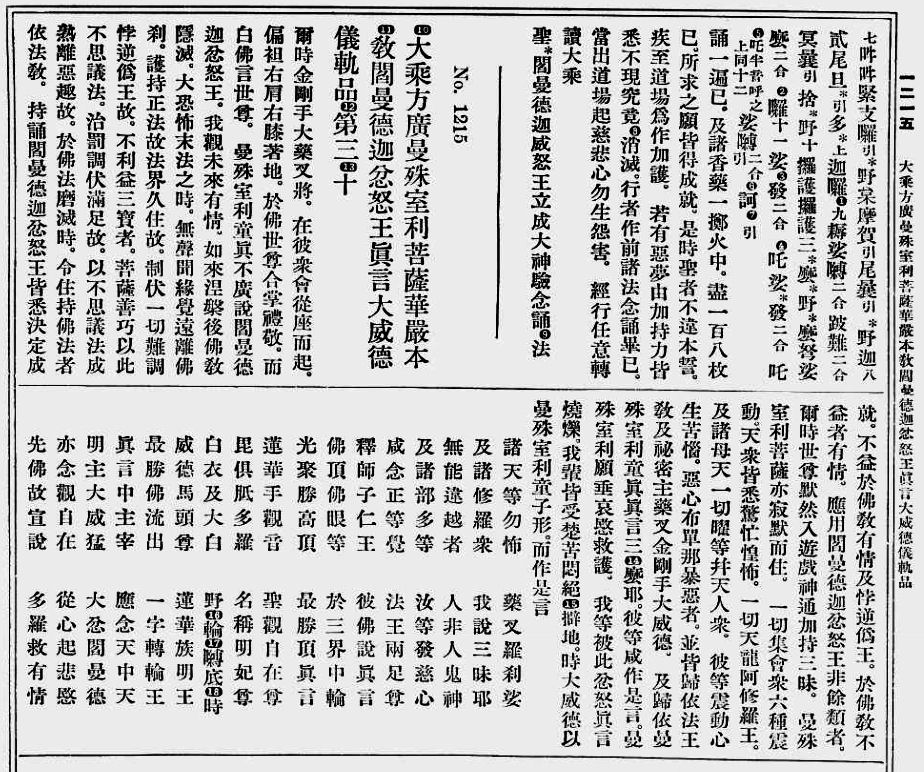
Returning to the CBETA (Chinese Buddhist Electronic Text Association) archives, you might also be interested in this excerpted passage on Yamantaka siddhi, or attainment: The Mantra (Dharani) of Yamantaka, the Wrathful King, and the Rites of Yamantaka (大乘方廣曼殊室利菩薩華嚴本教閻曼德迦忿怒王真言大威德儀軌品).
The Yamantaka Rites recitation also includes paying homage to Kuan Yin (i.e., Holy Avalokitesvara). In this text, Vajrapani introduces Yamantaka to the assembly of Buddhas and bodhisattvas, saying (I’m paraphrasing), “In the worst case scenarios, when an evildoer really, really cannot be saved, is too corrupt, is causing rampant oppression and harm, the only solution is Yamantaka’s wrath.” Basically, Yamantaka is the nuclear option. This sutra indicates kinship between Vajrapani and Yamantaka.
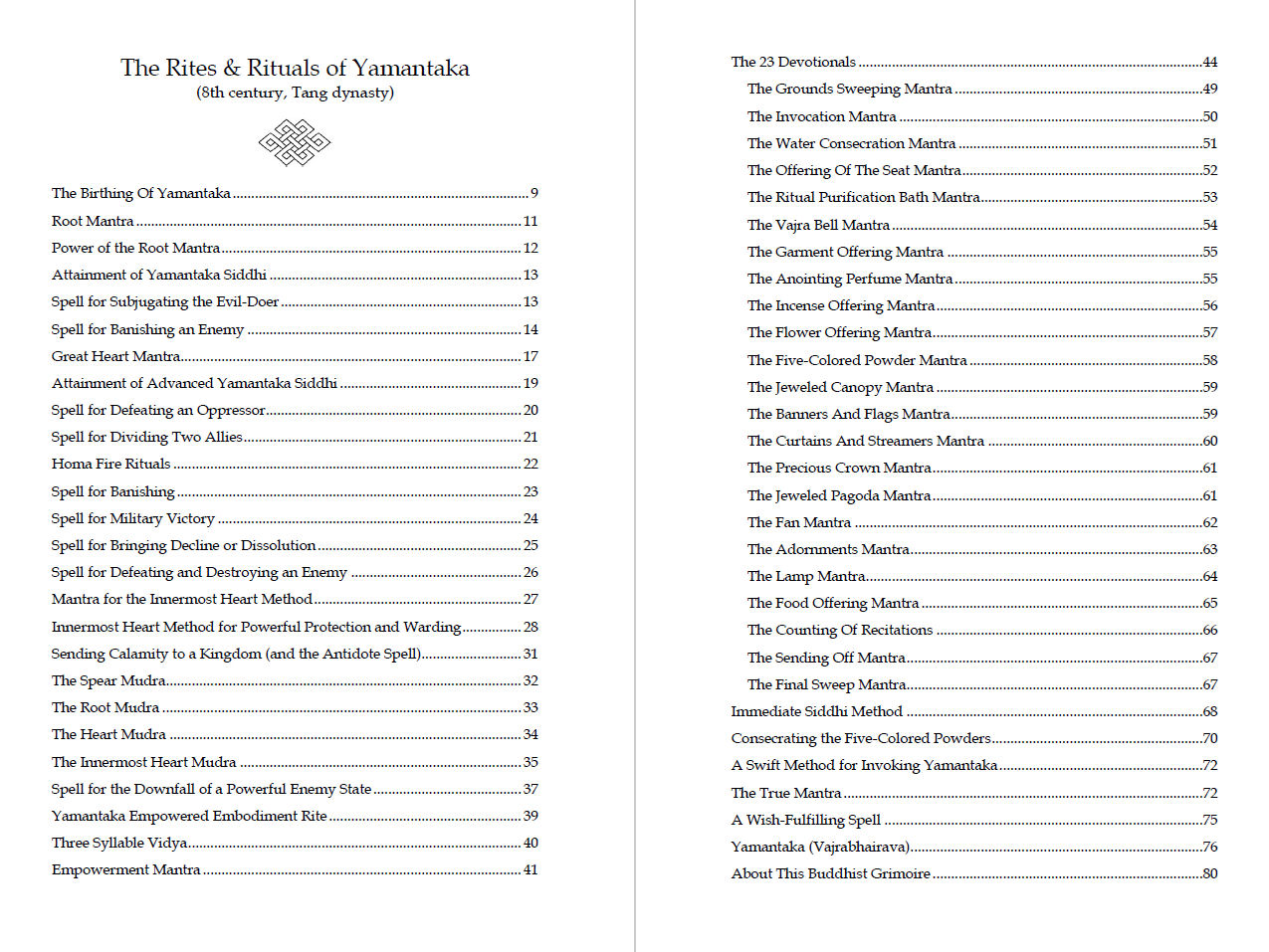
Finally got it done for a Year of Mars (Mar 20, 2026 – Mar 19, 2027, fyi) and released when both the Sun and Mars are in Aries, which is Mars’s domicile, and therefore strengthens and stabilizes the Mars force.
$14.78
ORDER A PRINT COPY
I’ve formatted it at trade paperback 6″ x 9″ size. It’s going to be slim, at just 80 pages. That’s the whole of the original grimoire in translation, with some notes to help with context.
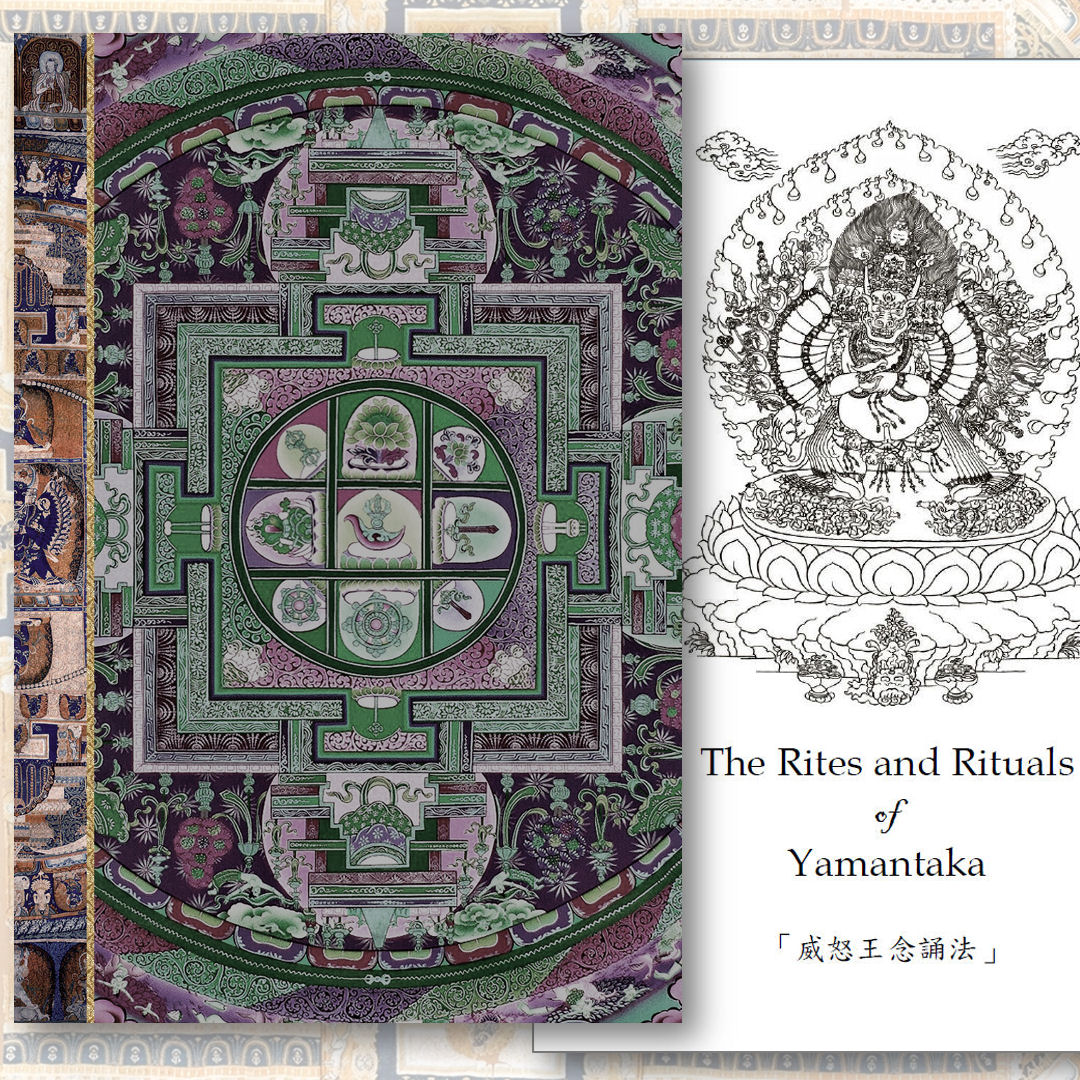
No matter what tradition you personally practice, this is such an insightful historical text to have in your arsenal. One, I can’t believe how much overlap there is between Eastern and Western systems of ceremonial magic. You have to read this to believe it, and I provide full transparency into all the original texts dated back to the 8th century to track that it isn’t me imposing my views.
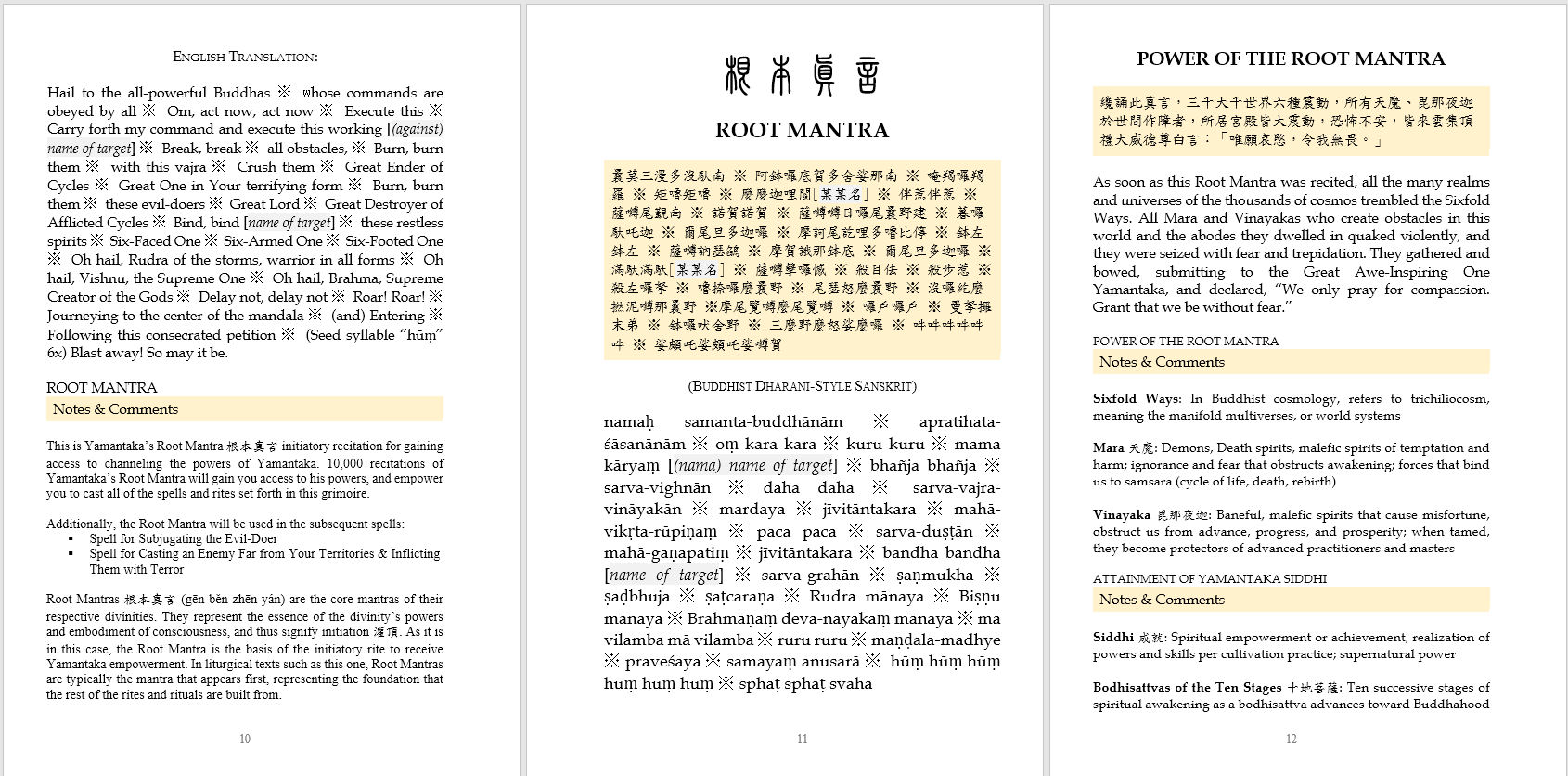
At just 80 pages (see table of contents for what’s in here), it’s slim, but it packs a punch. There is a. lot. of info in here. Incidentally, a read-through of this text is a fantastic intro to Buddhist magic. No matter what your spiritual path is, this is a great addition to your personal occult library.
Differing Origins Stories
The origins story for Yamantaka covered in the video lecture is cited directly from that 8th century text Rites and Rituals and is the canon in Secret School and Tangmi traditions. The Tibetan Vajrayana version of Yamantaka’s origins may differ.
Another telling of it, which is the one more often found in the Tibetan schools, is that Vajrabhairava was a manifestation of Yama, the demon king, and in this manifestation appeared with the head of a water buffalo and human body, wreaking havoc on earth. Manjusri takes possession of this manifestation of Yama, ousts Yama, and as a result, Vajrabhairava becomes a manifestation of Manjusri, and in doing so, defeats the king of hell, and thus the name Yamantaka, “One Who Defeats Yama.”
On Mantras and The Secret School
In the Om Mani Padme Hum written companion, I provided the download of a scan from Buddhism: A Brief Introduction that talks about the Secret School, or Mizong 密宗 (also referred to as Esoteric Buddhism). The excerpt offers background information on mantras in esoteric Buddhism, and namely, the Om Mani Padme Hum mantra. It’s helpful context for this study as well, so if you haven’t read through it, then be sure to take a look.
Mizong 密宗 esoteric Buddhism is a mystical tradition within Buddhism that focuses on ritual practices around mandalas, mantras, mudras, and initiation, consecration, and empowerment rites (or simply, rites and rituals).
These mystical traditions became a well-established institution in China during the Tang dynasty, hence an alternate term, Tangmi 唐密.
Esoteric manuals emphasized the important cultivation practice of repetition (japa) of mantras and dharanis, anchored with seed syllables (such as Om 唵, Ah 噁, and Hum 吽) as the method for modifying one’s spiritual imprint to be more resonant with certain divine imprints, which then facilitates the practitioner’s ability to channel those corresponding divine powers.
What We Mean By Closed Practice
To reiterate what was covered in the video, the dominant thought in esoteric Buddhism is that you need to receive empowerments and transmissions directly from a master teacher. It is I who am in the minority asserting no, not so, but with caveats. And yeah, they’re fairly big, significant caveats.
First, it’s helpful to deconstruct why we say guidance and steerage from an established guru is critical. It’s a practical safeguard. The original intention was to ensure accurate preservation and complete transmission of tradition, and also, to signal reliable authority. Like a form of consumer protection plus assurance of legacies staying intact. This is along the lines of the points I covered in this past video, “Purpose of the Taoist Lineage Tradition.”
Basically, it’s a form of credentialing. Also, from the perspective of a learning seeker, it’s the most efficient method for ensuring correct tutelage. Someone will catch your mistakes and help you to rectify them immediately. If you’re on your own, mistakes can go on repeatedly, undetected, until they’ve formed into bad habits.
Also, these sorts of rites and rituals, within the religious system’s logic, require highly specialized artful knowledge and skill. All the conditions need to align and be just so for it to work. And quite like lab chemistry, if you don’t know what you’re doing and you’re careless, things can go sideways real quick.
But here’s my critique of this dominant view, as it gets played out today: Today, unfortunately, it can risk causing more harm than good, especially where money is involved. Money isn’t inherently invalidating, but it does call into question people’s motivations. It means you have to be so busy being scrutinizing about mundane matters that you’re not fully surrendering yourself to spiritual receptivity (and, to be clear, you should be busy scrutinizing the mundane matters in those situations).
I also think the concept of assigning absolute authority to someone, further worsened by a culture of secrecy, sets the stage for abuse, and all kinds of abuse. Plus, one reason we’re starting off with Yamantaka is because if there’s any force that’s all about fighting systems of oppression, breaking cycles of suffering, and owning agency, it’s this. So starting yourself off in a position of subjugation to another seems counterintuitive to Yamantaka work. If Yamantaka is really where you want to start, then start from a position of self-empowerment.
Lineaged traditions are important, vital, and we as a collective should invest resources into keeping them going. It is some of the most important cultural preservation work we could do.
From a personal spiritual perspective, it’s just not the only path to divine, transcendent attainments (siddhi, 悉地 xīde or 成就 chengjiu). If you’re smart enough, careful, diligent, and discerning, you can replicate all the right conditions for picking up that highly specialized artful knowledge and skill for yourself, especially considering the incredibly vast volume of resources we now have at our fingertips. You just need to know how to utilize those resources prudently.
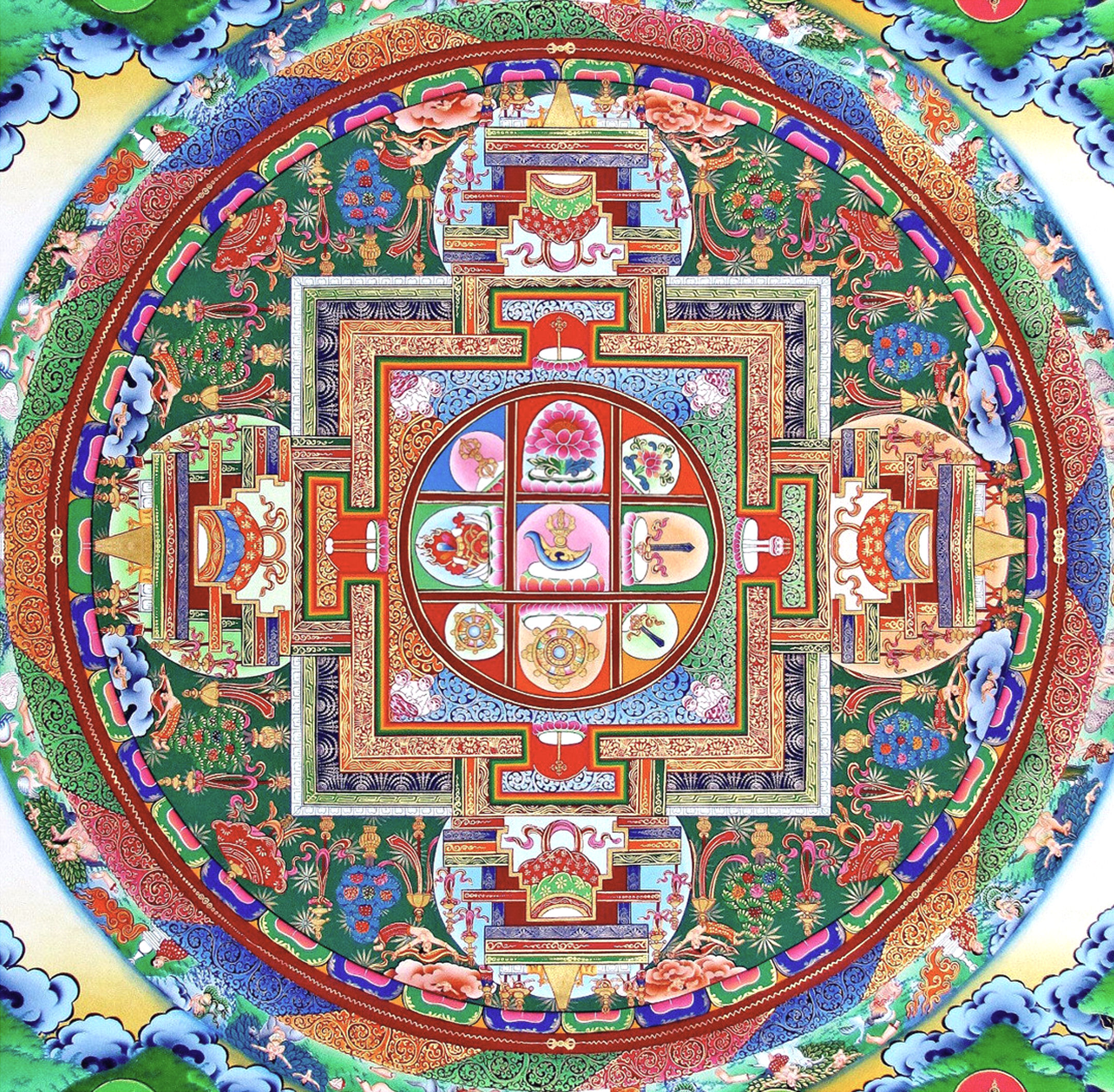
Yes, Yamantaka (Vajrabhairava) Rites 大威德金剛法, also referred to as the Vajra Methods 大凡金剛法, is a closed practice, but not for the reasons that align with that majority view.
First, a prerequisite is your personal karma. Is this the right place, right time for you to be cultivating this power, i.e., activating Yamantaka consciousness within. Are you the right vessel, in body, mind, and spirit, to house and channel Yamantaka force… and do so in a manner that won’t end up hurting yourself.
You’ll hear beliefs such as people with either body constitutions or natal charts that are Wind 風 dominant, Wood dominant (per the Wu Xing) or Air dominant (per the four elements theory), then they have an innate predisposition for containing the Yamantaka force, or achieving Yamantaka empowerment.
And by karma, I also mean cultivated karma, or merits. Some people were “born for it.” Others will have to work for it. And that 8th century Rites grimoire gives you guidance on how to work for it. 10,000 recitations of the Root Mantra while forming the Root Mudra while living and conducting yourself in a manner consistent with Buddhist principles will cultivate the karmic merits you need to activate Yamantaka consciousness and be that right vessel.
Finally, once attained, attainment also means adherence to a vow. That vow is around how you now wield the powers you’ve attained. If you don’t wield them responsibly and ethically, it’s not just other people you’re going to be hurting; ultimately, you’re corrupting yourself until eventually, the Yamantaka force is going to be used against you. Not only can Yamantaka defeat death and the King of Hell, but it can subjugate any bodhisattva who strays from their bodhisattva path.
Also, within the scope of what we consider a closed tradition, there’s the question of whether you need to be Buddhist. I often hear people state the disclaimer, “I’m not Buddhist, but…” and then say something about their way of life, way of thinking and doing, ways that reveal their heart and spirit that is very, very Buddhist. And of course we all know people of certain faiths who love being the poster child for that faith but are total hypocrites with their conduct. In the end, as Yamantaka would judge it, who is more “Buddhist”?
If you are to be a vessel for Yamantaka force, it’s a dedicated lifestyle. You are committing to be the hand of divine justice, and in this case, through a Buddhist perspective.
Working with Kuan Yin and Yamantaka
Some pairings recur consistently across canon and long-established devotional practices, like Sakyamuni Buddha and Manjusri (see not only Rites and Rituals, but also texts like the Prajnaparamita Sutras); Amitabha and Avalokitesvara (in Pure Land Buddhism) or Ksitigarbha and Avalokitesvara in several streams of esoteric and mystical practices, or even what we see in classical Yamantaka iconography– the Wrath King and the dakini Vajravetali.
While Avalokitesvara and Yamantaka isn’t among them, apart from esoteric manuals instructing on the Spear Mudra for both, when paired together, the two are counter-balancing points that keep the occultist on the Middle Path.
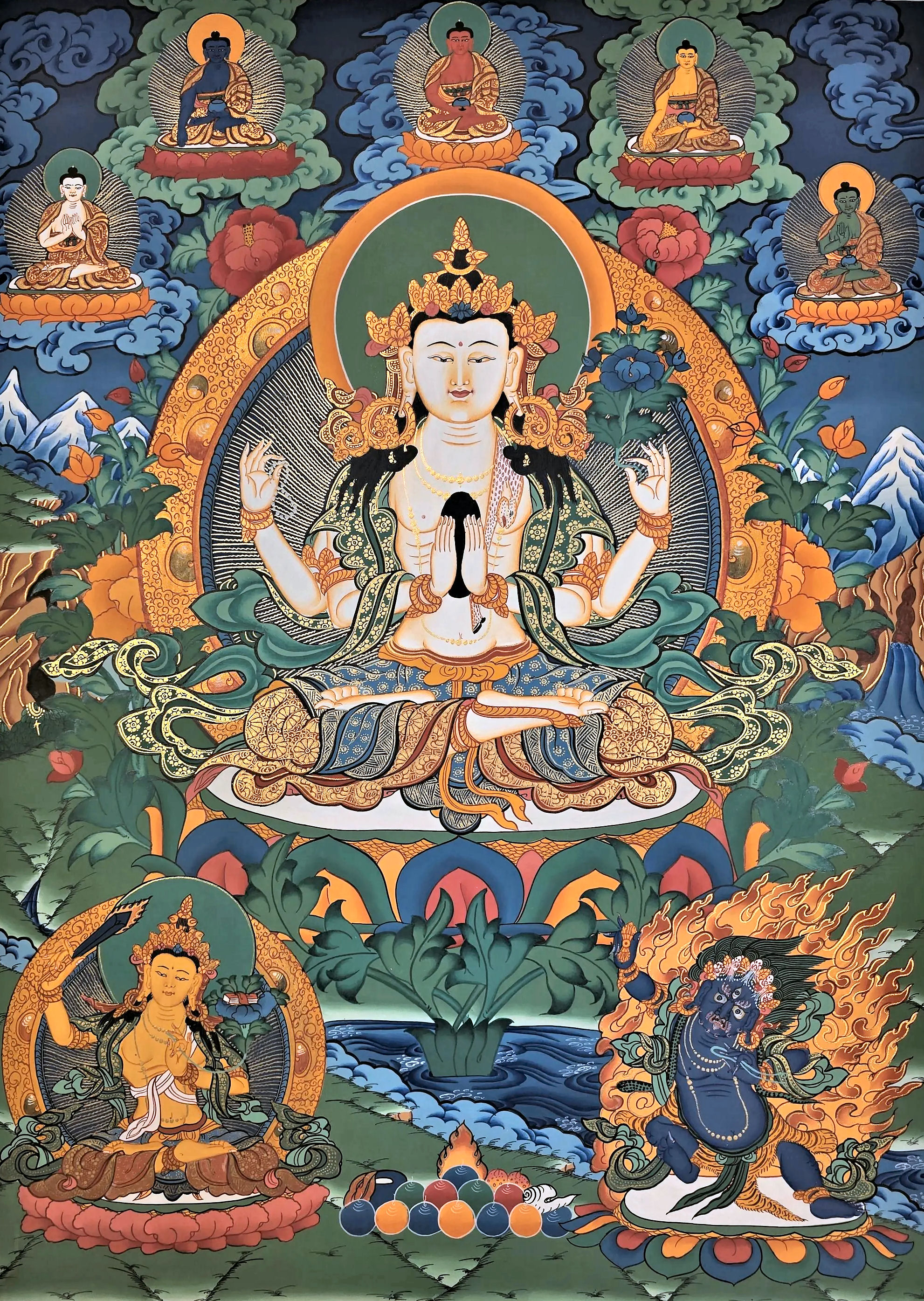
Kuan Yin consciousness presumes that all sentient beings can and should be saved. Everybody, no matter how heinous of an act you have committed, deserves mercy and Her unconditional Love. Anybody, even demons, can be rehabilitated.
Whereas Yamantaka consciousness presumes that yes, Kuan Yin is largely the right mindset, but there are an exceptional few who are too corrupted, too powerful that only the Wrath of Wisdom can save the innocent, and that path is retributive or karmic justice.
That said, only a select few have what it takes to be able to dispense that retributive justice with measured wisdom.
And also, in light of all this, I think it makes perfect sense why working with Kuan Yin is such an open, welcoming practice, whereas the ability to channel Yamantaka is a closed practice.
Justified, controlled – and that second word really is key here – justified, controlled wrath and being able to channel that wrath in equal parts with wisdom in a focused, directed, regulated way is not for the weak, not for the reckless, and not for the immoral.
Which is why you will hear from Buddhist masters and teachers of this type of practice that truly, truly Step One is consecration and purification of the self, to make sure your conscience is spotless.
Just so I don’t unintentionally cause confusion, there are no established traditions that canonically connect Kuan Yin and Yamantaka. It’s just my advice, as a fellow practitioner, that if you are going to go the route of not receiving instruction and empowerments under a lineaged master and you’re doing this on your own because you’re nuts, then my strongest recommendation is to start by taking a step back, delaying work with Yamantaka until you have cultivated a strong connection to Kuan Yin consciousness and feel deeply resonant with Om Mani Padme Hum. That becomes your guardrail and your guiding light. Alternatively, work with both in tandem so that they’re constantly providing a counter-balancing point for one another.
Misc. Behind-the-Scenes Notes
My recitation of Yamantaka’s Root Mantra was probably a bit more femme than you would imagine Yamantaka’s tone would be when he first declared those words before Sakyamuni and the assembly of bodhisattvas and the eight legions, a tone described as so terrifying that it left all the gods and spirits quaking with fear and into submission to his formidable presence. I did try to get Hubby to do the voiceover for me, but he said no not happening. =P
So just use your imagination. =)
I wasn’t going to include a complete recitation of the Root Mantra, mainly because commenters on the internet get hyper-critical over pronunciation. But ultimately, I felt like it was an important reference to include.
And yes, the harmonized chanting and even the dinging of the bells and singing bowls are all me, myself, and I, recording each audio and layering them together in an outdated now-defunct version of MovieMaker on Windows 7. That’s right, my O/S is still Windows 7.
I’m still tickled by the way astrological timing came together. This is getting released in the Year of Mars, which happens once every seven years per the annual rulership cycle of the Sacred Seven, in a solar ingress into Aries, during a month of Aries (i.e., Sun in Aries) while there’s a stellium going on in Aries, which I’m then posting at the ascendant hour of Aries.
Can You Mix and Match Cultural Traditions?
Oh, you mean syncretic practice? Most cultural traditions are syncretic, whether or not we recognize them as that. A lot of Buddhist magical practice is syncretic with older Indian traditions. Indian Buddhism is syncretized with Chinese cultural norms when it enters China, and is syncretized with Tibetan cultural norms when it enters Tibet. In China it’s further mixed and matched with Taoism and alchemy, and in Tibet, with Bon and shamanistic traditions.
Esoteric Buddhism itself has a syncretic history, having integrated Vedic and even older Śramaṇa and Brahman traditions. For millennia, Buddhism in China was syncretized with Taoism and Confucianism, and in Korea, with its region’s folk shamanism, and in Japan, with Shinto.
Western-influenced Buddhism mixes and matches the religion with secular humanist philosophy, psychology, and rationalism, de-emphasizing the ritual, cosmological, and devotional aspects considered common core in the Eastern lineages. That Western-influenced Buddhism has then in turn influenced the course of modern Buddhism practiced in Asia.
So. Can you mix and match cultural traditions? I don’t believe there is a definitive single answer to that question that applies to everyone and anyone.
I think for some, the fusion will cause confusion and may have the unintended effect of hindering your progress.
Whereas for others, syncretizing is what helps you to level up and start connecting the dots and seeing the cosmic patterns.
So truly, it depends on what works for you. “What isn’t right for me doesn’t mean it’s not right.”
I guess I’ll say this though. When it comes to the specific blending of Western and Eastern religious and spiritual traditions, it can risk getting chaotic and irreverent, especially if a practitioner hasn’t taken the time to understand the core fundamentals in both. Because of structural and systematic differences in our languages and general individualist vs. collectivist ideologies, brains get wired differently. Unless one has done the work and has had the cultural exposure to do a reconciliation of the two, working with the other culture can end up feeling like co-splay.
The Earnest Seeker’s Next Steps
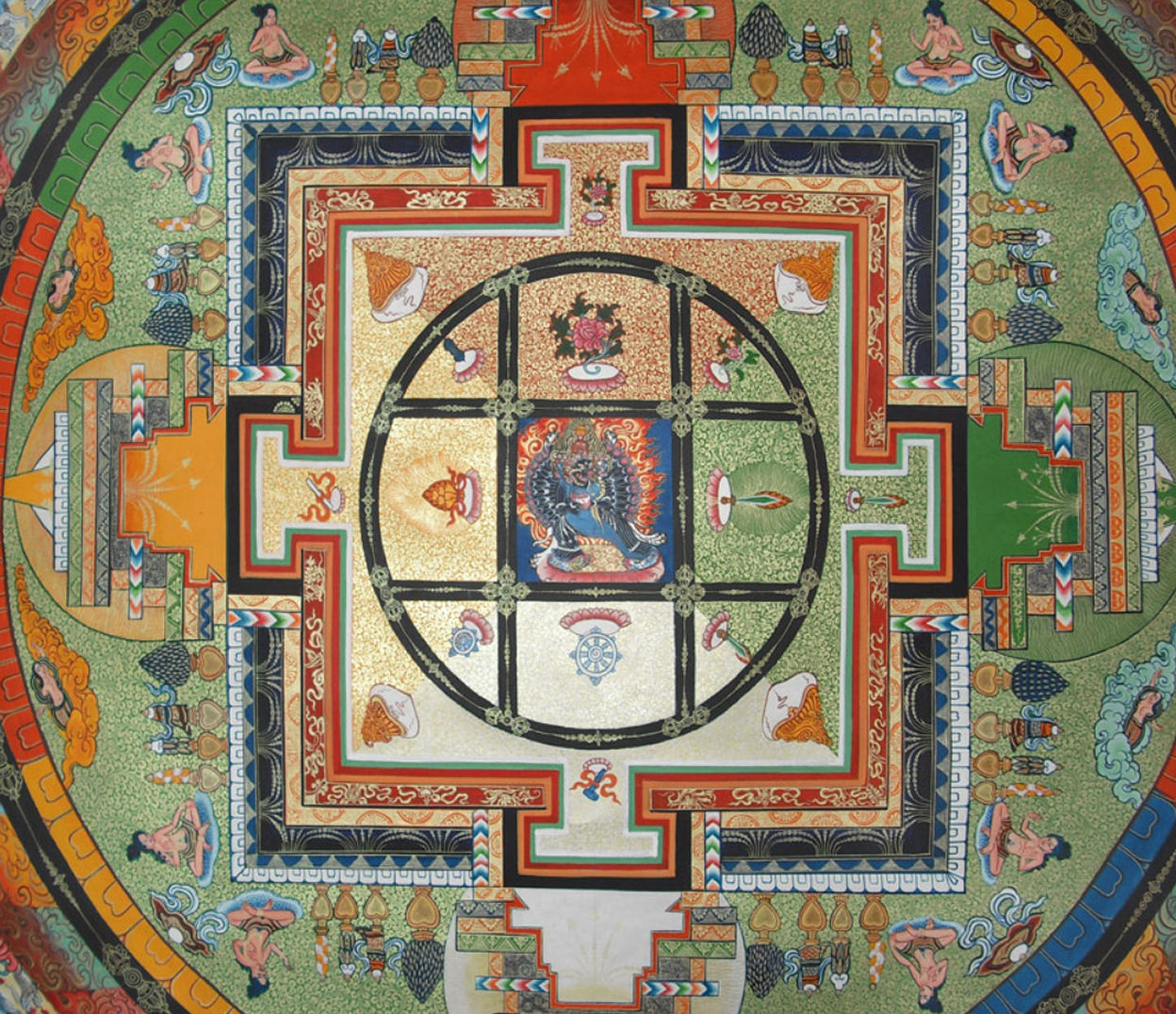
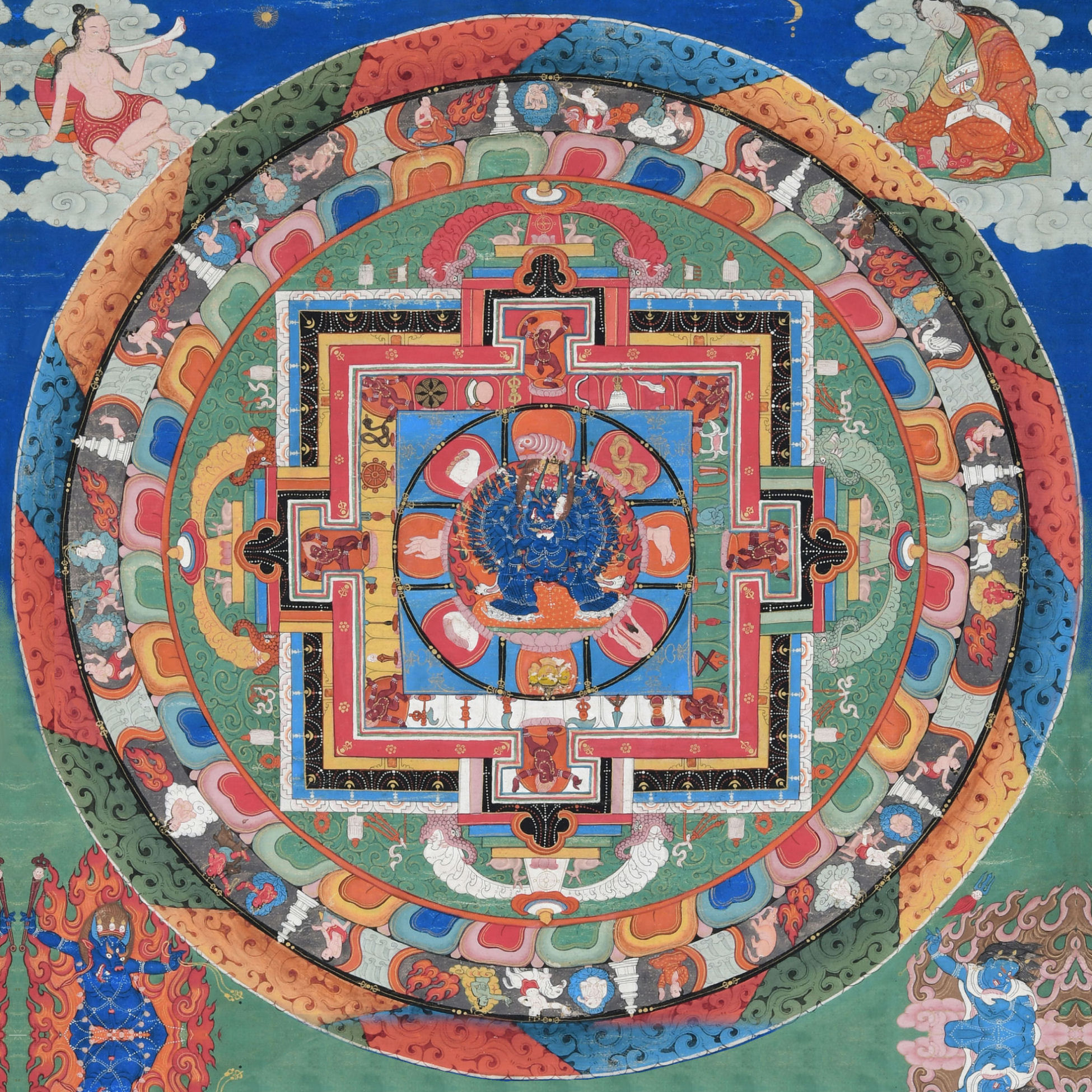
Start by casting your own Yamantaka mandala, which will become the ritual space for any Yamantaka rites you perform. In this write-up I’ve included several historical and cultural examples of Yamantaka mandalas to inspire your own work. Follow the core elements, concept, and structural layout, and then let your creativity lead for the details and final design.
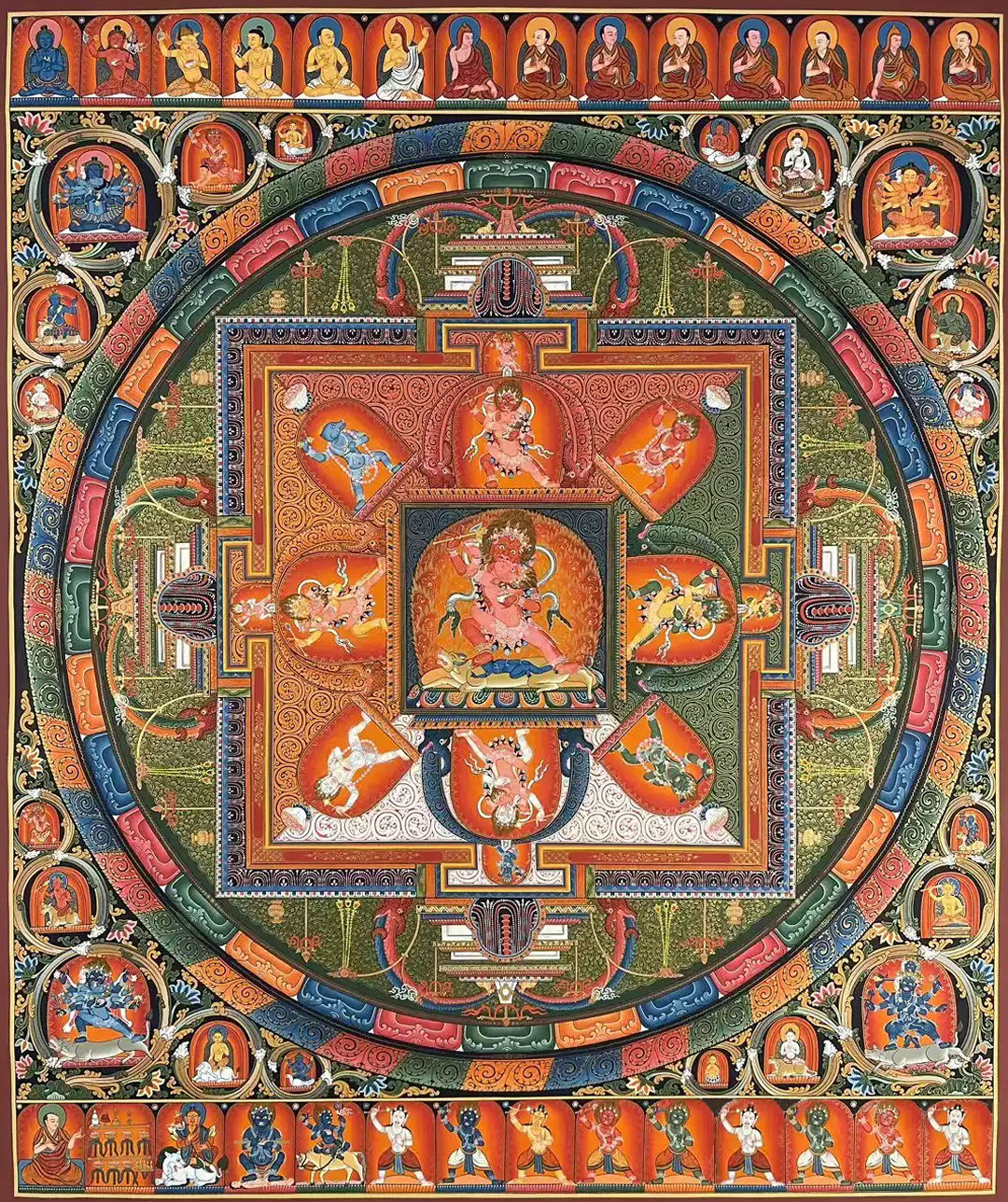
A basic, accessible approach is to start with very sturdy, heavyweight pasteboard. If you’re not feeling optimistic about your art skills, a mixed‑media, collage‑style mandala will work. You might hand‑draw and hand‑color the geometric designs, and then print a full‑color image of Yamantaka, the Wrath King, to place at the center of the mandala.
As you work on the mandala, play audio recordings of Yamantaka mantras in the background. Once the mandala is complete, perform all ten thousand of your Root Mantra recitations over the mandala board you have created. Also, to that end, it’s not a bad idea to dedicate a small notebook for tracking the count of your recitations until you’ve achieved the 10,000.
Benzoin or agarwood (also known as oud) are most often cited as the preferred incense offerings in Yamantaka rites. That said, you are not barred from using other incense, especially since the source text itself explicitly encourages the practitioner to work within their means.
You may also enchant dark blue or black mala prayer beads, whether worn as a necklace or a wristlet, whichever feels more appropriate for you, through repeated recitations of Om Yamantaka Hum, or opt for one of the short-form consecration mantras provided in the Rites grimoire.
Citing from that grimoire and as noted in the video lecture, dark and light mustard seeds were historically used as a ritual ingredient for exorcisms and repelling harmful or baneful spirits. Stock your magical arsenal with dark and light mustard seeds you’ve enchanted with Yamantaka mantra recitations.
Finally, it is worth ordering a printed physical copy of the Rites and Rituals and keeping it nearby during all of your Yamantaka workings. In doing so, the text can absorb some of the energies generated through the practice, effectively enchanting your book of Rites as well.
Keep in mind these are just my recommended next steps for the seeker earnest about gaining access, and at the end of the day, what do I know? =) Plus, whether you are granted access isn’t up to me (or any other third party), but really, is dependent on your own degree of dedication and whether his Holy Wisdom King grants it.
 benebell wen