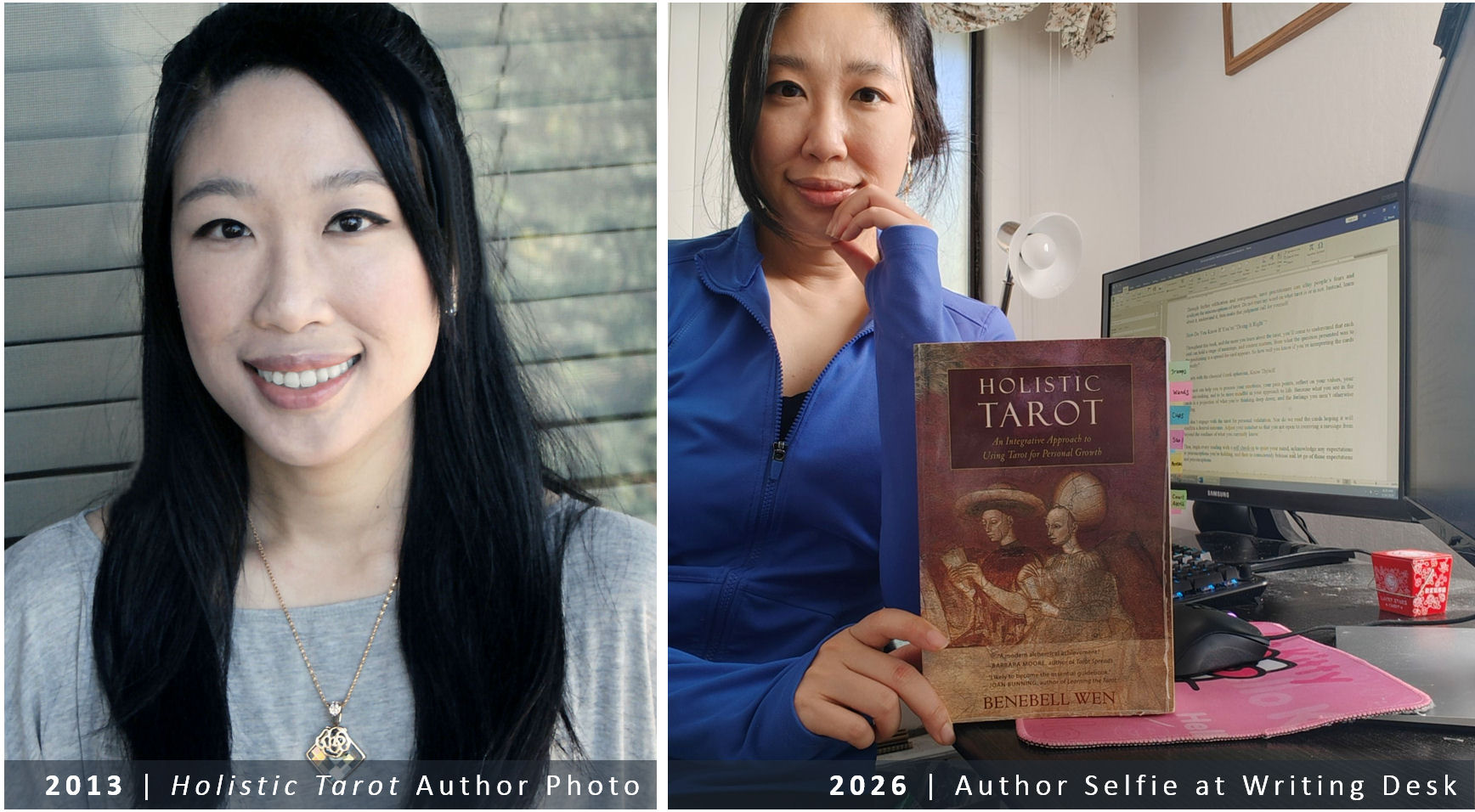
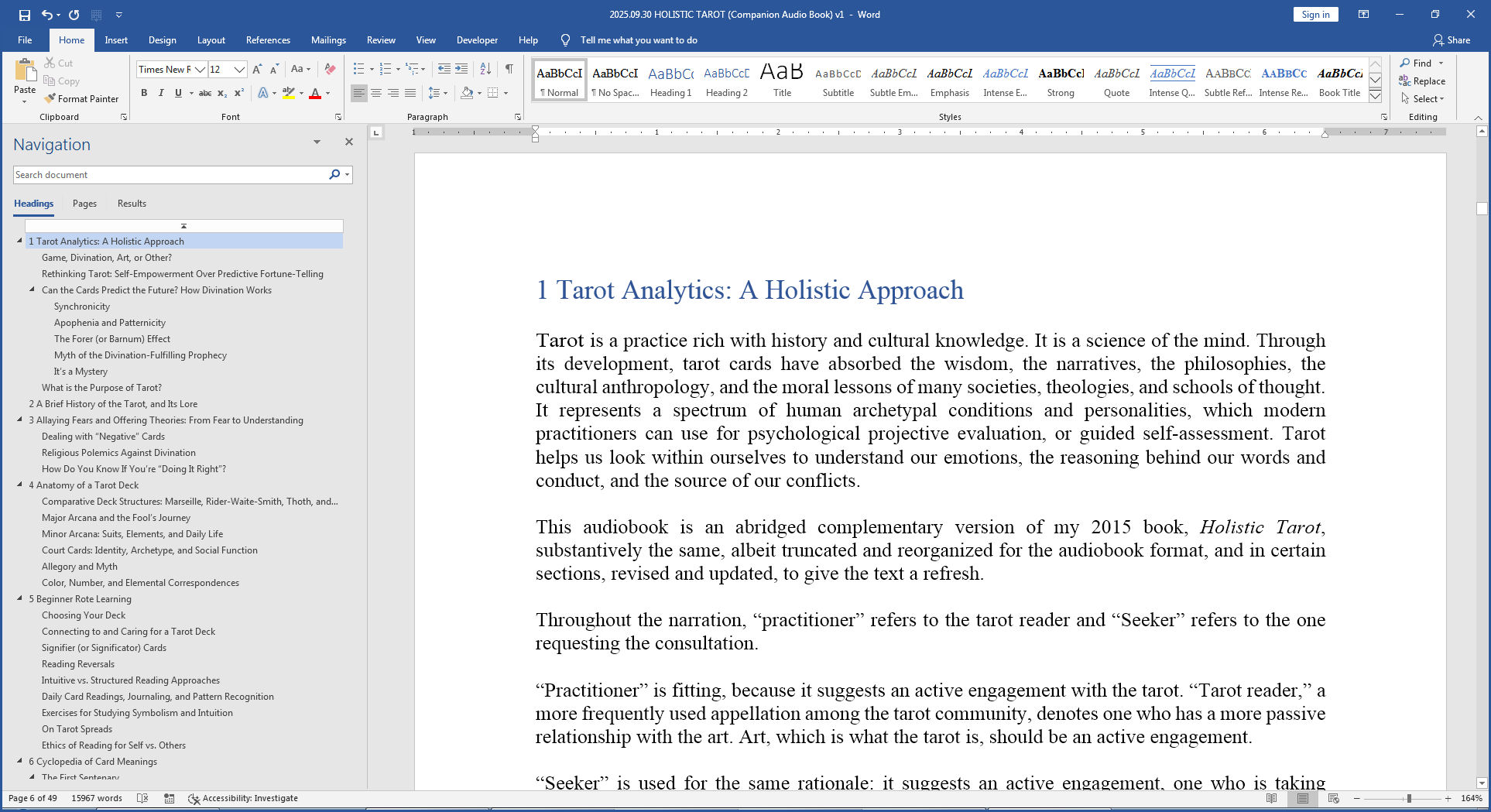
Recently my publisher reached out to me about doing an audiobook version of Holistic Tarot, but, you know, Holistic Tarot was like 850 pages, so an audiobook version would need to cut from a 200K+ word count down to maximum 85K. That’s like … crunch, crunch, crunch… 57.5% of the original book!
I like the idea of someone being able to put on their headphones and listen to educational content on the tarot while going about their day, multitasking. I could approach it as scripts to a podcast series, and each chapter is an episode that builds on the previous episode and leads to the next. So I said yes.
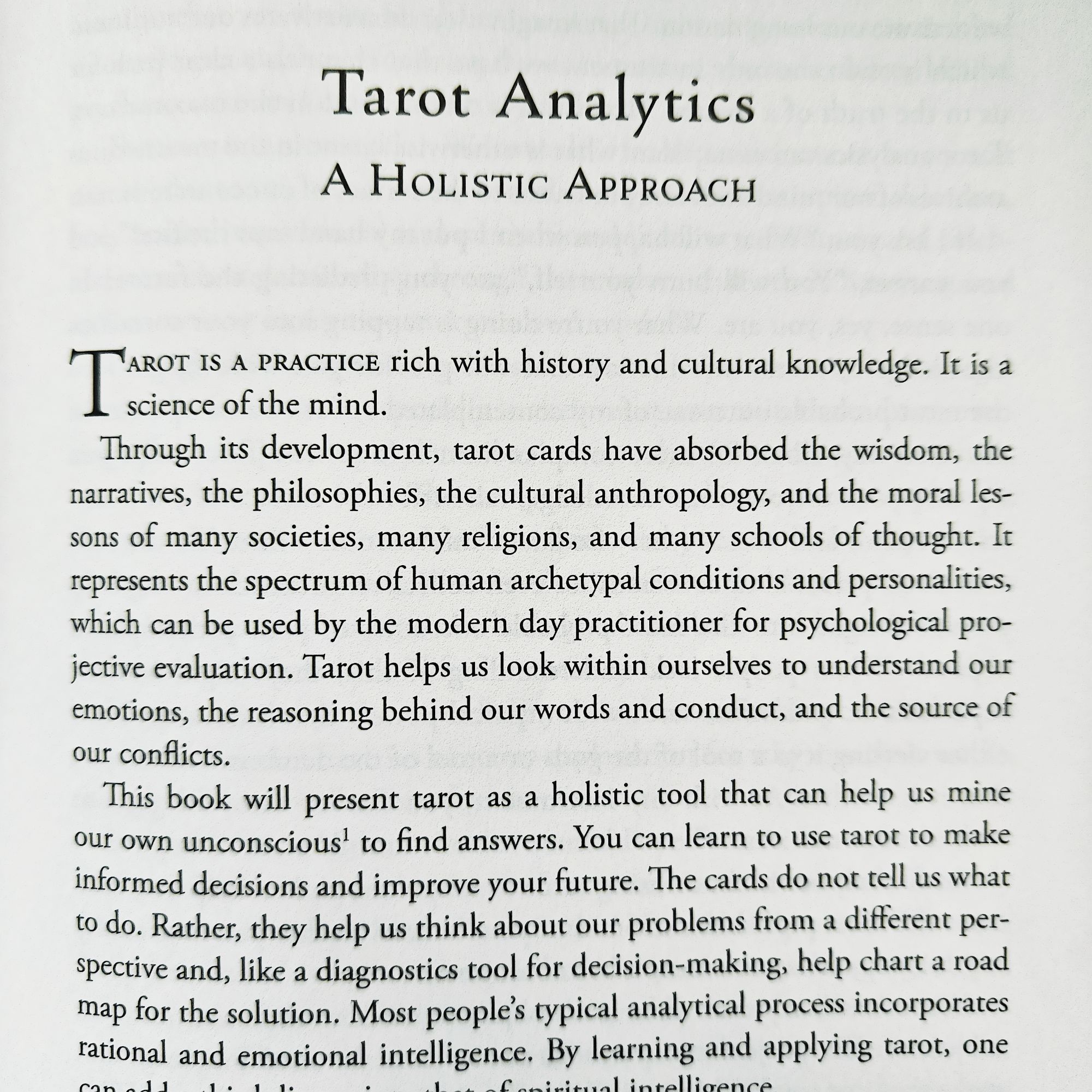
That said, the project has turned out to be a lot harder than I initially presumed. You can’t just cut out 115,000 words from the original text with no revisions to the remaining text and have it make sense. Not to mention my printed book was graphics, table, and chart intensive, so now I have to carefully review the manuscript to make sure it’s audio-friendly.
Funnier yet are some of the self-realizations that are happening while I reread something I wrote well over a decade ago.
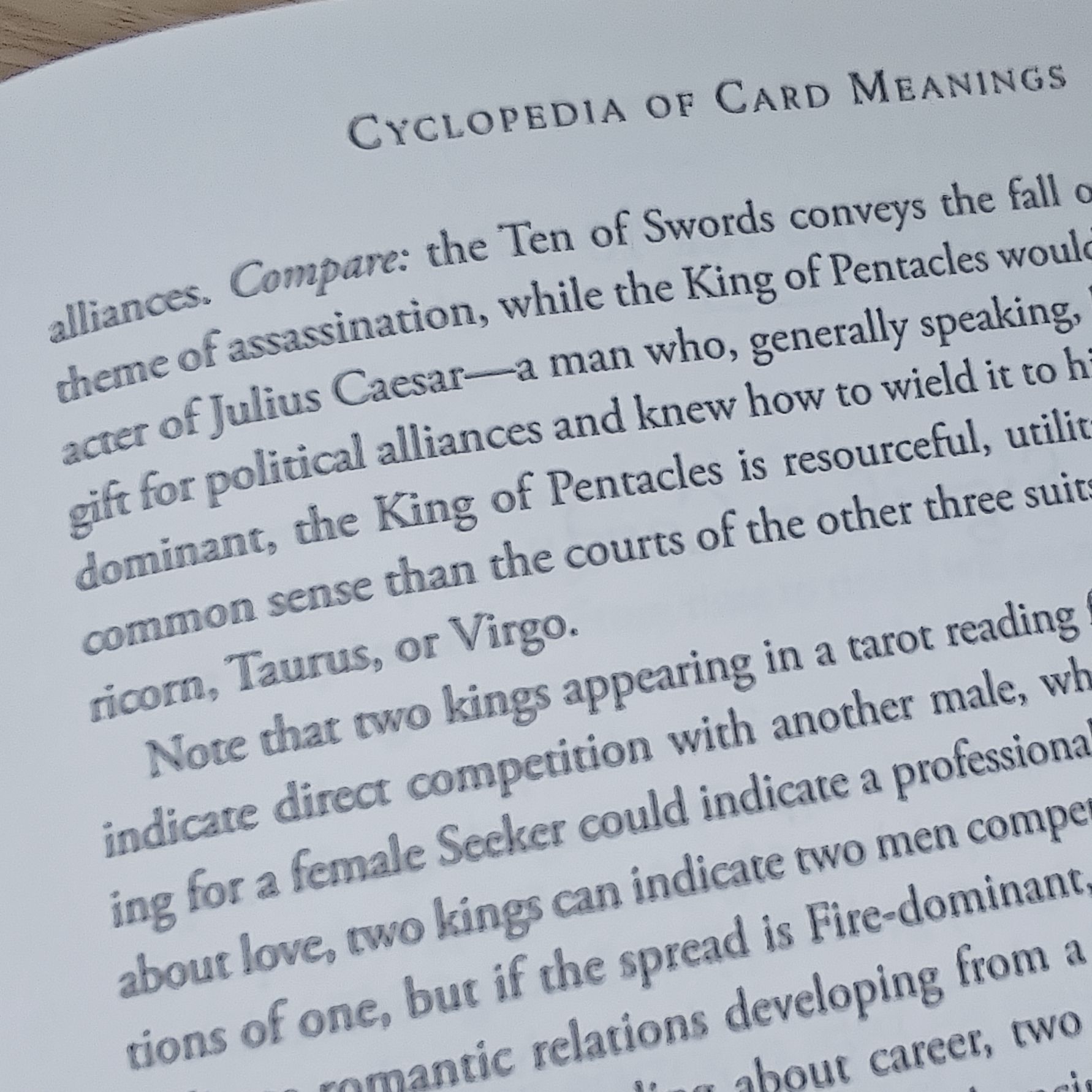
One, tell me why it reads like AI wrote it even though this was a decade before LLMs. Em dashes galore. Compare-contrast sentence structure (FYI, that’s academic writing; it’s kinda how those of us who get graduate degrees were trained to write, especially in legal writing. “It’s not just ___, it’s ____” is littered all over any legal brief). Or starting sentences with Moreover, Nevertheless, Notwithstanding, Whereas… I mean crap, that’s still how I write contracts.
Actually, we know why — it’s not that I sound like AI. It’s that AI was trained to sound like academic writing, and my writing style at the time was academic, and not just academic, but specifically juris doctorate academic, and those kinds of publications were a big part of what AI learned from. Funny enough, I do recall back when HT first came out, I got a lot of criticism about how the book’s style came across as too dry, pedantic, even robotic.
When I wrote Holistic Tarot (HT), I was just 5 years out of law school, determined to write and publish books, but not sure in which direction. Did I want to do more legal research and writing, and publish a book on critical race theory, specifically intersectional feminism? (This was way, waayyy before CRT became a mainstream thing; at the time, CRT was still a very niche academic subject only legal nerds talked about). Did I want to finish TFN (“that fucking novel”) I had been plowing my way through all of law school and while I should’ve been focusing on studying for the bar? (I was using the tarot at the time to help with plotting and character development for that novel.)
As it turns out, I wrote a hefty book on tarot fundamentals. Coming straight out of an academic legal research and writing background, my initial concept was to name a “novel” (I mean, it’s not really new new…) approach to tarot reading, and define the scope of this specific, niche approach that you’ve named. So the whole book was premised on the concept of “Tarotanalysis,” my name for a very specific approach to reading tarot.
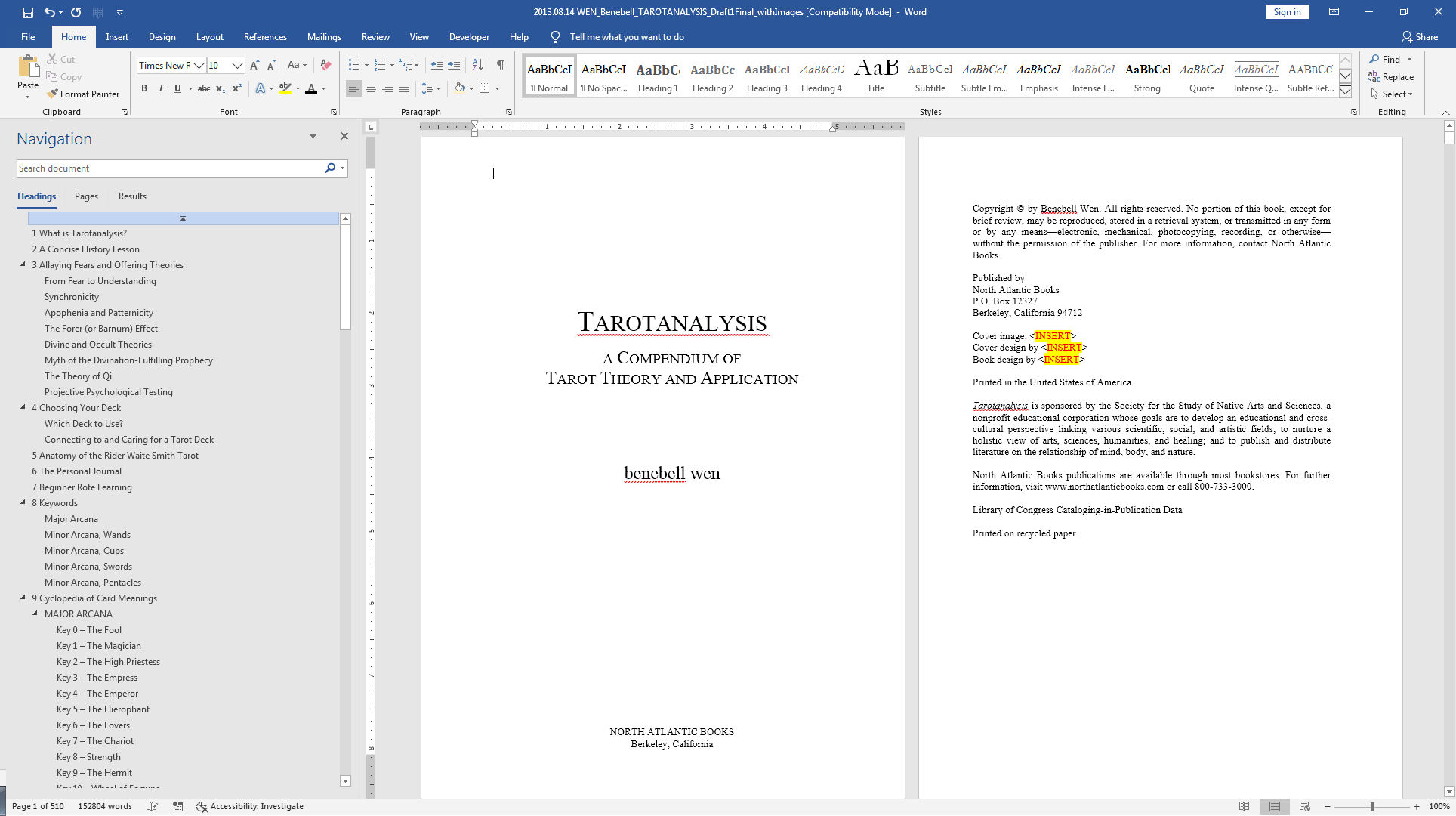
As the developmental edits progressed, the publisher felt like “Tarotanalysis” as a title wasn’t very marketable, and they were probably right. They pitched several title alternatives.
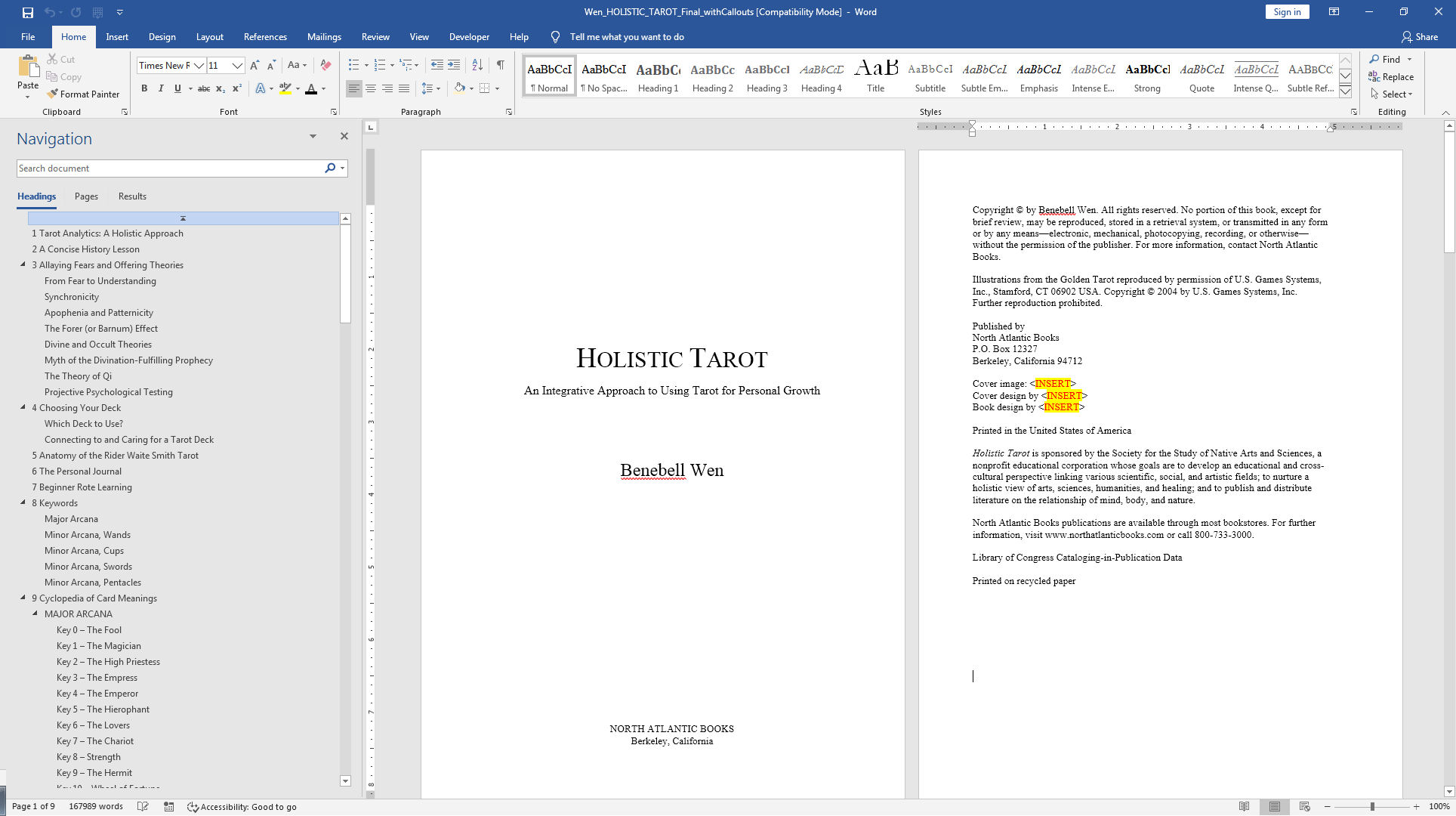
I can’t say that I loved the title “Holistic Tarot” when I first heard it. It felt a bit like the total opposite of what “Tarotanalysis” or “Tarot Analytics” was going for. But ultimately I did get on board. Hence, “Holistic Tarot.”
I do have to acknowledge that this book ultimately did as well as it did because we went with the publisher’s more marketable title. Had I gone with Tarotanalysis, Tarot Analytics, or Analytic Tarot (which were my title ideas), I don’t think the book would have sold as well, or at all, lol.
In rereading this book over a decade later, the substance of what’s in HT and my approach hasn’t changed, but I would say I’ve since evolved and refined my approach.
A lot of the verbiage in the original manuscript was based on the premise that I was defining a “new” approach to the tarot — ehh, a better way to put it is a very specific, niche approach to tarot reading — “Tarotanalysis” or “Tarot Analytics.” And so when I went on and on in the printed book about how this is not fortune-telling and yada yada, in my academic mind, it was my way of narrowly defining the scope of what “Tarotanalysis” is. It’s not that you should never do fortune-telling; it’s that fortune-telling would be outside and beyond the scope of the Analytic Tarot approach.
But because of the many different ways it was revised and with the last minute title change, ultimately the final result was a bit harsher than maybe I would have wanted to come across. So now in my audiobook, I get this opportunity to refine my tone.
Most contemporary tarot and metaphysical authors already have a conversational and casual writing style, at least much more so than I do, so they convert easily into audiobooks. Whereas my more academic style of writing in HT doesn’t convert so well, not without some noodling. So I’ve been trying to balance keeping consistent with the style that HT and pretty much all my published books established while lightening the tone just enough so it’s a book you listen to, rather than an encylopedic reference you touch and go into from your study desk.
It’s also a very writerly impulse to reread something you’ve written and immediately feel the urge to revise it. And with stuff I wrote a lifetime ago, I find myself wanting to stop at every sentence and rewrite it entirely. Even the way I originally structured some of the chapters and paragraphs no longer feel right, especially for an audiobook. So I’ve been doing reconstructive surgery… and I’m only on the first three chapters.
Which is all to say that what I’m writing here isn’t just a condensed version of Holistic Tarot for the audiobook format; it’s really become a different… I dunno, expression (?) — projection (?) — of that 850+ page printed book from 2015.
The print book was written for the reference desk. It was for slow study, for you to take notes, to accompany a tarot journal, with loads and loads of charts, tables, and visuals.
An audiobook version of such a text has to be more narrative, episodic, and for someone who is on the go.
The printed version of HT is for you to be in stillness, seated at a study desk.
The audiobook version of HT is for you to be in motion, multi-tasking, half listening and hoping enough of the information is registering for it to be educational and worth your while, and so easy enough to follow with just half your attention.
If you have the printed copy of HT, the audiobook will be a return to familiar terrain, but matured, refined, in some places sharpened, in some places softened.
If you’re new to my work or new to tarot, I hope HT the audiobook proves to be an effective tarot education supplement. I’m working through the audiobook rewrite with that in mind, at least for myself — what would I want covered, and how should it be covered, in terms of learning tarot as a total beginner, or even an intermediate seeking a refresh. I think learning only from one single audiobook on the subject is gonna be rough, so I’m not even trying for that. I think an audiobook should be a supplement to enhance your learning. And that’s what I’m trying to achieve.
 benebell wen
Maybe we can print this version also? ❤️❤️ I would love to read the new version!!
LikeLiked by 1 person
That would be an interesting option or feature to work out with my publisher! ❤ Cool idea!
LikeLike
I second this idea!
LikeLike
I have all your books as references.
I also have a brain tumour and very often have double vision both horizontal and vertical where I am bed bound. I use audio books at these times, and I have a special mask to keep my eyes from tracking light.
It is true most want to have audio books for lighter reading and for shorter books. I however, look for longer books and or a series.
Thank you for undertaking a mammoth task yet again.
Vera Cruickshank
LikeLiked by 1 person
Hi Vera, So great to hear from you again! ❤
LikeLike
Firstly I must comment on the excellence of your blog/website. I appreciate how you 1) don’t have ads 2) don’t have paywalls 3) include pictures, diagrams etc. 4) the format, layout and aesthetic is comfortable and pleasing 5) the top-quality of the writing 6) the honest, authentic voice
Secondly, this sounds like a great ‘avatar (?)’ of HT, or more generally of your tarot wisdom. Looking forward to it. Thank you 🙂
Andy K
LikeLiked by 1 person
Wow, that’s ambitious! I’ve just come across your work. I’m intrigued, and pleased to have done so.
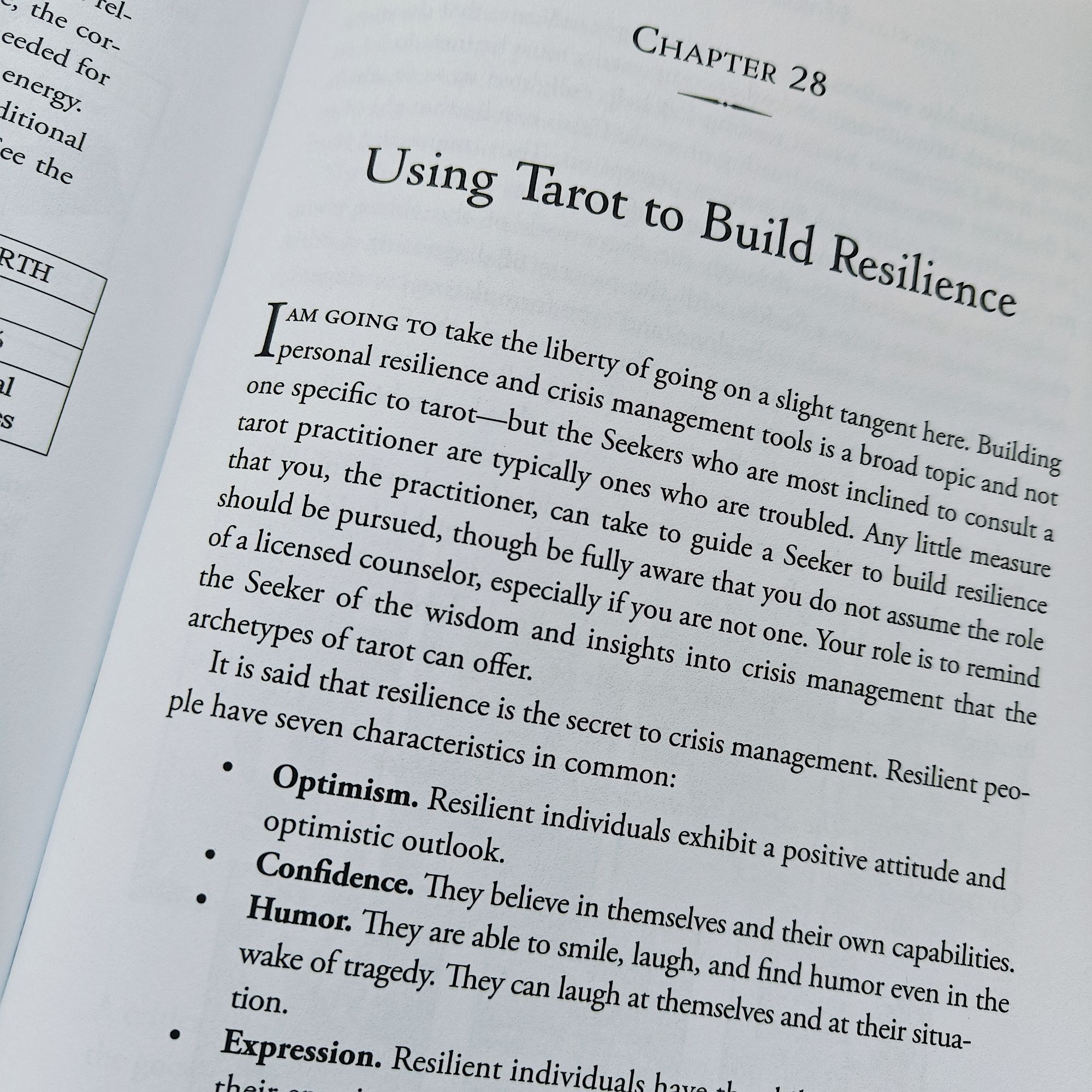
Regardless, Using Tarot to build resilience seems like a solid inclusion to me!
Thanks for your work.
Deidra
LikeLiked by 1 person
Whoo hoo! I love your writing style, but I appreciate the more academic bent of your books. There’s so much fluff out there. While I do enjoy a little fluff now and then, it’s nice to have something with substance too. I can’t wait to hear the audio book!
LikeLike