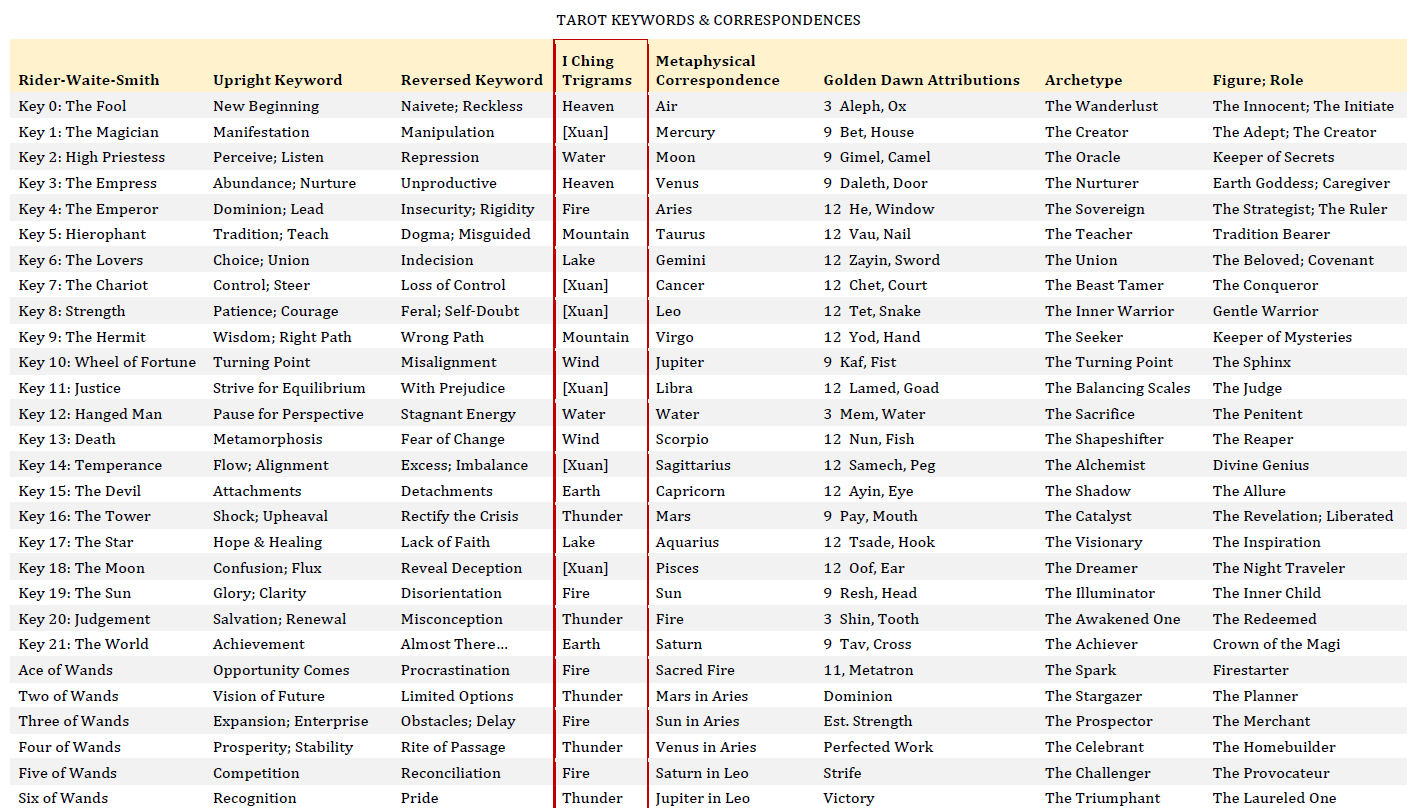
I’m an I Ching aficionado and also a tarot aficionado, wrote chonky books on both subjects, so naturally I’ve thought long and hard about how the two systems reconcile. This page is a download of a tarot and I Ching correspondence table for your easy go-to referencing.
I see auras. And also, I pay no attention to them. For most of my life I presumed it was a defect with my eyesight or brain or both — which by the way, that’s most likely it.
That said, medical explanations don’t take away from the spiritual implications, at least not for me. Ocular migraines and severe astigmatism are both known to cause a person to see a halo-like glow around people. Chronic dry eyes and corneal irregularities compounding ocular migraines and astigmatism can then make the glow appear to bear color.
Synesthesia can also be another culprit for what we think of as seeing auras. Your senses get cross-wired, so you see color when you hear sounds, hear musical notes when you see colors, and feel notes and numbers on a musical scale in different bones; likewise, someone’s presence — which we can all sense, it’s the “vibes” you get off a person — can get color-coded, and that’s the aura color a synthesthete might see.
Having not just one or some but all of the aforementioned conditions is probably why, medically speaking, this is what I see when I look at people:
Trying to use colored pencils to show what auras look like to me…
Note: I wrote this after two generous glasses of port on an empty stomach…
Every so often, someone calls my translation of the I Ching or my work-in-progress on the Tao Te Ching “New Age.” They’ll say it dismissively, as if they’ve discredited the authenticity of my work, and the legitimacy of my scholarship. Funnier yet, not one has been able to competently articulate how and why my work is more “New Age” than its counterparts. For some reason, my interpretation is automatically assumed to be wrong if it departs from what some old white guy from the 50s wrote about these Chinese texts, and we give the old white guy, taking a Christianized outsider perspective, miles and miles of grace.
When pressed, their explanation collapses onto itself in circular reasoning. “It just sounds New Agey.” Or “Well it’s because she’s an occultist so she can’t possibly be unbiased, neutral, objective, and scholarly.” They’ll say it doesn’t sound like “ancient Chinese wisdom.” And that expectation is problematic.



 benebell wen