

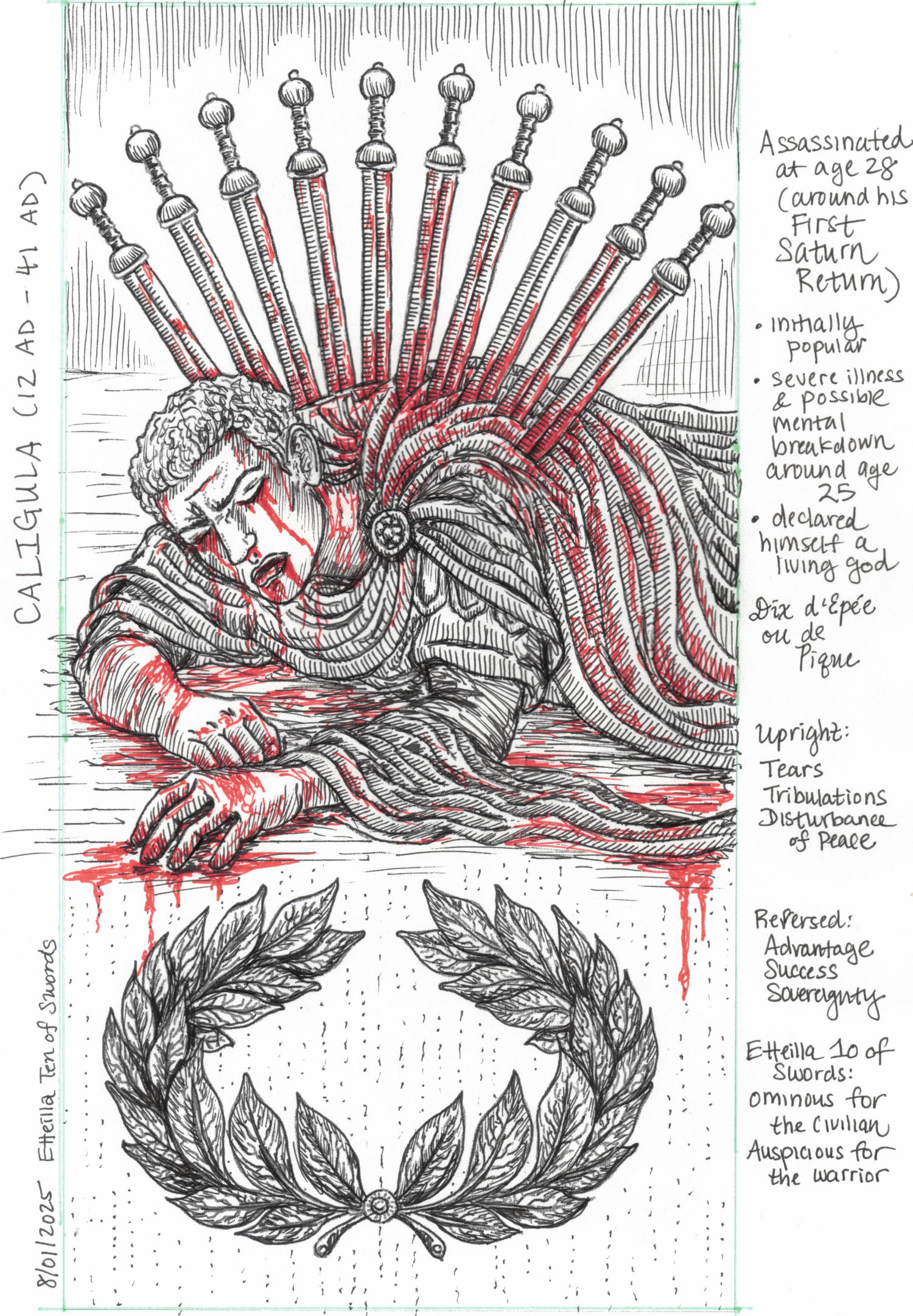
Left or Right – Which one do you prefer? The left G-rated version that leans more into psychological pain? Or the right bloody version that leans more into the physical manifestation of our suffering?
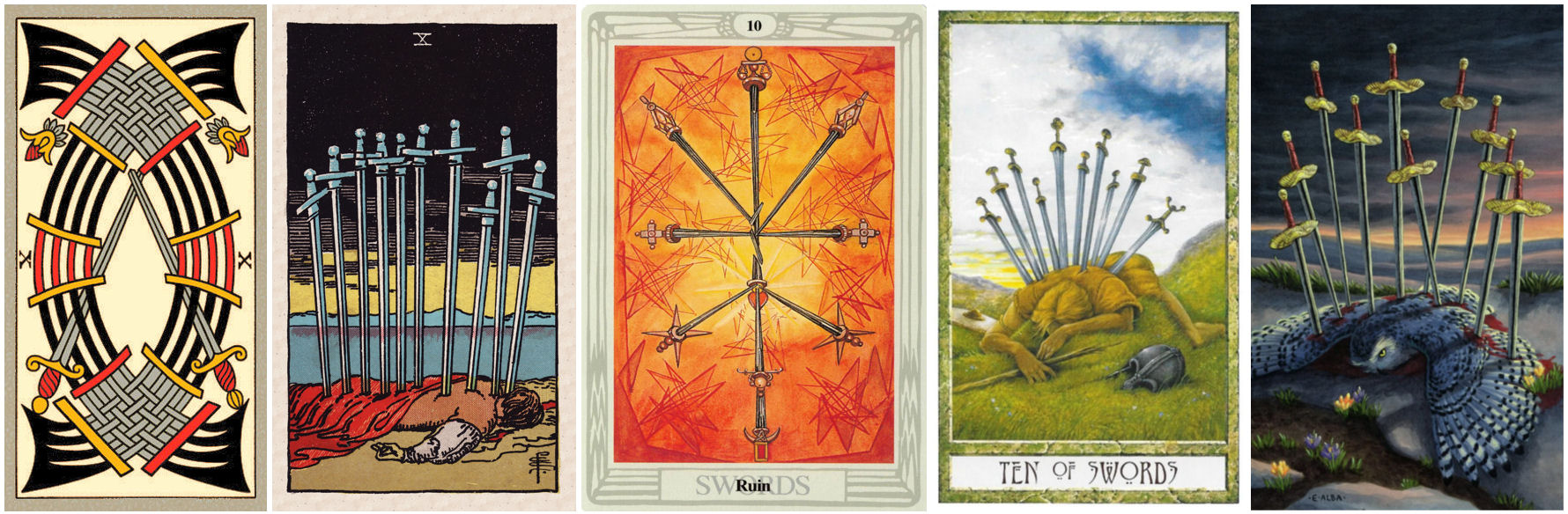
The Ten of Swords in tarot has come to be associated with betrayal, treachery, backstabbing, the pain of being double-crossed, and the breach of trust. So how a deck creator illustrates the Ten of Swords reveals a lot about their unconscious processing of these themes.
It’s also the soul wound, a crisis of faith, where faith and reason are at war. It’s the mob mentality vs. individuality. Seeing an artist’s rendering of the Ten of Swords will reveal to you that artist’s relationship to the archetype of the ego-death.
At least that’s always been my impression.

Does the artist lean in to the doom and gloom. Do they depict a lot of blood, or do they sugarcoat these themes with a more palatable depiction? Where is the focus — the subject being stabbed with swords or is the focus on the largeness of the swords? Do they focus on the silver lining, on the potential of transcendence the card can imply?
Does the illustration indicate some sort of fixation or romanticizing of the card’s violent imagery? Do they intellectualize the concept of the ego-death? Do they try to underscore hope and transformation, movement toward individuation?
How you draw the Ten of Swords (and for readers, how you interpret the Ten of Swords card itself) is a mirror into how you might deal with wounded ego, betrayal, psychological harm, the stripping away of power, and then the surrendering to powerlessness as the path to reclaiming power.
Maybe those of us who like to graphically illustrate the blood and gore are more prone to externalizing inner pain, or maybe it’s identification with the martyr complex, if I’m playing armchair psychiatrist. Whereas those with a more optimistic reinterpretation of the Ten of Swords have the wisdom and ability to reframe, to heal, and to grow. Though an overly sanitized fluffy Ten of Swords might suggest an avoidance personality.

The SKT Ten of Swords depicted ego death and growing pains leading to spiritual transcendence, set in the cultural traditions of Mongolian shamanism, commonly referred to as Tengrism.

The third iteration of SKT (the full-color Revelation) started with the above sketch, a revision of my first edition Ten of Swords. This was from July of 2020.
I mention this because like most tarot readers, apart from the ones trying to be contrarian, it’s not like I love the Ten of Swords. But I do feel like I have a special connection to it. I interpret it as taking you to a lower point that even, say, The Tower, the Death card, or the Three of Swords.
Actually, maybe it’s not about comparing degree of suffering as it is the cards depicting different stages or points in time of suffering. In the Ten of Swords, it’s the open wound.
And so both as a deck creator and as a tarot reader, I prefer a Ten of Swords that’s unabashedly in-your-face about the presence of pain and suffering. I want it to be raw, and fleshly, and piercing (no pun intended).

For the SKT I intentionally followed the RWS stabby-stabby imagery, though I feel like the final work product’s spiritual nature, the energy it gave off, was noticeably Thoth. But I mean yeah, it’s the imagery that you’ll find in the majority of RWS-based tarot deck iterations today.

However in contrast, for the Etteilla Ten of Swords, my original intention was no stabby-stabby, and to keep to the iconography of those early printings, but there was also a bit of a conundrum…
The lower third of the Eteilla II features Caligula, who was assassinated by stabbing from his own legion of guards (those who were supposed to protect him). So actually, Pamela Colman Smith’s illustration in the RWS and the iconic RWS imagery for the Ten of Swords would work here in the Etteilla.
And then artistically I just really, really felt pulled in the stabby-stabby direction, even though I would have preferred to depart from that Ten of Swords trope.
I guess it’s because I want a Ten of Swords that you cannot sugarcoat.

I wonder if the zoomed-out full-body depictions in my SKT Ten of Swords suggests disassociation, and detached or emotionally-distant intellectualized processing. It felt more third-party witness-mode.
Whereas what I did here for the Etteilla Ten of Swords is zoomed-in, focused on the face, hands, and the swords stabbed into the upper back. This feels more intimate, raw even, and more visceral. The SKT Ten of Swords had conveyed transcendence and having successfully processed trauma, but here, I hope it gives high emotional intensity.

As noted earlier, the Blocquel letterpress printings of the “Grand livre de Thot” (or Etteilla II) features Caligula on the Ten of Swords. Caligula was assassinated around the time of his First Saturn Return, an inside-job where his own guards were the ones who stabbed him to death, before turning on his wife and infant daughter to kill them as well. According to lore, the baby girl had her head smashed against the wall. Such a brutal assassination was intended to send a message: damnatio memoriae, meaning condemnation of memory.
So the stabby-stabby illustration I went with for the Etteilla appears to be RWS-based but it is well within the scope of the original Etteilla intentions.

In the Etteilla, the keyword printed on the Ten of Swords upright is Tears — lamentation, affliction, sorrow, sadness, pain, crying.

In reverse, it’s Advantage (I went with “Rise to Power”) — gains to be had, profit, success, grace, a favor, benevolence, empire, authority, or usurping power from another. Which is to say when it comes up in reverse, it’s actually a pretty good card! 😀
FYI, for the laurel leaf crown, I only drew one half of it freehand, then reversed and traced the other half.

That concludes the ten pips in the suit of Swords. These are still just the first drafts. With the SKT, in the process of completing all the first drafts, my art shifted stylistically and technically, so then I had to go back to earlier cards I worked on to tweak. My guess is the same thing will happen with this Etteilla.

Like at this point I finished the ten Coins almost a year ago, in some instances almost two, and now that I’m looking at this spread, I immediately spot details that need to be tweaked. Arrgh.

Kinda fun how I went from working on The Tyrant card (Card 21, Chariot) to the Ten of Swords featuring the tyrannical Caligula. That sequence was unintentional and not consciously done… Nevertheless, feels very au fait with the times…
Anyhoo, do let me know which you prefer — the one on the left, no blood, or the stabby-stabbier version on the right. If you include a few notes on why you prefer that version, that helps me with my decision-making as well.
 benebell wen
I prefer the picture on the right–it feels more visceral to me. The picture on the left in comparison seems like it’s downplaying the situation (even though the expression on the face hasn’t changed). But then, I actually really liked the “too much” red doodle on the scanned art, so maybe I’m just bloodthirsty.
LikeLiked by 1 person
I like the one on the left…but I prefer the facial expression and red tinge of the one on the right….it’s more dramatic and less corpse-like. If you could swap out the face I think that might get across a sense of both physical and psychological affliction. I’m so stoked for this deck! And the massive tome I’m sure will accompany it. LOL
LikeLiked by 1 person
100% prefer the image on the right for me. The image on the left gives the impression that he is being protected from the swords by some sort of golden glow. Or maybe that they missed and hit the dirt behind him.
LikeLiked by 1 person
I find myself drawn more strongly to the stabby-stabby version, not for shock value, but because it feels more congruent with the emotional truth and symbolic lineage of the card. Visually, the focused framing pulls the viewer into an embodied immediacy where there’s no option for dissociating or distancing. It’s not just a depiction of pain; it invokes it; which feels essential, not only in keeping with the Etteilla tradition, but also with how the card is anchored in betrayal, grief, and psychic rupture.
I think it aligns powerfully with the message of damnatio memoriae in the story of Caligula—a murder not just of body, but of legacy and memory. The viscerality of the stab wounds brings that erasure into flesh and form, and paradoxically, into memory again. A kind of resurrection through imagery. So while it echoes the RWS visually, the Etteilla context and your brilliant rendering give it its own haunting weight—one that feels both transcendent and intimate.
By contrast, the non-stabby version feels almost ethereal, like a dream-image of pain rather than pain itself. It holds the sorrow, but at a distance…more like the memory of suffering than the wound. There’s a certain serenity to it, a quiet aftershock that reads as reflection rather than rupture.
It’s beautiful in its own way. But to me, that soft, almost disembodied quality feels more like the echo of the Ten of Swords, rather than its heart. The stabby version doesn’t let you drift away from it. It grounds the grief—sharp, specific, unforgettable!
That unresolved quality and the sense of something still echoing is what makes the darker version feel mid-wound. Which to me, makes it worthy of your deck’s intensity and emotional depth. You’ve captured the moment before the transcendence…the part we often want to skip past, but shouldn’t.
So IMHO…yes…stabby-stabby all the way.
LikeLiked by 1 person
Originally I leaned toward the left, then I thought about how it needs to be blunt and “in your face,” which is what this card has always been for me: that friend who knows they have to give you the hard truth without any gloss, so that you will finally get the message after you kept ignoring it, over and over again, for so long. The right one it is for me!
LikeLiked by 1 person
I like the stabby-stabby one too!
LikeLiked by 1 person
I like the one on the right with the slight amount of blood. I feel it delivers the intensity of the card without being so graphic that it pushes the reader towards a specific interpretation. I resist the traditional negative connotations of the Swords. I believe everything in Tarot has both a positive and negative interpretation. I feel the design on the right allows me to find both.
LikeLiked by 1 person
Hi, definitely the G-rated version, the psychological pain.
Looks like it’s going to be a wonderful deck.
Kind Regards, Janette
Get Outlook for iOShttps://aka.ms/o0ukef
LikeLiked by 1 person
hello, I prefer the picture on the right because it gives me the feeling of those swords in my back. At this stage you need to feel the pain if you want to evolve and move past it. It is raw and powerful. I would not ‘sugar coat’ it 🙏🏻
LikeLiked by 1 person
hi, I prefer the left one, as a woman I am so used to seeing blood that it sometimes does not register that it’s bad, however psychological pain does draw a more deep felt reaction. Plus there are people who don’t like the sight of blood, that if I am reading for others I would be extremely wary about this card. Just my thoughts:)… both look good. 👍
LikeLiked by 1 person
Hi Bel;Right! Definitely the
LikeLiked by 1 person
The card on the left is more my taste. G-rated. Thanks
LikeLiked by 1 person
I prefer the image to the right — the ‘stabby, stabby’. I don’t take the red haze as even necessarily being physical blood — it could be emotional or mental pain. It’s a nice middle ground between no red haze and the heavy red ink scribbling that you indulged in.
LikeLiked by 1 person
I prefer the stabby stabby because it shows that the pain, the betrayal, is a tangible pain. It’s not something that is easy to walk away from and there isn’t a divine intervention protecting you from it, like the other one appears to depict.
It’s a pain that requires your own personal power/strength to get up, move forward and move on. And that shouldn’t be lessened. It was a hard lesson, you endured and you have the scars. Those scars aren’t visible everyday but they are there as a reminder of your strength.
Definitely the stabby, stabby!
LikeLiked by 1 person
Hi Benebell, just wanted to say thank you for the incredible resource your website and writings provide, and for the time and effort you make, gratis! Really incredible and rare – I have just bought your book too from a local supplier (The Tao of the Craft), so looking forward to when that gets delivered. Re: your card illustrations – firstly, sublime. Re: Tarot generally – for me, the cards are always, always a choice or invitation interpret (a doorway) because they are communication with the Divine. So, they are always in the context or frame of the question being asked. E.g. Ten of Swords answer for quotidian questions probably references quotidian but still frustrating reasons. I prefer the first 2020 iteration because of the interaction with the divine, and also because the sword is neither good or bad – e.g. a surgeon’s scalpel can be used for healing, but is still ‘injuring’, so to speak – similarly, acupuncture needles are ‘stabby’, but in a much more healing sense. I am probably being avoidant/fluffy, but I love a choice/invitation. The 2025 one is still a powerful drawing and I definitely think you should make art on the side, or publish a graphic novel! (Apologies if you have, and I haven’t seen it!). 🙂
LikeLiked by 1 person
I like the one on the right. I don’t want a sugar-coated Tarot.
LikeLiked by 1 person
Stabby seems important to portray but like the glow of hope in left.
What would stabby say if there were one ray from one sword?
As always thanks for sharing. You’re amazing!
LikeLiked by 1 person
I’m drawn to the left card; it feels like it’s surpassed the physical plane and ascended to something greater. It speaks to the death of the ego after an awakening shifts the way you see and choose. 🙂
LikeLiked by 1 person
I can’t wait for this deck! I prefer the one on the right. This is one of the cards that I think of as radical acceptance: inwardly processing the situation/troubled thoughts (that came to a head in the 9) and anticipating the end of the stresses. We are releasing/dispersing thoughts after solving some sort of mental equation. I love what the person above said, “resurrection through imagery”…YES!
LikeLiked by 1 person
First, the deck looks amazing. Please sign me up. Secondly, Caligula is so closely associated – in fairness, or not – with types of mental illness that severely harm other people, that the using him for 10 swords has a, ‘he had it coming’ aspect to it, for me. The debauchery, entitlement and cruelty of the emperor suggest each sword bearer was participating in an act of freedom from tyranny. In that case, the card becomes a heinous act that rebalances.
By contrast, RWS has a very different vibe. The deceased may or may not have brought such harsh consequences on themselves. The act is finished; the corpse is at rest. My readings with 10S sometimes reflect associations with the underworld. That corpse is embracing the earth, referencing deep wounds still felt but now past. The image from Thoth reflects this well. Thoth, RWS, and DruidCraft all include a sunrise or ‘new day’ among other imagery that foreshadow peaceful developments for the future (flowers blooming!)
The Caligula 10S on the left is future tense. There is an energetic barrier between swords and body. The image on the right is very present tense. The agony is upon the subject. Pain is on the face of the character in each iteration, so why not just let him have it? Let the blood flow.
LikeLiked by 1 person
I much prefer the one on the right – the stab-stabbaty-stab-stab. It has more bite and impact, but also I’ll try and explain further…
I love how tarot scenes are of other-worldly, or at least, rarely or never experienced scenes, for me it coaxes greater symbolic interpretation. Not that everyday scenes, and tarot images of such, cannot generate rich symbolic interpretation.
However, to take one such (hopefully 😂) never experienced scene and break its own ‘inner reality’ with some symbolic interpretation (i.e non-real swords, or non-stabbing), may take away from the readers own interpretive space.
It may also be like in a film where the suspension of disbelief is broken, the cards have their own internal-logic and unless there was an intentional depiction of Caligula somehow being protected and avoiding physical injury, I think it might break the magic a little for me.
Anyhow, continuing to be in awe of the beauty and grace you are putting into this deck, and your work in general. Memes off to you again!
LikeLiked by 1 person
And… stabby-staby it is!! Let’s keep it real ;).
And thank you for all of this, it looks so amazing! I can’t wait to have it in my hands to be honest, but patience, patience…
LikeLiked by 1 person
I prefer the one on the right, because it evokes the open wound that you speak of.
A really beautiful deck is taking shape here! Can’t wait to see more.
LikeLiked by 1 person
Definitely the left-hand one – his lying down shows the physical effect of the psychological swords in the back
LikeLiked by 1 person
right for me
LikeLiked by 1 person
LEFT please! 10 of swords for me is often about a sense of helplessness
LikeLiked by 2 people
My vote is for the right but they both work for me.
LikeLiked by 1 person
Hello Benebell
I prefer the picture on the left. As person calls tarot for advice and inspiration on his/hers quest, I would like to see a gentle-softer image, but maybe more sharpen swords with the wind like shape rushing towards the body for that the reverse suggests raise to power. Perhaps for more sensitive seekers it`ll be obvious symbol-meaning, what the next step are. As for the bloody variant, I think its looks hopeless and finite. In my opinion there is always HOPE even in the most appalling conditions, especially when in reverse, suggests RISE TO POWER.
Your cards are angelic, and I love it!
Blessings
LikeLike
Definitely the right. Psychological wounds very much bleed into our physical reality, and of course can be cause of real physical pain and maladies. I think the essence of the card is rather traumatic; the 10 of swords can’t help but be of both internal and external consequence. Really though, you should go with whatever feels right to you.
LikeLike
I like the bloodier version!
LikeLike
I’m going to suggest something I learned from this great teacher named Benebell Wen – there is a third way. That’s the way I advocate for – the middle path. Why is it one or the other, left or right? Why can the swords not be full of light and dripping in blood? To me it is the combination of the two that fully encapsulates the 10 of Swords. It is when mental anguish so consumes us that it causes physical wounds. If we take Caligula’s story as an allegory, it is the home guard (one’s one body) attacking itself to save the soul from psychic wounds. The death of his partner and his child are the death of relationship and legacy that have grown corrupted. Those are swords of light impaling his back to bring down a false sense of purpose and an abandonment of self. Rising up means remembering – or re-membering – and that requires condemning memorials and memories of one’s corrupted behaviors in order to revive. To me, the 10 of Swords is about when we must look upward and inward from what feels like outward betrayal to examine our own selves and find out where and how we’ve lost our way. When we do that, the reversal begins to form. The swords are no longer needed and they fall away. Slowly the wounds they caused begin to heal, though the scars remain to remind us where we don’t want to go again. The 10 of Swords is a wounding of the psyche and the physical body that can only be transformed through the remembering of one’s purpose and one’s true heart. To me, it is both of these images together that wholly embrace all this card represents.
LikeLiked by 1 person