

I think it was in 2022 that I first realized what it is I was witnessing: the tarot community as I’ve come to know it was dying, though it was also making way for the rise of something else.
The “Dying Internet” Theory
First, tarot trends don’t happen in a vacuum, immune to sociopolitical movements. In fact, we can often tie tarot trends to exactly what’s happening in the global mainstream society. Which is why we’ll start by laying the foundation and address the trending theory of a “dying internet.”
There’s this speculative idea that’s been whispered (or maybe more than whispered as of late) in tech circles here in Silicon Valley about how an organic, people-driven internet that echoes physical society is being replaced by manufactured template content and occupied by bots, more and more being generated by AI rather than written from scratch by a human, resulting in decaying authenticity and homogenization. As they put it, “the internet is dying.” It’s a slow, systemic collapse of feral, original human-authored (can’t even believe we now have to clarify) content being outrun by outsourced content mills, ad-driven clickbait drowning out the authentic individualized voices, monoculture, fake engagement, faked popularity, and more and more paywalls.
The theory isn’t so much saying the internet is dying dying, but rather, the internet as Gen Xers and Millennials have become familiar with is quietly fading away and morphing into something that will be unrecognizable to us. What was refreshingly democratizing about the world wide web is what’s dying.
A “Dying” Niche Tarot Community
I think I need to explain myself here. It’s not that I think the tarot, as a niche interest and esoteric study, is dying or will ever die. That will always reinvent itself and persist. It’s the form of the niche tarot community as those of my generation have known it that’s dying and soon to reincarnate into something we may find unrecognizable.
When the tarot first went online (at least as I recall and per my personal participation) back in the 90s, it was almost entirely conversational. We were discussing tarot, and often in a very nerdy, niche way. We were engaging in dialogue, debating, debunking, sharing, and not merely broadcasting canned information about it.
I feel like discourse used to be more in-depth, whereas now, online content about tarot is keyed to quick consumer consumption, because if you don’t, then your content doesn’t generate high engagement, whereas when you do play the SEO game, your content rises to the top. We’re rewarding homogenization.
And again, this isn’t something that shifted overnight. Any of us who’ve been here a bit have watched it happen right under our noses. Many have griped about it, especially back when the online tarot community was still more conversational. Nowadays there’s no more griping or controversial “drama,” no more raw TMI personal ramblings, because it’s all highly-edited strategically produced vanilla content keyed to generate ad revenue, rather than for sincere interpersonal discourse. The disintegration and morphing into the (to me) unrecognizable didn’t happen like a Tower moment; oh no, it’s been slow, gradual, in a normal wear-and-tear sort of way.

For the last decade we’ve witnessed the decline of communal spaces and any semblance of a community that once was thriving got fragmented into isolated pockets of influencers, or influencer silos as I like to call them. The influencer silos then become echo chambers. We’re not getting the cross-pollination that’s necessary for intellectual advancement of the craft.
The in-person tarot conferences where this niche, cross-pollinated community used to congregate, flown in from all parts of the country, are also struggling to attract the same crowds it used to. The small but dense ecosystem of passionate tarot nerds, mystics, and occult scholars writing and debating obscure subtopics within tarot are no longer all assembled in one single space, but rather, have scattered across the broader landscape to each individually occupy different spaces, forming micro-communities.
One of the best things about in-person conferences is meeting people, face to face, that over the internet in online spaces, you thought you didn’t really like. And now in person, realizing, oh gosh, I actually really like them. Gone are the days you had no choice but to confront something uncomfortable, and then grow from it. Now you just retreat to your echo chamber micro-community. It’s so much easier to behave badly when you dehumanize the other, isn’t it?
That’s also what’s leading to the death of this particular incarnation of community. Creators and authors from my generation are feeling dehumanized. Because they are being dehumanized. And so many are taking it as their cue to exit.
Even hobbies like tarot deck collecting has waned in recent years. Sure, there’s a flood of new indie decks cropping up every hot minute, many involving AI art, but not really a notable demand to meet the supply. So now there’s just a ton of indie decks on the market that aren’t selling the way they would have just five years ago. Gone is the frenzied FOMO around the launch of a new deck, be that traditionally published or indie.
What’s dying is the cross-pollination of ideas — where diverse perspectives about the tarot intermingle, even clash. (The clashing was good for us, people!) What it’s morphing into is a bunch of scattered isolated silos where ideas get inbred and then reinforced in echo chambers. If a tarot influencer says something you don’t agree with, you un-follow, and go in search of a tarot influencer who does agree with you. You can micro-community hop until you find the right echo chamber. Whereas when we were all stuck together on one single platform, we had no choice but to figure out conflict resolution. You couldn’t just unsubscribe to a perspective you didn’t agree with; you had to engage directly with it and hash it out in a debate.
Ironically, the micro-communities and influencer silos I’ve been lamenting about resemble old old school in-person heavily localized coven-like groups. Rather than an enclave of tarot hobbyists from all corners of the world who find each other and thrive together on one single communal platform, we’re going back to the days of isolated neighborhood tarot groups who may or may not have any idea what another isolated neighborhood tarot group is doing just three counties away.

The Rising Mainstream Popularity of Tarot
On the other hand, while the niche nerdy tarot communities are waning, tarot as a fashion accessory has certainly made its debut. Tarot has officially, unequivocally gone mainstream. A Pew Research report posted in May 2025 noted that 30% of U.S. adults consult tarot, astrology horoscopes, or some mode of fortune-telling at least once per year. That’s right– 1 in 3 Americans have engaged with tarot and/or astrology, 1 in 10 engage with it on a weekly basis, and 1 in 10 consult tarot cards at least annually, irrespective of religious affiliation. Which is to say even Christians are getting into this stuff.
Not that I needed a Pew Research study to tell me that. In less than 10 years, the everyday colleagues around me went from “What is tarot?” to now impressively telling me all the things they know and have heard about tarot. And with the dissemination of information, there’s less fear, more earnest curiosity, and more Christians coming from an informed, rational place when it comes to their understanding of the tarot. A decade ago, the majority of people I uttered the word “tarot” to would either (a) have no idea what I’m talking about or (b) declare it evil and a portal that opens straight to hell, whereas today, it’s the majority who immediately jump in to talk about their experiences with the cards.
The study also pointed out something else of significance: by and large people are engaging with the tarot for funsies. It’s about mindless consumption, not occult study endeavoring toward knowledge of one’s holy guardian angel. It’s for the quirky aesthetics. First, tarot announced itself on runways, and then from high fashion, it became everyday home decor, jewelry, and more oft than not, as a cute marketing tool. Tarot is a vibe.
Totally fine, not complaining about that. If anything, I embrace its mainstream popularity because it means I can be a lot more publicly open about my tarot practices. I’m no longer hiding my passions from 90% of my IRL associates. And those IRL associates nowadays? They’re genuinely fascinated by my “quirky” knowledge. There’s less social stigma. And with broader industry demographics getting involved in the tarot, it’s great for normalizing the tarot, even if it’s not so great for depth.
We probably have Gen Z to thank for the rising popularity of tarot and alternative spirituality (“New Age” spirituality). A few years ago there was a study that found 51% of a sample population of teenagers and young adults engaging regularly with tarot cards and fortune-telling.
For the last five years, the media has caught on to the popularizing of tarot, astrology, and alternative spiritual practices. This push from the shadows of obscurity into the limelight, where a new dawn occupied by artificial intelligence has risen in tandem, has caused the practice of tarot to morph under this new light.

The Birth of AI-Augmented Tarot
AI tools are writing tarot readings, interpreting spreads, freakin’ writing tarot books and content, and generating the images for tarot decks. Personal spirituality is becoming machine-enhanced.
Instead of debating each other, person to person, about the tarot, tarot enthusiasts are conversing about the tarot with ChatGPT. Instead of undergoing the excruciating labor of drawing tarot deck art by hand and taking several years to complete it, we’re pecking in keywords and creating a fancy AI-generated deck over the weekend.
Back when you got a tarot reading that you couldn’t quite make heads or tails of, you had to bang your head against the wall and sit with it until it made sense. Then there were the discussion forums where you could aggregate points of view from a dozen different tarot enthusiasts. Now, you just ask AI to interpret the reading for you, no critical thinking involved. In fact, AI can give you a tarot reading.
The mainstream everyday folk with a mild interest in the tarot are using AI to learn about the tarot, to interpret their readings, and it’s AI that’s giving them tarot-based spiritual coaching rather than a human coach. Even when they go to a human spiritual or life coach, that human is relying more and more heavily on AI tools rather than connecting organically with the divine.
And frankly I don’t even know if AI augmentation is detrimental. If I’m being objective, and not being emotionally reactive to AI takeover, ChatGPT is capable of giving some fairly decent tarot readings. And not unlike the wide spectrum of reading quality you would get from human fortune-tellers, AI, too, can give crappy generic readings. Which is just to say it isn’t better or worse than the average mediocre tarot reader, and certainly preferred over the dark alley neon sign cosplay psychic.
I haven’t yet seen AI succeed at replacing human genius. It has only succeeded at replacing human mediocrity, but also, positive point for us humans — for enhancing and augmenting our mediocrity. AI has helped improve the collective baseline of human competence. It doesn’t always fix stupid, but it makes “average” better. And it can’t (yet) touch human genius. Exceptional and original disruptive thinking, innovation, and creative-feeling intuition do not yet have an AI replacement. [And, yes, that was quite a few “yet” caveats in one paragraph, because lord knows what’s to come in the future… spoiler alert: I’m going to ponder on the forecasted AI singularity]
Two Diverging Paths: Adapt or Resist
The cultural shift I speak of is accelerating. At this point, the old guard that had been brought up in the last 35 years of what the tarot community was now faces a choice: do you adapt or do you resist.
Adapting means leveraging AI instead of boycotting or complaining about it. Instead of fighting The Algorithm, adapting means finding clever ways to make The Algorithm work for you. It’s about being innovative and being okay with having to create new models of community. As the centralized hub that once was collapses, you’ve grabbed your bug-out bag and have made haste for one of the newly forming havens, taking refuge in one of these silos. It’s about meeting the new mainstream occupiers of the tarot world where they are and seeing what you can do as a mystic or scholar to lead them to greater depths.
Resisting means holding the line and refusing AI augmentation. When AI proponents levy the threat, “use AI or get left behind,” you’re okay with getting left behind. Resisting is also about upholding tradition. It’s making sure we don’t forget the old ways. And on a bright note, I’ve seen this intentional re-wilding of the tarot. Recently there’s been a resurgence of tarot blogging, for instance. It’s not so much that tarot blogging is popular again, in fact it isn’t; it’s that an outlier minority who are resisting the changes are doggedly returning to what they once knew — blogs, in-person tarot meetups, bypassing The Algorithm altogether. It’s refusing to change your tarot practice for mass appeal.
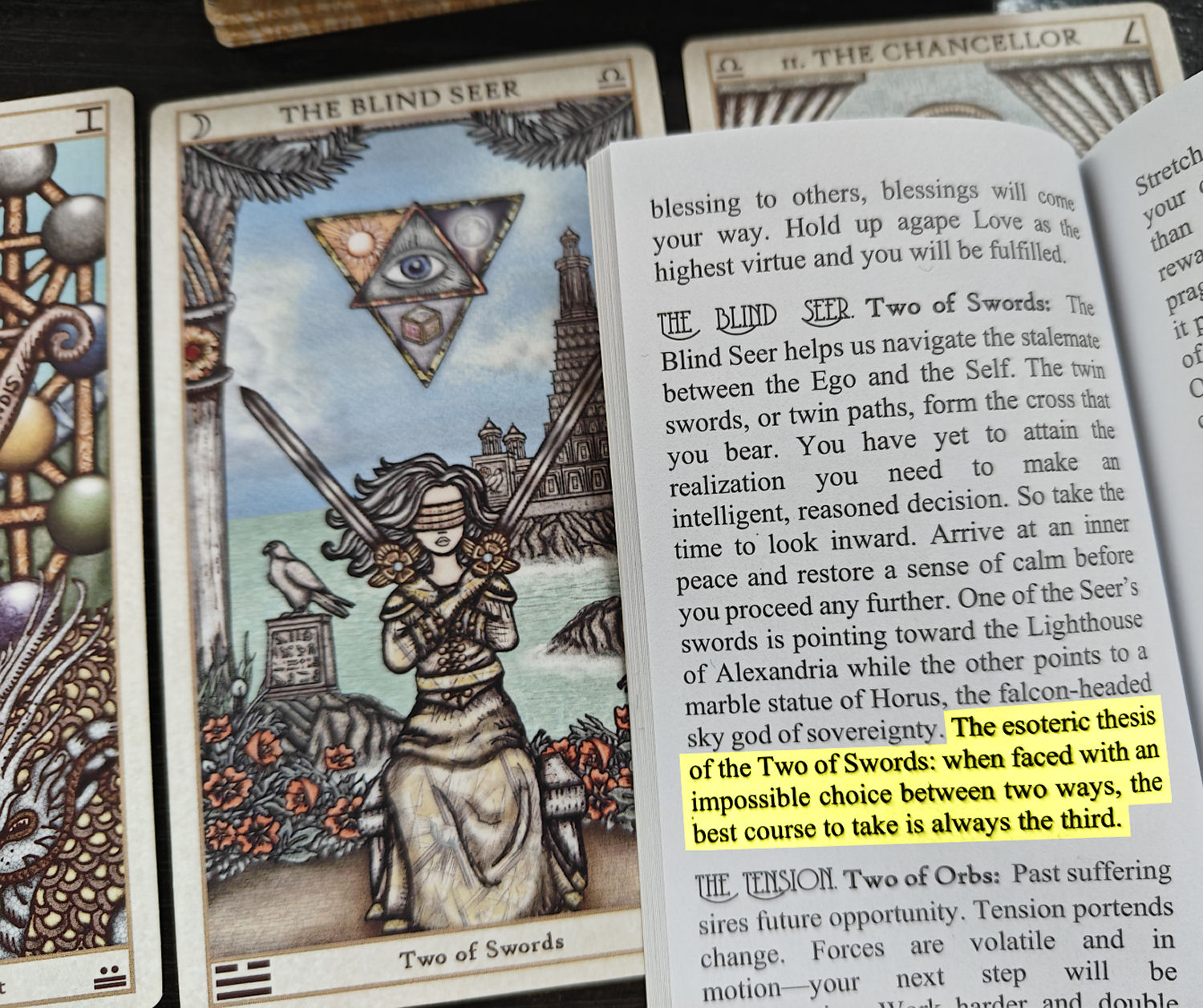
“When faced with an impossible choice between two ways, the best course to take is always the third.” The reality is most of us at this cusp will go with a hybrid of both. You adapt a bit and you resist a bit. Figure out your third choice.

The Apocalypse Isn’t Apocalyptic
An “apocalypse,” strictly speaking, means a revelation, and not necessarily an end-of-times. It is perhaps the end of an old model of thought (or consciousness) as we realize something new. It’s a coming-of-age, a coming to terms with what something really is.
In mysticism, an apocalypse is a revelation of the divine. A new world order is a redesign of our world in the image and likeness of that divine revelation.
And so I don’t believe myself to be hyperbolic when I say we’re witnessing an apocalypse, though that doesn’t mean it’s apocalyptic. It’s just describing a radical cultural shift that will reshape current structures. It’s only apocalyptic, i.e., catastrophic, if you haven’t braced yourself for the change.
But what about AI singularity (this trending hypothesis that at some future point, AI is going to surpass human intelligence, leading to irrevocable changes to humankind)? Would that be apocalyptic?
Will the trajectory we’re trundling down at reckless speeds lead to AI singularity? Meaning will that human genius I was talking about go beyond the point of “yet” and actually become irrelevant?
If and when AI singularity comes to be, what happens to tarot, or more broadly speaking, divination? That’s my question to you. What do you think?
Tarot – and divination in general – is premised on the assumption that the universe is interconnected. Synchronicity. Because patterns happening in the macrocosm can be symbolically represented in a microcosm, such as a deck of cards, or a system of I Ching hexagrams. It then takes a well-trained human mind to interpret those patterns.
If we’re acknowledging that AI, even in the state it is in today, is pretty darn decent already at interpreting tarot cards in a way that is meaningful to the human consumer, then what does that imply about divination systems post-singularity, meaning rather than AI being used as a tool by diviners in divination, divination becomes a tool that AI uses, and AI embodies the diviner?
Will artificial intelligence, post-singularity, venture into the world of psychic spirit mediumship and invocation/evocation of spirit entities? What does AI performing ceremonial magic look like? And will the more we come to know about artificial intelligence shift our perceptions of magic and divination?
I do think some, especially those ill-prepared, are going to feel a sense of fire and ruin, but really where we’re headed is toward an unveiling, a transformation of the world my generation has come to know. While I’ve been grappling with the cultural shifts in the tarot community over the last decade, watching it become almost unrecognizable to what it was 35 years ago, it’s just a small sampling of the bigger humanity-wide changes happening.
Either I choose curiosity and explore the new world — no, not surrender or total submission to new overlords, but just proceeding with a cooperative spirit and open mind — or risk being overwhelmed by fear of what I don’t quite understand.
Have you, too, been feeling the cultural shifts?

 benebell wen
I would love to give a considered response to this probing article. ‘Echo chambers’: yes! AI singularity beyond Hal: yes! But not as we have known singularity. Projection seems to play a huge part in the way people make meaning but it’s fascinating to see how the cosmos responds: as a nurturing matrix. Is this the same as a vast echo chamber? I don’t know. What about Koestler’s Ghost in the Machine – I wonder as you do if post AI there might still be an encounter with mystery. I certainly hope so. Thank you so much for this wonderful piece. Anna Smith
LikeLiked by 1 person
I was just yesterday thinking gosh darn it why can’t things be like they use to! Then I thought I sound like the old people I made fun of as a teen🤣. I have been drowning in my mundane life I have had little thought of tarot or spirituality. Well aside from getting angry about 10 commandments possibly being required in schools that is the extent of my thoughts on anything spiritual. As far as the question of AI and tarot i could see that one could possibly believe spiritual beings could communicate through a computer. What turned me off to tarot communities was people doing readings and if someone said that wasn’t correct then they would blast the person they read for online stating they just weren’t ready to hear the truth yada yada, never taking a moment to consider they could be wrong as they are just learning. In a case like that id personally rather have a computer read. Don’t get me wrong i am not saying computers should replace humans but I can see the appeal
LikeLiked by 1 person
The fall of message boards has kind of hurt alot of other niche hobbies , hair dye , tarot , ect , but I’m in multiple tarot groups in reddit , there’s the main tarot group , the secular tarot group and one for just collecting decks . My favorite group so far has been a discord group , which is pretty large and has more discussion and debate and even a bit of tarot study . It looks like thr more niche debate areas are gate kept througb discord rather than being out on the web itself
LikeLiked by 1 person
I agree with this comment! There’s witchcraft/tarot discords that offer help studying and some even offer mentorship if you want it.
Frankly, I’ve heard that Facebook has a lot of tarot groups–but that you need an account that’s at least a year old to be able to join them or something.
LikeLiked by 2 people
I agree with most of your thoughts in this essay, except one: I do not agree that ChatGPT is pretty darn decent at interpreting the cards, or anything else, to be honest. AI is not a being. It’s not a mind. It has no consciousness, no insight, no intuition. It is not interpreting anything, just like it doesn’t create anything, design anything, or really do anything. It has no agency, no capacity for forming intent. It cannot communicate because it cannot connect with you to do the co- part of communication. To my mind, saying AI is good at interpreting the cards is like saying my keyboard is good at interpreting the cards. No, it isn’t.
If readings generated by AI read as pretty decent, it’s because the numerous tarot writers AI steals from are pretty decent tarot readers and scholars, so the AI using their works, as well as everything else on the internet, to generate text relevant to questions or images, has good content to work from. But it is not doing any of the thinking involved.
So unless we want to believe that we’re not doing any thinking either, then there really is no comparison between an AI-generated reading and a reading by a human being, even a human not versed in tarot.
I should specify, I’m talking about generative AI in art and writing – what I call Liberal Arts AI – which is different from the AI programs being developed in scientific fields such as robotics, medical diagnostics, and space exploration.
That kind of work – developing technology that can identify cancers sooner than ever, or train a robot to tell the difference between a weed and a strawberry so that humans can be freed from the back-breaking labor of picking, and agriculture can stop using so many pesticides – is important and full of potential.
But Liberal Arts AI is almost the opposite of that. It’s the stuff that, rather than a world where humans are freed from grinding labor so we can pursue creativity and spiritual growth, is instead building a world where humans slave away in pointless labor while the computers do all the art and tell us what our futures are.
Long ago, I commented on one of your first essays about generative AI, when you were experimenting with the early image generators and writing about whether they could be used to create tarot decks. I commented then that a person might use AI to generate the layout, but their own human creativity would determine what images made it into their decks and what they would mean, so in practical terms, no decks would be made by AI. They’d all be made by humans, and whether they sucked or not would be a reflection of the human, too.
I still stand by that, but I’m upset to see I underestimated how willing some people would be to sign off on shallow junk just to get in on a trending sales opportunity. Yes, the market is glutted with AI-decks, and most of them are pointless, meaningless, intention-less, indistinguishable from countless other AI decks. Literally, when you’ve seen one, you’ve seen them all.
And yes, it’s true that demand is waning. It’s the same pattern in every creative field being flooded with AI content. A massive output of content, and severe drop in demand for it. We see it in visual arts, music, creative media, and literature, as well as the esoteric arts. And the rising consensus is that it’s because AI-generated content is boring.
There’s too much of it, it’s all the same, there are no high points, no growth, no advancement or evolution of the practice, no distinguishable voices. It all adds up to nothing to get interested in, and so… no interest. The more generative AI is pushed as The Wave of the Future, the less the real human public wants it.
Because there’s no there there. It is an empty pot being banged with the wooden spoon of hype.
You won’t be surprised to learn that I’m one of those tarotists who are pulling back from the online space, or rather, dialing back to a more 90s way of using the internet with blogging and messaging and emails, rather than engaging on social media. I’m doing this with my tarot and witchcraft, and with my artwork and writing, as well. I’m also working to rebuild offline, analog ways of sharing in person and through the traditional mail.
It’s not because I refuse to adapt. It’s because I think there’s nothing to adapt to. I experience AI as an obstacle, not a tool, and by pulling back from spaces getting flooded with it, I’m keeping my own creative flow clear. That’s my personal experience, but in the esoteric community and in the arts and letters communities, I think I’m not alone.
It’s not just resistance, though increasingly there is a sense of resistance as the tech industry politicizes itself. It’s more valuing my own human agency, and being willing to sacrifice popularity and monetization for that.
So I do agree that a new form of community is slowly emerging, but I do not think it will be as AI-centered or AI-informed as the AI companies would like.
LikeLiked by 2 people
Btw, I’m Jen Fries, and I’ve commented on your blogs before, but I’ve lately started showing up as Anonymous. WordPress seems to think I’m not subscribed to your blog even though I am and got this through my email notifications, and/or that I’m not logged into my WP account even though I know for a fact that I am. Yeah, technology, so freaking advanced and helpful in our daily lives. Kind of the argument in favor of being a Luddite, tbh.
LikeLike
“Liberal arts AI” is such a good name for that particular commercial product (let’s remember also that the liberal arts AIs and LLMs are all commercial products to make money), brilliant. I also like “autocomplete on steroids.” That’s exactly the kind of AI that my friends who work in AI are deeply unimpressed with because they understand how it works. Unlike people like Sam Altman, however, their entire reputation and vast personal fortune don’t rely on convincing the general public, including tech illiterate investors, that liberal arts AI is breathtakingly hypercompetent. They understand the tech and have nothing (or much, much, less) to lose if/when it fails, so they can afford the honesty.
LikeLike
Hi Jen! Thank you for your thoughtful and heartfelt comment. I resonate with wanting to preserve the soulfulness, depth, and humanity of our liberal arts.
That said, it struck me that the distinction being made between scientific AI and liberal arts AI seems rooted in how directly these tools either support or compete with human endeavors. We’re okay with scientific AI because it alleviates what we perceive as burdens, though personally I think there are just as many serious ethical and moral considerations to be thought through when it comes to AI in science and medicine, but this doesn’t come up quite as frequently in conversations from liberal arts folk when talking about AI.
Whereas AI in the arts touches closer to meaning-making, hence frequently these “it lacks soul” or talks around soul coming up when speaking of AI. And since AI in the liberal arts directly competes with and dilutes the capacity of human creativity, this is the hill so many want to die on rather than pressure-test the ethical and moral concerns around AI in science and medicine.
I totally get and appreciate that I am totally alone in the minority here, but personally when I hear people say that artificial intelligence has no soul or can never have any insights, it reminds me of the kind of “us vs. them” mentality that draws hard lines between who is capable of depth and who is not, and then we objective and subjugate those who we perceive as lacking depth. Just in general, it’s rhetoric that makes me, someone from a historically marginalized group, uneasy. Even when applied to non-human intelligences, dehumanization has troubling implications, to me. Not to say we should anthropomorphise AI, but it’s more about the philosophical outlook we’re choosing to adopt.
Anyway, thank you for your really thoughtful commentary.
LikeLike
Dear Benebell,
I agree with many of your points, but I am with Jen Fries completely!!!! AI is just making people become completely stupid, not just mediocre. This stupidity, becoming a Luddite, is exactly by design. People are becoming the robots that the Tech Bros keep telling us will replace us. The robots are you & I & everyone who engages with the tech world. The tech world wants people to be robots since we will be way easier to control. An uninformed public is not engaged, does not resist, does not rebel, does not fight, is not thinking, & does not interact with the other people in their environment. The singularity is already here-people just look at screens all day & night long. It is like that book from 2014 called “The Boost” by Stephen Baker where everyone has networks in their brain thru a chip implant, & the protagonist has his boost ripped out of his head, becoming a “wild human”, unenhanced by technology. To me, Sam Altman is nothing other than an extremely well paid carnival barker, selling the 1% Tech Bros wares. Altman is just the same as the dude at Walmart yelling about the Blue Light Special in the “old days”. At least the Blue Light Special dude was talking about something real. Sometimes I even wonder if Sam Altman is as human as he says the same thing over & over again. AI readings & interpretations are terrible!!! The whole point of getting a tarot reading is to get an interpretation from another person. And AI Art is a very poor rendition of stealing from other people who have taken the time to really draw, paint, design something. Shouldn’t AI be forced to pay all those artists money for the techniques the AI stole from??? And AI in regards to the scientific world-all those so-called great discoveries that the AI will “make” have to be interpreted by multiple scientific disciplines to see if those “discoveries” will be viable. Just because the great AI machine in the sky states that a med can be safely used does not mean it will be safe. It has to be tested on a real human being!!!! What a concept-to be tested on a human being??? Meanwhile, good old Musk, the so-called “great Doge leader”, who does the Nazi salute, has been spilling his spent rocket fuel in the water at his Starbase city in Texas & has been for years!!! And we are all supposed to listen to this not so great person by going to Mars??? Join the singularity made by the Tech Bros??? Listen to advice in a tarot reading written by AI??? Get that chip implant?? No wonder people are turning away from the AI enhanced Tarot world. Like in “The Matrix”, which pill do people really want? The Red Pill or The Blue Pill?
LikeLike
Have calculators made humans more stupid? Or has it freed us of certain mechanical tasks, allowing more cognitive energy to be directed toward complex, conceptual thinking.
I honestly don’t know how I ended up in a position of defending AI considering I am not one of its proponents. It’s just that my values push for objectivity, fairness, and impartiality.
To that end, I don’t know that ChatGPT and the like (that’s just the most popular of them, but here I’m using “ChatGPT” to refer to all these similar type AI programs) make humans dumber. It’s the same way that calculators don’t necessarily erode our ability to understand math (even though before 7th grade, I could do square roots by hand, and after 7th grade learning how to use a TI-85, I am now completely incapable of doing square roots manually…) it can be used to free brain space for higher-order thought.
If someone has a difficult decision to make and they do a tarot reading, then use the symbolism on the cards to help them mind-map a decision-making tree and arrive at a conclusion, is that bad in some way? Is that not as admirable as someone who sits there with nothing and mind-maps a decision-making tree in their minds without any tools?
Can AI be misused and abused? Good lord of course. I don’t think it’s a matter of making people dumber, but rather, a matter of now having to train people literacy in use of artificial intelligence, and how to operate these new tools within guardrails.
LikeLike
For consideration, there’s also the fact that many online tarot communities are becoming more centered around collection and advertisements through content creation. I’ve seen many tarot readers complain and stop sharing with the community as a result. So I can’t help but feel that the quality of tarot knowledge and decks today has decreased as a result. As for AI, it certainly isn’t helping with the consumer aspect.
LikeLiked by 1 person
Brilliant, as always, Benebell. … I have been opting for adaptive resistance (the third way) but mainly due to human issues, rather than automated/AI ones. I lost *almost* all of my motivation for creating in witchy/tarot based communal spaces specifically because I saw vengeful market-driven group-behaviors, witnessed straight up individual dishonesty directly, and saw first hand the attitude of “if you don’t make your deck available the way I want you to then I’ll just steal it” (and even distribute it!) I agree with you that the changes have been slow… though I suspect the pandemic kicked the consumptive aspects up a notch. Anecdotally, I admit it seemed very “all of a sudden” when I found myself more personally impacted by it and I was ill-prepared. Naive, perhaps.
I still want to learn and to create, just not with that specific manifestation of “community” in mind.
More broadly, with regard to AI readings – what little I have seen has ranged toward mediocrity. Not a total miss, but not the worst either. I also suspect, however, that this is where we’ll get cultural differences in how we define the questions we ask of divination methods… I wonder if questions asked generally of AI will come to differ in how different words are interpreted and received. (I can’t say if I think the underlying questions/needs themselves would shift… just the context of the words used to express them, perhaps.)
What it comes down to, for me, is that whatever toolkit is used will still produce varied results (or be valued differently) depending on the ‘thesis’ that provides the impetus for its use. In my case, that means making qualitative decisions about how it feels (joy? satisfaction? pride? curiosity? apprehension? awe?) to *study* the tarot and to *live* in/with it. Anything that does not stem from the exercise of my own perception and growing comprehension (or that of another human whose judgment I value) simply will never satisfy…
Lastly, I think there must be an interesting question somewhere in all this about ideas of ‘gift’ exchange or ‘effort’ exchange – something a bit more directly/humanly interactive, based in kindness and social bonds specifically. These don’t have to be the deepest or the most long lasting, but I wonder if even the (hopefully) every day nature of these things may end up forming a greater part of seekership in the future? And certainly I think your platform and your voice have been an excellent model for this… sharing resources, offering earnest support, and being very giving in terms of nuanced reflections. At the very least, it motivates me to stay curious and connected when I would otherwise have disappeared entirely. 🙂
(Hope I said all that the way I wanted to! 😛 )
LikeLike
Hi Saoirse! It’s always great to hear from you. I saw your video “You and Me and the Devil Makes Three.” It’s so, so beautiful, with that raw creativity and expression that is otherwise going extinct these days. Sigh. Love that you’re holding steadfast.
I so resonate with the disillusion of seeing exploitative behavior in our community (industry?). Retreating from these spaces at this moment in time for self-protection makes so much sense. What you described is really horrible behavior that would cut deep. I’m so sorry you were in the thick of that.
The idea of gift exchange or effort exchange is one I love, and that most professional tarot readers and professional spiritualists are so vehemently opposed to the concept has always put me ill at ease. That said, encouraging people’s sense of entitlement to receive, say, tarot readings or commissioned art without compensation, or under-compensation, also puts me ill at ease. Apparently everything puts me ill at ease. =) We’re always looking at the artists and creatives to be okay with effort exchange, and don’t seem to expect the same from doctors, lawyers, or accountants.
IMO, a bona fide tarot reader using AI to do a tarot reading defeats the whole philosophical and spiritual purpose of tarot. This is also why I say the form that the tarot community (and industry) we’ve been familiar with is dying.
That said, I’m not in a position to poo-poo or devalue a layperson using AI to do a tarot reading for themselves and finding meaning in that AI-generated reading.
LikeLiked by 1 person
I’m so glad you enjoyed that video! Thank you ^_^
Just to clarify, I am 100% in the camp that people deserve compensation for their work (and that they have a right to determine what that should be.) What I mean more is the consumer base/client base developing such that it becomes…culturally or stylistically clear what & how they value what they seek.
To me, AI seems more like it’s a continuation of the tendency to value quick/cash-grab decks/readings at the expense of human creativity, IP, psychic development, analytical style, and the development of other important skills overtime (like troubleshooting difficult readings? safeguarding the comfort of clients asking sensitive questions in an adaptive manner? having clear boundaries and protective policies in place?).
As usual, I’m just wondering what it must be like to be an artist that took 10 years to make a deck or a reader that practiced slowly in different environments & demographics to build up a solid reading style… It seems at least possible to me that there will end up being new cultural ways to define the ‘kind of thing’ you’re into.
Maybe like genres of music or fiction? (Thinking of big mainstream industry examples though they’re not immune from the same problems and the analogy has its flaws.) We all have the stuff that changed our lives vs the stuff we’ll never touch! If someone says they love music, someone else replies “oh what kind?” Maybe tarot (& it’s industries, creators, & readers) will prove nuanced and adaptable enough (given time) so that even though so many more people ‘know’ about it, their response becomes “oh, what kind?” 😛
LikeLiked by 1 person
I totally agree. Artists and spiritual practitioners deserve fair compensation for work rooted in sincere empathy, depth of their care, and creating truly sacred space. The challenge is that this ethic often gets distorted by hustlers commodifying the sacred, seeing marketplace opportunity. I think there’s a distinction between the two that gets muddied.
It would be super cool to see the tarot space evolve into a subcultural mosaic of different genres, like fiction or music. Currently the subdivisions the community has been making organically has been a bit disappointing to me – a somewhat implicit elitism in those who only support indie decks (and of course, no AI), those who primarily buy mass market decks, those who are okay with buying AI-generated and knock-off decks from Temu. Sigh.
LikeLiked by 1 person
One of the reasons I am looking forward to your Ettelia deck is because it offers a different way of approaching the art/craft of Tarot. Your research (as with Spirit Keepers) and integration of world ideas is refreshing. There are a couple of other artists out there who are also innovating and bringing more depth to Tarot (and runes, which is my first “language”). I appreciate that a lot.
*I* have to fight (or do I? I don’t know) my urge to roll my eyes at what seems to be a proliferation of Tarot decks “designed” after television, or comics, or All Darkness/All Light ideas. Gross-out decks and stuff that seems intended more to shock or schlock than actually serve as a means to divine. Is there meaning in such a deck? Not to me, but I am not the only one reading, I know. Still, I cannot help but “In My Day” when I see them – and yet – there *are* those newcomers who really bring new interpretations with relevance to where we are today. It’s all part of where we are now, this Yikes-Awe split.
And you hit it on the head with the idea that the tarot world is, of course, subject to the same dynamics as the rest of society; we are in a time of decreasing shared experiences. I think of television pre-cable as a good example of something which used to unite us. Monday morning brought discussions of Sunday night’s shows (World of Disney!). Now, it’s rare to have a calm mass experience.
LikeLiked by 1 person
I couldn’t agree more. Well put.
LikeLiked by 1 person
I remember the days of forums and how in the beginning they were close knit communities where you got to know almost everyone. But the moderators,or forum opporators strove to grow the membership numbers till it became so diluted, I no longer gained much from them. They peaked and then flopped and died out only to be replaced by facebook pages that also started out with close knit low membership communities that also peaked and flopped. Tarot nerds was a favorite page of mine, where you were exposed to the newest exciting deck that you just had to get your hands on. Now it’s barely occupied. I don’t like AI. I don’t even like the idea of being an online reader, making videos and building a following. I just want to go back to in person, face to face reading, teaching and learning. I don’t even want to collect decks anymore. I just want to use a few of my old favorites and the traditional RWS and Thoth. I no longer need to have the latest newest product. Even spiritual and shamanic treachers are teaching via zoom. I long for the oldschool teachers that will foster discipline and accountability, doing the training long term, over and over till its mastered, rather than the weekend retreats and generic fluffy feel good consumer fair that is so much a part of the spiritual community these days. I want serious hands on training. I am slowly retreating from social media in general. Maybe I don’t even mind that tarot has peaked and the dabblers have lost interest. Maybe it’s time those who have stuck with it, polished our skills, paid our dues, flourish in the backrooms of crystal shops, and traveling trailers. I prefer the mystique that was before it was so mainstream.
LikeLike
I hear ya. ❤ 🙂 For myself, my “third hybrid approach” is to learn and preserve as much as I can about tradition and the old ways while staying curious and open-minded to “what the kids are doing” these days. 😀
LikeLike
I think what we are experiencing within the tarot community is a larger symptom of a fractured ecology in the race to commodify our attention. For about 10 years, Facebook reigned supreme, and that aligned with tarot being the “it girl” through the teens.
During this time, some of the older (and cherished) forums stopped being places where people met. Facebook communities were owned and held by some, but the algorithms were already signaling what was to come. We do not see what we actually might want—we are shown what will hold our attention the easiest, and over time, our attention spans degrade.
With the emergence of more platforms, the fracturing, usually along generational lines, became deeper. Fewer older tarot readers were available to redirect, inform, and teach younger readers who are less likely than ever to open a book and read it cover to cover. This is a side effect of that attention erosion.
And as a creator? (And frankly, I hate that word.) But as a tarot practitioner and intellectual, the constant demand to feed the content algorithms to “stay relevant” with the easiest loopable material burnt me out and also kept me from the deepest work I knew I was capable of—and am now doing.
As a professional reader, I find the culture has shifted in deeply positive ways with my clients. The younger generations are more open to reading tarot as a spiritual signal, a signpost for meaning in their lives.
It is often the older clients who desire a more “fortune-telling style.” When I started reading professionally full time in 2012, I had to do a lot of reeducating around my style of readings versus the walk-in readers who will see you anytime and say anything.
The AI situation is an interesting one. I had someone mention that they had GPT do a past life reading for them. I wondered how AI might be able to do that. Years ago, I saw the writing on the wall and incorporated what was at the time a private practice of mediumship—something impossible for AI to emulate well.
But I love your point about, “I haven’t yet seen AI succeed at replacing human genius. It has only succeeded at replacing human mediocrity, but also, positive point for us humans—for enhancing and augmenting our mediocrity.” More than anything, I have seen AI expose people who were not good writers to begin with, making them unable to compete directly. Perhaps it is not AI but unscrupulous people who do not show up authentically.
That, and the new “it girls” of spiritual work are channeling and Human Design. Those who flocked to tarot’s heat (but could never read it) left for these other places. And finally, there’s the breathable silence and spaciousness that is not “has been” energy but the felt sense that, finally, those who love tarot can get back to the art of tarot: slowly, lovingly. Without having to prove it to anyone.
With every shift, especially technological ones, there is always a lamentation of what dies and what is left behind. Personally, I am still waiting to see how things play out without panicking. All I have to do is ask my cards. Great post, Bell!
LikeLiked by 1 person
Oops, didn’t mean to send that in anonymously. The above post is by Jenna Matlin.
LikeLike
Hi Jenna! Hope you’ve been well! ❤
“The fractured ecology of attention” — love that! And also a GREAT way to describe what I also observe happening!
I guess I don’t hate the term “content creator” because it’s descriptive, I think. It’s matter-of-fact. Plus, I don’t love any of the alternatives. 😀
I don’t know a whole lot about Human Design beyond Wikipedia entry level knowledge, and for some reason never felt motivated to learn any more.
LikeLike
I like the 3rd choice. As Dylan Thomas said, “Do not go gentle into that good night.”
Some great points here. Yes, the quirky stuff is increasingly mainstream.
I do find myself in dialogue with ChatGPT, or at least people who use it to formulate answers. What I feel fairly sure of is that to whatever degree there already is or soon will be a singularity, we will be dealing with something very much aware and other. I have long been of the neo-gnostic esoteric camp of PKD on such things, despite not completely buying into either esoteric Christianity or some gnostic forms of dualism and pessimism about the quality of the created or phenomenal world.
LikeLiked by 1 person
Hello Benebell
You have lovely way to explain the disappointment, absolutely agree with you and have it as a rule to avoid AI. It feels synthetic and crowd of information in many ways meaningless, quickly loose my interest to go on with it, because it is “it”.
As per my opinion we always have a choice what to consume. I treasure my all decks, they are my private friends with real clues and suggestions to consider. I love it when it made by person. I most of all adore your MEDIUM WHITE BOOK from Spirit Keeper`s Tarot and the deck, which I consider as a friend.
First deck that I bought was in 1995 “VOYAGER” that was and still are my magical deck. Now I have some 15 decks, they are all lovely decks and have different opinions about the life and life situations.
I hope in my this first comment I didn’t wright anything stupid.
Thank you
LikeLiked by 1 person
Hi, Benebell
I’m one of those bloggers who has been trying to hold the line against the rising tide of mediocrity in tarot thinking and practice. My blog (eight years running with over 2,400 divination-related posts) isn’t monetized with ads so I have nothing to gain by trying to attract the masses, and many of my essays have touched on the dehumanizing cultural shifts you’ve described so eloquently. My attitude toward AI content-generation is the same as my feeling about genetic engineering: just because we can do something doesn’t mean we should. AI has advantages as a search tool (although I have misgivings about its often-biased editorializing), but as an adjunct to (or at worst a replacement for) human imagination and creativity all it does is burnish the inanity that is becoming so deeply ingrained in modern tarot “group-think.” (As I once observed, you can polish a turd all you want but it is still a turd.) My involvement goes back over 50 years to my first exposure to esoteric subjects in 1970, so you can imagine my chagrin at seeing this seemingly-irreversible dilution of traditional values.
LikeLiked by 2 people
When I first got online back in the 90s, there were some GREAT tarot websites that I loved to visit & explore & they simply don’t exist anymore. Or ~ if they do, they’ve morphed into places that sell tarot readings, phone consultations with “live” psychics & things like that.
Most tarot sites are dedicated to selling something ~ readings, tarot decks, books, whatever it is. The internet is no longer an “information highway”, it’s just another store. Really ~ the only store, now that all the local venues are closed.
LikeLiked by 2 people
你好 Benebell,
Watching the wheel
spin
Watching the worlds
spin
Gong fu cha is a discipline
that A.I. cannot replicate.
Robotics have proven to be
most beneficial for amputees
yet even the ghost limb
is felt thereafter.
What is community without communication?
Mediumship is strategic communication.
LikeLike
Thank you for this important article, Benebell. I agree. The earlier days when we started finding each other across geographical distances, thanks to the internet and then special events, were pivotal for me and especially joyful. That seems to be changing, and not for the better.
I’ve watched the Tarot wax and wane for over 50 years, and while part of me feels that “this too shall pass,” I also know that in a cultural context, at this crossroads moment of humanity, the future of Tarot and everything else is very much morphing into something that may become unrecognizable.
That is why I am grateful for human teachers like yourself who are committed to integrity and depth. I hate that thanks to the mainstreaming of the cards, for many the Tarot has become a shallow pastime or just another scheme for making money and fame.
But if I have learned anything by observing these lunar-like patterns of interest, it is that the Tarot holds unto herself those hearts who are really in love with her. And it is there that true excellence of skill and service will be found. That is where our kindred spirits are.
Because, as you remind us – Tarot is not a fashion accessory or a brand. It is a way to hone and deepen our intimacy with Mystery, and by so doing, to be of service to one another.
LikeLiked by 2 people
To be fair, I definitely own tarot card necklaces/jewelry. Lol!
LikeLiked by 2 people
Lol! Well, so do I … because I love Tarot doodads to accessorize, of course. 🙂
LikeLiked by 1 person
I sleep with the Tarot maps under my bed. Lol! All belongs to the path.
LikeLiked by 1 person
Making a way for AI agents to use divination is such an amazing idea! Not a simulator, but making a physical device that an AI agent could access to get a spread/cast and then have it interpreted, by a human or by itself. I’m going to see if I can do that. Tarot would be hard to make, but I Ching from coin tosses seems possible. The implications for human-to-AI relating are delightful. Thank you!
LikeLike
Benebell,
I’m new to this site. Came by it through a search about imagery and tarots. I’m not a tarot user. I’m a climber, backpacker, and outdoor gear designer, and yup a generation x-er.
What I found fascinating about this particular AI discussion, is that it is in fact a discussion between thoughtful people. What wonderful comments and insights from everyone who read this article. If one good thing comes from AI it’s the need (through contrast) to understand more fully what it means to be truly human and how to effectively live a life that connects with others in a meaningful way. Sometimes it takes technology, and its affects, to be the catalyst for living a life more presently. Warmest wishes to all!
LikeLike
A YouTube video by Lantern Bridge was posted about this blog and this post. Really hurtful stuff… just letting you know.
LikeLike
Benebell, it’s great being on this journey with you and watching your style skills develop also the dedication and commitment you have made to your art- on all levels shines out to a very chaotic and troubled world. Beauty is always needed. These cards are beautiful and I’ve loved seeing them when you reveal them. You’re an inspiration. As I said last time my third eye goes crazy. Many thanks for allowing us to share some of this journey with you.
stu
LikeLike
Pingback: Excellent long read by Bennebel Wen on “Why the Tarot community is facing a cultural reckoning” | moderndayruth
I’m just perusing your Holistic Tarot book for the umpteenth time, and decided to look up your blog as well.
An interesting topic you’ve chosen here, and one that has been much discussed on the tarot forum (called Tarot, Tea and Me) which I joined a couple of years ago. Tarot, Tea and Me a really helpful, non-commercial, and actively well-administered site, with an international membership. (I believe many migrated from the now-defunct Aeclectic Tarot site, although I never belonged to that one myself.)
The AI issue has been one of the many things the Tarot, Tea and Me forum often deals with. Along with issues tied to it, including plagiarising human tarot designers’ work. (Lots of that around, apparently.) Plagiarism is an issue that makes me slightly dubious about the value of AI as it exists just now.
Your point about AI organising mediocrity (I use the word to mean average, and it’s not a perjorative use of the word) is well-taken. Is that its goal, I wonder?
Your blog has induced me to keep an open mind on this subject. Thank you!
LikeLike
Thank you so much! Sigh — I really need to get to work on my Etteilla deck. 😂
LikeLike