
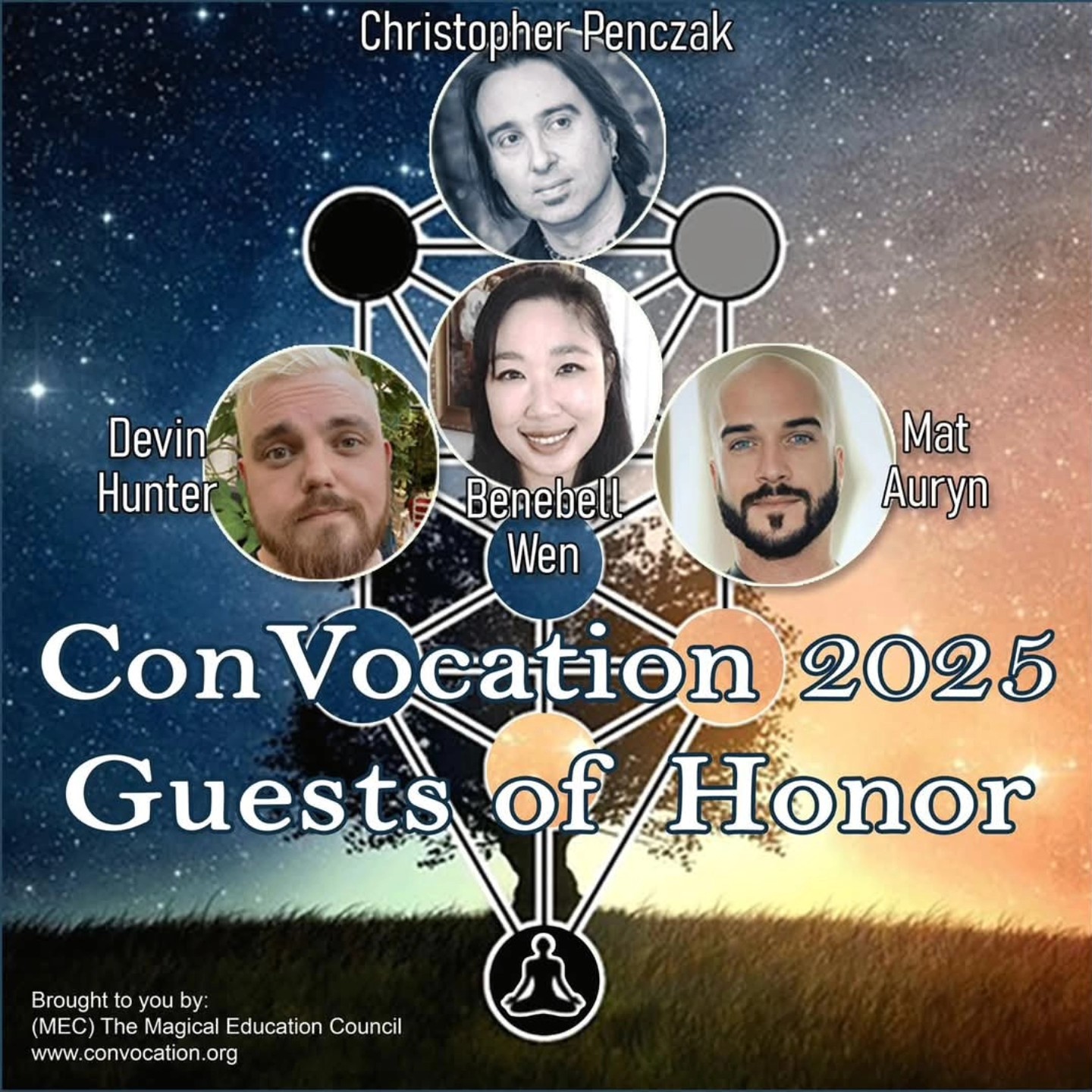
I was invited as a Guest of Honor Headliner to speak at this year’s ConVocation, and this is my recap of the event, as it was also my very first time (1) attending ConVocation and (2) attending a pagan event in the Midwest. ConVocation is a pagan conference that has been going strong in the Upper Midwest since 1995, and truly what sets it apart is how community-oriented it is.
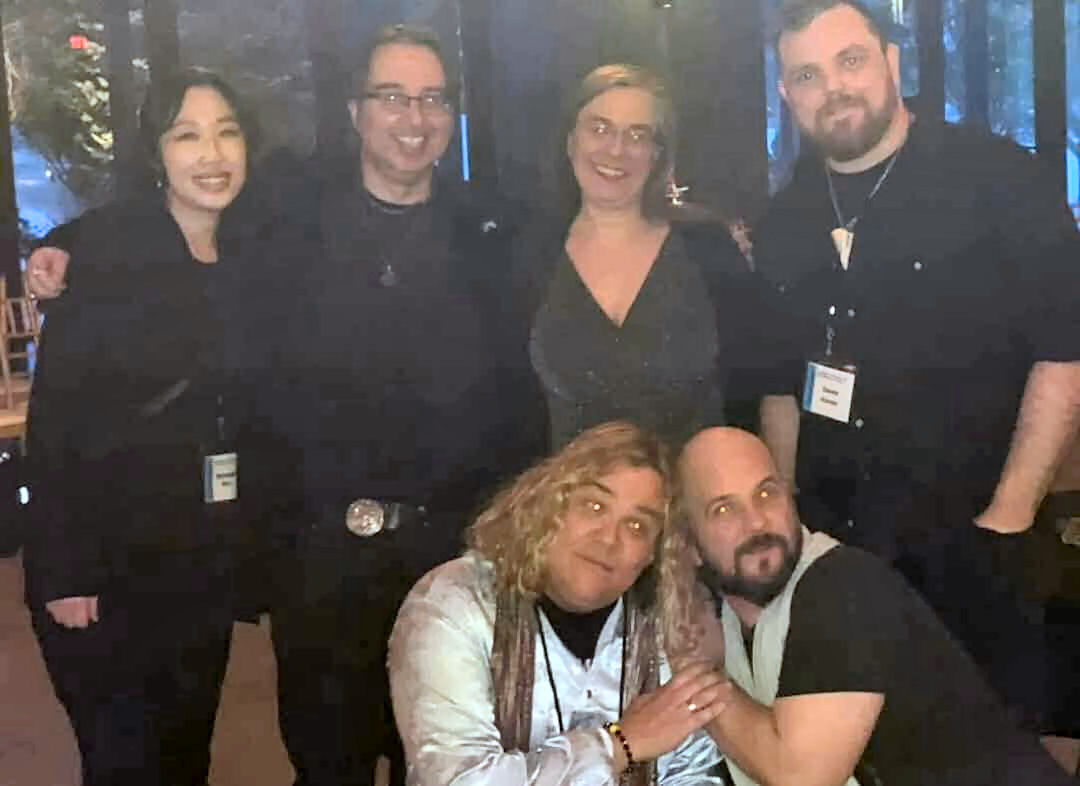
My write-up is coming out a bit later than planned, as I had initially hoped to include some of the official event photos from David Loken-Rozian‘s 2025 ConVocation album onto his Flickr. Since the album isn’t available yet, I’ve decided to go ahead and post this recap, so apologies for lack of people pics. I don’t know why I always forget to take photos of people at events; I have a dozen photos of snow and trees, food, rocks, and clouds, but none of people. Argh.
In the meantime, if you’re interested in a visual highlight of the event, check out his Flickr Photostream later for his amazing photos once they’re up.

Headliners typically present three classes, workshops, or rituals. I went with:
- Shamanism Meets Taoism, tracking the history of how Wu 巫 shamanistic-historical traditions and practices were absorbed into Taoist mysticism,
- An Overview of Occult Influences in the Tarot, covering the esoteric traditions that have shaped the occult practice of tarot– Hermeticism, Kabbalah, Western alchemy, Pythagoras, and Hellenistic astrology, filtered through the lenses of Gnosticism, Rosicrucianism, and Freemasonry, and how these influences converge in modern tarot practice, and
- Soul Retrieval: Theory and Practice, covering the diverse cultural approaches to the concept of soul retrieval, soul fragmentation, and belief in soul dualism across the Sinosphere, and what common core first principles we can extract from a collective analysis of those traditions.
For those who were wondering, the last three password-protected posts are for attendees of the above three classes, to download the supplemental handouts, notes, etc. That’s why they’re not public, and in WordPress, which is what’s hosting this site, the only way I could think of to most efficiently distribute those supplemental handouts to class attendees was via these password-protected posts, and then giving them the password during class.
Theme & Focus
The theme for 2025 was Malkuth, closing out a 10-year commitment to the Tree of Life theme. Malkuth is the bridge between the spiritual and the material realms, where divinity fully expresses itself in tangible form. It’s “Kingdom,” which we might also interpret as community, the importance of being good stewards of our physical resources, and interconnectedness. It’s Shekinhah, the indwelling of divine presence. And it’s spiritual awakening to begin the ascent, the return.
Starting in 2026, the theme is pivoting to Hermeticism. This marks an exciting shift toward deeper explorations of alchemical philosophy, the principle of correspondence, and the interplay between magic and rational thought.

Attendees were asked to bring a rock for the opening ceremony, which the collective would then energize. Afterward, you’d take a rock to bring home. I brought one from the depths of Crater Lake, a sacred site to the Makalaks, or Klamath tribes, where deep waters fill a sleeping volcano. And the rock I’m bringing home is what you see in the above photo on the right. It’s nifty how it seems to have something etched into it reminiscent of how we crown Fu talismans or Taoist sigils (i.e., the San Qing 三清 Three Pure Ones).
Another synchronicity: the hotel room number I was assigned was Room 816, which is one of the rows in the Lo Shu magic square (total sum 15). Two out of three my talks focused on the Lo Shu magic square, and actually all three referenced it, because it’s just that important. =P

Workshops & Speakers
The lineup was impressive. Since this year’s theme was Malkuth, Ivo Dominguez kicked off the event after Opening Ritual with a lecture on expanding our understanding and perception of Malkuth; I also loved Christopher Penczak’s talk on the Sphinx and the Four Princesses: A Vision of Malkuth.
There was a talk on Greek and Roman cursed tablets, one on how gods, ancestors, and spirit guides show up in the psychotherapy process, addressing the crossroads between psychology and animism, folklore of Britain’s Middle Ages, and ranging conversations from Traditional Witchcraft to Modern Witchcraft and Neo-Paganism.

You had academics providing a comparative analysis on witchcraft in the mainstream vs. Mystery seekers and pagans, psychotherapy as healing magic, practical master classes on ritual leadership skills, and a range of workshops and lectures on shamanism and how shamanism looks in various regions of the world. I really loved that they included a workshop on defining diversity in our community, which I attended and found deeply insightful.

If you’re new to ConVocation, it’s annual multi-day convention that brings together practitioners of various spiritual, magical, and esoteric traditions. You can expect a diverse range of classes, workshops, rituals, and lectures, covering esoteric traditions such as Wicca, Druidry, ceremonial magic, Norse paganism, and indigenous spiritual practices, to occult and hermetic studies, such as tarot, astrology, alchemy, Kabbalah, and other systems. There are healing and energy work classes, group rituals, and deity-specific rites, trance work, drumming circles, lecture discussions on folklore and mythology, and modern paganism.
In retrospect I may have miscalibrated my selection of lectures topics for ConVocation. While I greatly enjoyed presenting on indigenous Asian traditions, I found that these topics may have been better suited for audiences in more culturally diverse areas like the San Francisco Bay Area or Los Angeles, where there tends to be greater familiarity and engagement with East Asian spiritual traditions.

Given the demographic and cultural makeup of the ConVocation crowd, a stronger focus on Western esotericism, or tarot–topics with broader recognition and resonance in that setting– might have been a better fit. If I were to present at ConVocation again, I’d likely adjust my approach to ensure that my material aligns more closely with the knowledge base and interests of the audience.
In general, I would have to say that my experience was that, while those in leadership positions are sincere with wanting inclusivity and diversity of cultural representation at the event, the reality was those in attendance did not behave in a way that indicated any interest in inclusivity or diversity. I don’t know that who I am and what I do was necessarily compatible with the event, the majority of attendees, their values, interests, or where they were at in terms of their own spiritual journeys.

Venue & Organization
I am so, so impressed with the level of community organizing that went into putting this event together! ConVocation is organized by the Magical Education Council (MEC) of Michigan, run as a non-profit, by a committee, where every penny earned from the conference goes right back in to funding future conferences.
Through and through you see that it is not for profit, not some pet project by private individuals, and therefore has none of that patina of commercialization that sometimes can be felt at other similarly situated conferences.
The mission is education. The passion is education. Heck, most of the people are educators by trade or in some way working in the field of education. The spirit of the event is education and that purpose is unequivocally felt.

What’s more, it’s not just about education. In fact, they somehow manage to balance the dual values of education and community. This is truly a community event, built on the commitment to foster equity, to celebrate diversity, to make sure all feel included and safe. If you can’t afford food, there is a hospitality suite offering hot food, snacks, and drinks from 10 am to 2 am daily. There were food and clothing drives for attendees to donate to pagans in need.

Speaking of inclusion, for the opening ceremony, we four keynotes were to call the quarters, and I had asked if I could share my tradition, because our approach to the four gates, four guardians is a bit different. There was also the matter of figuring out how we would reconcile what was fundamentally different approaches to elemental and directional correspondences. Everyone was super kind and enthusiastic about finding ways to syncretize different traditions and integrate. It was just a really lovely experience to get to share my tradition, combine it with others’ and witness that cross-cultural exchange happening in real-time in ritual.
Which is to say that the sense of belonging and mutual support was palpable the moment I arrived. It wasn’t an impersonal hotel bus or Uber sent to pick me up, oh no. It was a member of the MEC board who personally came to get me, who already had my hotel room key at the ready, and even food in case I was hungry!
What really stands out about ConVocation is how the organizers prioritize relationships as much as education. The event is not just about learning from speakers, but equally about learning from one another, growing together, and reinforcing the bonds that make spiritual communities thrive. There is a warmth and a generosity that emanates from all quarters of this space.

As for venue, the hotel was fantastic. There were spacious lecture halls, conference rooms, a beautiful glass-encased space for ritual, and cozy meeting rooms. We had a few tech hiccups and I had to deliver one of my seminars in the dark just so the PowerPoint slides could be visible. We didn’t have microphones, so I felt like I had to shout my presentations. The one thing I really appreciate about tarot conferences is, even the audience is smaller, the organizers always have microphones at the ready for presenters.

Personal Takeaways
Attending ConVocation 2025 as a Guest of Honor was an incredible, deeply enriching experience. It provided invaluable insights into the dynamics of the modern pagan and witchcraft communities, and I look forward to seeing how the conference continues to evolve.
What struck me most was the scale of the event compared to what I’m more used to– tarot conferences I’ve headlined. ConVocation had close to 900 attendees, a sprawling schedule of classes, rituals, and meetups, yet it somehow felt more intimate, like one big extended family reunion.
In contrast, tarot conferences tend to be smaller–usually under 200 people– but paradoxically, feel “bigger.” The energy at a tarot event is often more cosmopolitan, and what surprised me, comparing the pagan event to a tarot event, is that tarot conferences draw more diverse crowds. At a tarot conference, you’ll find practitioners from more diverse backgrounds and professions, who are more well-traveled, have seen more of the world, and dare I speculate, even the socioeconomic status differs a bit between the events, or at least that might be the impression you get from observing the two different groups.

On the flip side, the breadth of spiritual traditions and magical practices represented at an event like ConVocation means it’s harder to gauge the baseline knowledge level of the attendees of your class or where people were in their personal studies. So how much rudimentary beginner-level background info do you need to give? How advanced can you go? Whereas at tarot conferences, most attendees already speak the language of tarot fluently, which creates an environment focused on deepening expertise rather than introducing foundational concepts.

ConVocation is a memorable experience, offering both an expansive and cozy space for community, cross-tradition exchange, and learning. What really sets this event apart is its heart. It’s all-around so wholesome, so inclusive and supportive, so family-oriented in every way, and dedicated to education. It’s a true gathering of kindred spirits.
As the event transitions into a new thematic chapter with Hermeticism next year, I look forward to seeing how it continues to evolve, building bridges across traditions, and fostering an ever-expanding tapestry of esoteric thought and practice.
I leave you with a recommendation to listen in on this incredible talk about ConVocation 2025:
Bellamy of the Ask a Witch podcast chats with Meg Raphoon, one of the Magical Education Council board members. The episode covers a lot of ground, from cultivating personal spiritual paths without fear of gatekeeping or needing formal initiation, how pop culture, such as Fullmetal Alchemist, might serve as a gateway into deeper esoteric studies, how to find the right spiritual community for you, the importance of creating safe, welcoming spaces for diverse backgrounds, and, of course, the meat and potatoes of the episode: about ConVocation, its history, themes and evolution, and how it serves as a crucible where spiritual exploration and transformation can take place. They also talk about the MEC board’s active engagement of underrepresented communities and diversity initiatives at ConVocation, controversies around cultural appropriation and closed practices, and the importance of community-building.
 benebell wen
ConVocation is one of my favorite weeks of the year. Learning about other’s paths, and being able to interact with so many like-minded people is always a joyous experience for me. I do hope you’ll be back to present in the future, I really enjoyed learning from you!
LikeLiked by 1 person
Thank you so much for your kind note and feedback! ❤
LikeLiked by 1 person
Reading this is very interesting, thanks for sharing.
I live in Italy, too far from where this event takes place, so I can only read and see the pictures you share, trying to feel the energy generated during the event and it’s already beautiful.
It would be great if one day I can phisically join it, but for now I will try to join it with my interest, reading, studying and cultivating myself also thanks to what you share in this blog.
Thanks again
LikeLike
Reading this is very interesting, thanks for sharing.
I live in Italy, too far from where this event takes place, so I can only read and see the pictures you share, trying to feel the energy generated during the event and it’s already beautiful.
It would be great if one day I can phisically join it, but for now I will try to join it with my interest, reading, studying and cultivating myself also thanks to what you share in this blog.
Thanks again
LikeLike
A practical compromise topic would be: “Wands, swords, ruyi, and plowshares: Are they all the same and interchangeable?”
An obvious wuxing “No” means “No” answer is that some of the tools are made of metal, while others of them are made of wood, so they must be different. A “Yes” answer is peacetime Manjushri melting his sword and using the metal for a scepter instead. What does Lingbao Tianzun have to say about melting plowshares and turning them into swords? Is that ever a good idea from a celestial point of view?
This is a subject where you could bring an interesting different perspective, and still be talking about familiar concepts to mid-westerners: especially the part about plowshares.
Anyways, thanks for getting the landscape picture, very inspiring reminder to go outside as the seasons are changing. Here’s a Haiku for the land:
tree ear’s deafen days
listen for earth matrix revive
pine window snow flats
–Brad
LikeLike
I am so happy you came to ConVocation. And so glad we met. Can not wait to see you again!
Barb
LikeLike
Pingback: 2025 Year in Review and Reflection – benebell wen
As a woman that was born and raised in America, and found out somewhat recently (via AncestryDNA) that I am genetically mostly Western European: I try to be very mindful and very conscious of the spiritual practices of those from more diverse and/or marginalized groups.
My main goal in gaining occult / esoteric knowledge is to enrich my soul. The flip side (equally important goal) is making sure I am not participating in any sort of offensive or culturally appropriative behaviors. Since I am a curious soul, I have found that most people I have encountered with different cultural roots than me do not mind my learning about them. I have also learned that it’s what I do with that knowledge that REALLY matters. Do I make any sort of income, or gain any sort of financial or material benefit from my knowledge? No. That is where I draw my own line. I cannot speak for others, though, whether or not that is too tight or loose a boundary.
I could never live with, or be comfortable with myself if I were making any sort of material gain from cultural practices that were not my own. The line of ‘ok vs not ok’, ‘curiosity vs exploitation’ has always felt very clear to me. With the current political climate, though? I can see how those with my background (and political beliefs) might feel uncomfortable exploring other cultures/backgrounds. If they’re like me and are genuinely curious and respectful as possible, then the line between what is appropriate to know, to practice, and to share may be hard to define.
While it is not the job of any person from a more diverse background, to explain anything to us less knowledgeable folk (outside of said person’s culture), I can imagine how helpful those explanations would be for people such as myself. I can say with confidence that I appreciate diversity and different cultures. I see it as a privilege that I am allowed to know of, and to explore in any depth, the cultures of others. Anyone from other groups that are willing or able to help define the boundaries for me / people like me, of what is appropriate, would receive immense gratitude.
The bare bones of my comment: physically I look, and genetically I am, very much white/caucasian/European/Scottish/English. A fact that I do not give any weight or importance to, personally, but also one that I am mindful of in respect to those who are different and/or are from more diverse ( and/or marginalized) backgrounds. As a person who is also very conscious of the political injustices in our country currently (America) it is sometimes hard to show my support and gratitude. These are conversations that NEED to be had more often, in my opinion. Not only to bridge the gap between allies and others, but hopefully to teach future generations how these gaps can be traversed gracefully and peacefully.
LikeLiked by 1 person
Thank you for sharing these insights and offering thoughts on mindful approaches to learning about other cultural traditions. ❤ We certainly need more people with your philosophy of life and compassion! ❤
LikeLike