
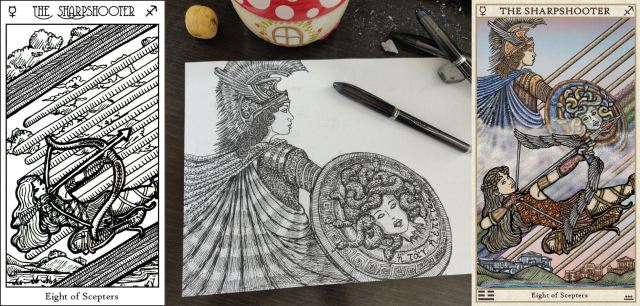

I saw an editor friend’s repost of this Vox article, “Everyone’s a sellout now: So you want to be an artist. Do you have to start a TikTok?” by Rebecca Jennings. It’s about the pressure on authors today to have a preexisting popular platform before publishing a book, or any creative work product for that matter. How well a book sells is determined by how well the author self-promotes. Pertinent to the circles I run in, let’s talk about tarot and witchy books.
Social media influencers have democratized culture, but perhaps have also diluted specialty creative industries. Instead of an experienced, established industry expert who is the gatekeeper of what ought to get published, the consuming public is now collectively the “gatekeeper” determining who The Algorithm will favor. Publishers are yielding to the consumer public opinion, via numbers, on who ought to be published.
Top selling books are not necessarily by the most knowledgeable virtuoso in that field but rather, are by whichever charismatic personality has the most followers on YouTube and TikTok. Therefore, to be a top selling author, you need to cater to that consuming public. It’s not about your resume, curriculum vitae, or credentials; it’s about your personal brand.
Inspired by that article, I thought I’d share my experiences on having to navigate social media, personal branding, and platform building as an author.
Holistic Tarot was picked up for publication right before the whole social media influencer culture took hold, and I am eternally grateful for that lucky timing. I had no “personal brand” or online presence to speak of before Holistic Tarot was published. I had a free version of a WordPress blog that attracted, maybe, tops, ten subscribers. I think one was James, two from my sisters, and a few from miscellaneous cousins.
Three months before Holistic Tarot would hit bookshelves, a publicity editor and I sat down to chat. They suggested — and this was long after signing the book deal, long after the copyediting and layout process — that as a new author, I might want to get a Twitter account. And maybe create a book trailer to post on YouTube.
Today, a debut author’s online follower count can sway whether they get offered a book deal or not. And even after you get the deal, whether your book will sell depends on how adept at social media you are. Forget registering an author Twitter account after signing a contract; you need a minimum of 30K followers to even get the contract.
What’s more, the cultural impact, sense of importance, and your notability hinges almost entirely on how many subscribers you’ve got and the loyalty of your fanbase. Authors and creators who aren’t showing up regularly with new, entertaining, and aesthetically pleasing content risk becoming irrelevant and fading into obscurity.
But there are so many personal consequences to showing up regularly on social media that are emotionally damaging to authors, who at the end of the day, are just imperfect people. With feelings. Shielded by anonymity, trolls will say the most vile things to you and about you. People expect that you make yourself available to them any time, all the time, every time. You’re constantly having to re-assert your personal boundaries. If your content is not generating much engagement, then you feel like you’ve wasted your time. If your content is generating too much engagement, then your anxiety shoots up sky high, because 10% of 1,000 comments is still 100 damaging, hurtful, and upsetting remarks that stick with you for perpetuity. And don’t even get me started on all the behind-the-scenes author/creator politics. People call it drama, but really what it is is politicking — who holds what social capital and power, the alliances and the rivalries between authors/creators that everybody else needs to walk on eggshells around.
There’s another reason why personal branding for an author matters. If you’re not careful and say anything at all “off-brand,” people will assume the worst about you and run with it into misinformation territory. No one will fact-check. No one will investigate further or look to the rest of your content for context. They’ll take that one off-brand touchpoint and make it your whole personality. So then authors who don’t want to be subjected to that kind of stress feel enormous pressure to stay on brand and heavily curate their online presence. And then if you do that, you get accused of being fake or inauthentic. But if you’re real and authentic, then best be sure people on the internet delight in pointing out your flaws. And then you are subjected to a constant blast of people telling you all the things that are wrong with you. Like you had no idea and it wasn’t already at the top of your list of insecurities.
Personal branding, which if done well means you get pigeonholed into one subject matter, can also make it difficult to be human, and by that I mean breaking out of that pigeonhole to pivot and share your passion for a different subject. Regular humans have lots of very, very different and diverse hobbies. You are not a one trick pony with one single interest in life. As an author, you are expected to live and breathe that one subject you wrote your first book about. Kind of like how kids assume their AP Physics teacher lives and breathes high school physics so when they see her downtown without her glasses at the bar shooting back Heinekens it’s weird.
Something I speculate my second book, The Tao of Craft, had to feel the brunt of is how pigeonholed into the tarot niche I was at the time. All my visible online work was centered around the tarot, and none of my personal religious practices, philosophy, or family heritage was part of that visible online work. Negative criticisms of the book were rooted in skepticism of my credentials and the authenticity of the content as descending from an established Taoist lineage.
It took seven years of steady, free labor content production onto the interwebs all about the religious practice of my heritage before the consumer public would acknowledge the pivot, acknowledge that I’m not just about tarot. That is the onerous “personal branding” and independent credentialing work authors need to do to be successful. The patience and hard work paid off, though. My third book, I Ching, The Oracle did fantastically well, exceeding my publisher’s sales forecasts. The tough truth is why it did well compared to my sophomore book: personal branding efforts related to the subject matter of the book.
Switching gears a bit, “Are Modern Witchcraft Books Failing Modern Witches?” — Ivy the Occultist recently presented that question for thought. Lou Valcourt, who I’ve been following on YouTube forever, did a video response, “Are Modern Witchcraft Books Failing Witches? – A VR to Ivy the Occultist.” (Lou, thank you so much for giving my book a shout-out!) The comments I’ll be making herein are responsive to those videos, so hopefully you’ve watched both of them for context.
In short, with so much obsessing over personal branding, everybody and anybody trying to gain a bit of credibility will get a book published, because a published book further legitimizes your personal brand. And anybody who’s good at personal branding can get a book published. So it’s not even that hard.
Yes, it’s not lost on anybody that it’s a vicious chicken or egg cycle. You can’t get a book published unless your personal branding game is strong, but to have a strong personal branding game you’ve probably got to publish a book.
A beginner book is the easiest to write, and easiest to get published. Intermediate and advanced books are difficult to write well. So beginner books it is.
Every social media personality in their respective niche community will inevitably release a beginner book on that niche subject, because that’s what sells. With witchcraft having gone mainstream, that’s going to mean an influx of beginner witchcraft books written for the mainstream.
Lou raised a point I had been pondering, too, but hadn’t quite fleshed out: Back in our day (she and I are around the same age), witchy books were few and far between, and you had to go out and proactively hunt them down. Once you acquired them, you cherished them, studied the chapters repeatedly until the pages were worn and the covers had fallen off.
Whereas currently consumers are flooded with options. If you wanted to, you could buy five beginner witchcraft books every month and still not have acquired everything that’s been published that year. That over-saturation means we don’t cherish each book quite as much as we used to.
And yet the before times weren’t necessarily better than the state of reality in current times. Back in the day, our witchy book options were limited, so only one very specific profile of a witch or occultist could resonate fully with the content of those books. The rest of us felt left out and just made do with what we had. Today, it’s a lot easier to find witchy books by authors we can identify with, and traditions more aligned with what we were intuitively searching for.
Referring back to points raised in the videos, I’m also curious about what exactly we mean when we say “decrease in quality” of modern witchcraft books. Reflecting back on the, say, top 10 notable beginner witchcraft books of 1994 vs. the top 10 notable beginner witchcraft books today in 2024, personally I don’t see a decrease in quality. Most of my witchy books from the 90s that I bought at Barnes & Noble were hot garbage. (That’s harsh. Strike that. Let me rephrase. They weren’t what I was intuitively searching for.) If you ask me, the witchy books you can get right now off a Barnes & Noble bookshelf are way better in terms of substantive content.
Are beginner witchcraft books today just the same old same old re-hash from the beginner witchcraft books of yesterday? Some of it, yes, I think so. But are we not also grateful that a lot of bad information that was peddled in those before times have now been corrected and updated?
Sure, there has been an increase in quantity of witchy books, but that doesn’t mean a decrease in quality, at least not from my vantage point.
In fact, I could be swayed to argue the opposite: there is an increase in quality of beginner witchy books because there is now something for everybody. If you want an academic and scholarly treatment of witchcraft, it’s a lot easier to find that today. If you want witchcraft from a very specific perspective, one that embraces a particular marginalized identity, well there’s a lot more available now than there ever was.
These days there is a witchy book for every aesthetic, which means there are more entry points availed to the uninitiated public. There is no longer just one doorway that everybody’s got to walk through to get into the Craft; there are many different and very different doorways. If over-saturation means that beginners are plagued by indecision over which book of the many options to get, then sure, that’s a conversation to be had.
What I think I’ve observed, though, is the unspoken pressure on authors to crank out books on the regular. There’s the valid fear that if you go too long without a new book release you will become irrelevant and a new author brand will take your place. With personal focus blurred a bit by that pressure to churn something out asap, corners can get cut, the author doesn’t do quite as much research as maybe the topic warrants, and doesn’t cover the topic as comprehensively as the topic deserves (not to mention some publishers impose a word count limit; thankfully I’ve never had one). Maybe they’re not solely writing to market, but subconsciously there is still that social pressure to conform to market trends so that the book can generate healthy sales. It is not at all unreasonable to want a book you’ve written to generate healthy sales. And maybe sometimes when the author’s focus is on that as the end goal, even if they’re of good intentions, they get tempted into writing to market, and oftentimes writing to market means writing to the lowest common denominator. We end up with all these books by otherwise great authors who are writing to that lowest common denominator.
Another great point raised in both videos is that there’s nothing new being added to the latest beginner witchcraft books. If you’re at all into collecting and reading witchy books, then surely you’ve noticed that many of them regurgitate the same info. Same could be said for tarot books. And not too long ago I said something to that effect about tarot decks.
I don’t disagree with the observation that it’s been more of the same. The question I find myself asking is what would we have a witchy author write about instead? In the realm of beginner tarot books, if someone were to write a beginner tarot book today, how would they do it differently from what’s already been published? Or are we implying that tarot authors should stop writing beginner books?
Whether the marketplace saturation of beginner witchy books is serving our community or hurting our community was another issue explored in both Ivy’s and Lou’s videos. I’m reminded of that psychological trick where if you don’t give the consumer any options but one, the consumer is actually happier. But if you give the consumer too many options, then they’re never fully satisfied with their choice and they end up less happy. When there is option overwhelm, we’re inclined to believe none of them are that great. Whereas if there aren’t any other options, we’re more inclined to put the one available book on a pedestal, because it’s that book or bust.
Are the beginner witchcraft books from the 80s and 90s really better in quality than the beginner witchcraft books today? Or are we just nostalgic for what’s old, and are prone to assuming that what’s old is more authoritative?
Now what is a sore is the new flood of AI-generated books and what Ivy dubbed “algorithm books” aka “write to market.” Both problems are ravaging every genre of books at the moment. An example that was given in the referenced videos was an author by the name Mari Silva, who I had not heard of until Ivy’s video. Somehow I had just never come across that name until this discussion. So I had to do a little googling.
Mari Silva has published hundreds of beginner or introductory level books on everything witchy, occult, mystical, spiritual, and/or new age. Everything from Kabbalah, Qigong, Vedic Astrology, Druidry, Vodou, Santeria, and Yoruba to chakras, alchemy, numerology, beginner tarot, Akashic Records, mediumship, a Wheel of the Year book series, zodiac sun signs book series, runes, telepathy, Hermeticism, the pineal gland, reincarnation, twin flames, I mean you name it, this Silva person has self-published a book on it. The listings on Amazon and Goodreads all generate stellar positive ratings and reviews, not to mention it looks like there are aggressive sponsored ads featuring Mari Silva books that come up any time you type in keywords related to any of the above-listed topics.
Are the Mari Silva algorithm books AI-generated or plagiarized or both, as so many have been alleging? Is “Mari Silva” one person or a team of ghost writers? As for quality of Silva’s books, I haven’t read any, so I cannot comment on quality, but I certainly have my presumptions. Interestingly, you cannot preview any of her books, not one page of it, in Google Books. Unless I’m looking in the wrong places? Has anyone been able to preview any of this author’s writings?
Now, what brings this discussion back full circle is why so many in the community find Mari Silva as an author to be suss — because this author does not have an established social media platform. Doh. Back to the article I linked.
It’s like we can be aware enough to critique the plight of requiring authors to be present on social media, but then to ascertain whether a certain author is legit, the first place we go is to check that author’s social media presence. Siiigh.
Not that we’re wrong for doing that. Because it’s true. As a general rule, any writer today who is that authentically prolific is going to be tweeting, or chatting it up on podcasts and engaging with their fellow creatives. Authors in the same genre all know each other by two degrees, so we would know someone who knows said Mari Silva. Does anybody reading this know someone who knows Mari Silva?
Mari Silva’s existence (and I guess popularity among consumers) prompts some follow-up questions to that personal branding article. Silva doesn’t have a strong personal branding game where she’s contributing regular content to social media and engaging with followers. Yet clearly her books are doing fantastic. So what’s that about? I guess investing efforts into personal branding on TikTok is not the end all be all for authors?
I find personal branding pressures imposed on authors to be a double-edged sword. It can potentially level the playing field, where own voices native practitioners can win over the masses and finally get a book deal they might not otherwise get because they didn’t grow up with the privilege of learning how to play the establishment game. And yet for sure, it can pressure the highly-knowledgeable and experienced but woefully introverted writer to feel like they have to get out there and be a circus clown. From the consumer perspective, getting to know an author through their free content can help me to make more informed book purchasing decisions.
When my occult community colleagues note that a certain popular WitchTuber or WitchTokker has come out with a “bad book,” meaning it’s reductive and incomplete, that colleague is also not that influencer’s target market. More often than not, those from that influencer’s target market love that “bad book” and it’s perfect for that particular reader demographic. I speculate that Mari Silva’s books are intended for the lowest common denominator and it is succeeding at that, which is why it generates rave reviews (I’m going with the good faith assumption that the reviews are genuine).
What I speculate is happening is the lack of deep-dive intermediate and advanced books where that occult community colleague would be the target demographic. But is that failing modern witches? That’s a compelling question to ponder.
What sorts of books would be useful to an intermediate or advanced practitioner of the occult anyway? Do they really need an intentionally “intermediate or advanced” book on witchcraft written for that purpose?
Or maybe at that stage of spiritual development it’s more about actually practicing the craft and independently building, in your own unique way, with those tools provided in the beginner books?
At the stage of being intermediate or advanced, you’re fine-tuning personal gnosis and seeking experience. Do you need a book for that? Would a book on somebody else’s unverified personal gnosis not risk leading you astray, because you are tempted to trust that other person’s UPG instead of trusting your own experiences? I guess on some level, my question is why would an advanced occultist even want a step-by-step how-to book?
“Intermediate or advanced” texts would thus be found in the realm of university presses and peer-reviewed academic journals that you reference for targeted cultural or historical learning. And if scholarship isn’t your vibe, that’s totally valid — your path is going to be solitary practice in the woods and learning straight from Spirit, or in traditional group practice, in which case learning how to advance in your craft happens through workings with your group.
What I do believe is happening, which the article and both Ivy and Lou have touched on, is that current personal branding and social networking pressures have resulted in influencer books being amplified over the knowledgeable virtuoso’s books. Being actually the best in your field will not guarantee sales success. It’s personal branding and how well you hack social media algorithms that will determine sales success. Credentialing and noteworthiness is not determined by the quality of your book — your book won’t speak for itself. Credentialing and noteworthiness is determined by how aesthetically pleasing you are online and your follower count.
 benebell wen
I worry a lot about how available society seems to want authors to be and how vulnerable that makes them. I remember when you maybe saw what your favorite author thought about something then they gave an interview or were on a book tour. Now with 24/7 social media the slightest off-base comment gets snapped up and takes on a life of its own.
You’re absolutely right that expertise is no longer as powerful as it should be. It’s like that double-edged sword Wikipedia. When there are enough voices the truth is generally available but in smaller circles it can become a popularity contest.
LikeLike
Speaking of Wikipedia, one thing I’ve found quite alarming about it is a very particular non-native point of view and voice will dominate when it comes to entries relating to non-Western cultures or religious traditions. There are very few own-voices native experts fact-checking those entries.
LikeLiked by 1 person
Wikipedia is a good place to start but my goodness do we ever need to fact check it all. I use it to get me going and find other sources. There are still great sources out there. But Wikipedia is definitely full of people with their own agendas.
LikeLiked by 1 person
You make some really important points that I do not think most new authors are unaware of. Thank you for this 💗
LikeLiked by 1 person
I’m more and more offline these days, and while it’s unquestionably the right decision for me (the internet is trash), I know my publisher won’t be happy about it as far as promotion goes. Burr honestly, I was never a big enough presence on social media for it to make a significant difference to book sales. It’s not like I had a following of tens of thousands, and I’m unconvinced that a couple thousand people on Twitter were *really* boosting my sales all that much. Still, it’s frustrating to come up against the demand for personal branding when all I really want to do is write books and then go live my life.
LikeLiked by 1 person
I do find myself very much enjoying the foxes and deer videos on TikTok though. 😀
You echo a great point from that article — we are demanding of the one group who is most loathe to self-promotional branding and marketing tactics — introverted writers — to constantly show their smiling face on the internet, dress pretty, and perform tricks. It’s insanity.
LikeLiked by 1 person
Pingback: Brief random note: authors and personal branding | Alchemical Thoughts
Well, mark me down as a knowledgeable virtuoso fan then, because I’m old school. Back in the day I drove an hour to buy books that I’m still using. As a creative I’ve learned I don’t do well if I’m so worried about trends and the latest thing. Obviously I have a unique take on what success is. But I’m thrilled with all the choices we have today, too.
LikeLiked by 1 person
Okay, I got carried away. Apologies in advance.
This is a difficult subject to parse. I’ll give it a try, having read your blog article and the Vox article and having watched both Ivy the Occultist’s and Lou Valcourt’s videos.
The way I see it, personal branding and the relative quality of books in a flooded market are separate, independent issues. Both bring potentially serious and not immediately obvious problems.
ISSUE 1: The relative quality of modern witchcraft books and whether there are too many beginner books on the market.
TL;DR: We need to be looking for alternative systems or ways to get around the algorithms or game the algorithms, not trying to please them.
Details:
I agree with Lou Valcourt’s take that it has been ever thus. Any time a topic becomes fashionably popular, it is going to trigger a flood of pandering pablum, to be blunt about it, from people who are eager to profit from the rising trend while it’s hot. This has been true for hundreds, if not even thousands, of years.
I’m an in-my-spare-time history nerd with a particular interest in the daily life of regular people in various cultures and periods, and I can attest that there does not appear to be a single recorded period of history in which there were not complaints about this exact topic coming from academics, experts, social leaders – the kinds of people we call “cultural gatekeepers” today – all expressing annoyance at their fields of interest being overwhelmed by shallow, watered-down, rushed, derivative, plagiarized, and even exploitative, fraudulent, misleading, and dangerous content in answer to a momentary popular trend.
Sometimes the crappy content was honestly produced by well-meaning but less qualified authors who are just as eager as the new consumers. Sometimes it was generic “beginner” content made by qualified authors in order to introduce the lay-public to the topic. Sometimes, it would be just empty junk-content produced by for-hire hacks. And sometimes, it was actually the malicious work of charlatans and con artists.
On the other side, a lot of the complaints were petty gripes motivated solely by jealousy or elitism, but many would be legitimate warnings against poor quality content or potentially harmful content.
This is the consistent historical pattern, and I think it’s pretty much the same now with trend-driven markets for books and other creative works. It’s annoying to an author to have to compete with a lot of white-noise content and titles to get your more specialized or advanced work in front of its audience, and it’s annoying to a reader looking for something less mainstream, less beginner-level, to have to pick through all the popular dross to find the in-depth gold. But it’s not a new problem, and it’s usually not a long-term problem. Popularity trends come and go, while the hardcore of interested readers tends to hold steady.
So I think the flood of popular titles is the less serious problem with the book market issue.
The more serious problem is that the so-called “democratization” of the arts, of witchcraft, of any other topic, in the social media age, is really not democratizing at all. The creative fields are still under the control of gatekeepers, only today voices are being excluded not by the academic gatekeepers of “quality,” but by the corporate gatekeepers of “profitability.”
It used to be that the trend-floods just temporarily drowned out less trendy voices in a topic market, but in the current business environment, algorithms effectively suppress less trendy voices to further amplify what is trendy in the moment, making it that much harder for more advanced books to be found even by direct searches for a given book or author. There’s an algorithmic thumb on the scale that makes the market fundamentally unfair and absolutely not free. It has nothing to do with the demands of audiences or actual interest trends, but rather with the aggressive exploitation and manipulation of capitalism.
Another serious problem is that AI is turbo-charging the production of garbage. This is also not a new issue, either. Every new technology triggers a junk flood as people rush to use the new thing. The invention of paper allowed every opinionated know-it-all in ancient Egypt to rush out scroll editions about their personal philosophies of religion, family life, cooking, or whatever. When the printing press was invented, everyone oohs and ahhs over the Bible that was printed, but there were a lot of Gutenberg crap romances and extremely questionable health guides, too. Thanks to cheap printing methods, the 1920s became a Golden Age of pamphlets on every conceivable topic, some of which were truly wacko. And everyone alive today has been living through the junk floods of the Internet Age.
But AI feels like the first new communications technology that comes out of the package loaded with antisocial intent programmed into the apps. AI makes the pressure from that algorithmic thumb on the scale even heavier.
Finally, a third serious problem is the way online shopping works. Back in Ye Day, I think it was actually much easier to find more advanced, in-depth works on any given topic than it is now, with the world at our fingertips. Before online shopping really started to displace brick-and-mortar shopping, we could go to a bookstore and look through a book extensively to figure out if it was something we wanted or if it was too basic or shallow. Now, we have to make do with whatever little snippets the author or the shopping site chooses to preview, which may not be anywhere near enough to make a decision. I find this really annoying. My reading has, frankly, dropped significantly in recent years, because I don’t like buying a pig in a poke. If I’m not sure a book is what I’m looking for, I’m not going to buy it and face the extra steps of returning it if it’s not for me, or otherwise get rid of it, or be stuck with a book I have no use for.
So when it comes to navigating the flooded book market – and art, music, video, etc., etc., markets – I think authors, artists, creators of all kinds, should take a step back, try not to be reactive to the markets, but take a cold, impersonal look at what’s really happening and what’s really impacting our visibility to the public.
I personally suspect that the floods of popular, if sketchy, titles is far less of a problem than the nuts-and-bolts workings of online business systems, which are the actual things putting up barriers to market access. I feel like it’s a waste of time to worry about what the systems are promoting instead of us because there is no way to win over the systems. They are never going to promote deep, serious work, because deep, serious work does not generate quick profits in the current quarter.
We need to be looking for alternative systems or ways to get around the algorithms or game the algorithms, not trying to please them.
I’ll post my comments on personal branding in another comment. Sorry for the length, but this topic is layered.
LikeLike
Rant Part 2, Issue 2.
ISSUE 2: Personal branding.
TL;DR: I think authors need to base their “branding” on expressing themselves, not selling themselves.
Details:
I think this is a universal problem because, as the Vox article points out, it hits everyone who does anything these days.
And I think the problem is less about the idea of personal brands and more a symptom of some people are trying to make their very narrow specialization have a very broad application, to make themselves relevant way outside their proper lanes.
Specifically, corporate marketing is not relevant to the creative arts. It’s also not relevant to spirituality, philosophy, science, office work, job searches, taking out loans, telling our friends about our vacations, and numerous other things humans do that are not in the plot of “Glengarry Glen Ross.” Period. End of. I’m sorry to the corporate-type marketers out there, but they are not relevant, and they need to back off from telling all of us how to do our non-salesmanship things. An accountant does not need a personal brand.
Now, as to the creative fields, well, honestly, we’ve always been about personal brands. I mean, hello, Lord Byron? Oscar Wilde? Georges Sand? Frida Kahlo? Pablo Picasso? Salvador Dali? Andy Warhol? Aleister Crowley? Alan Moore? Walt Whitman? Miles Davis? It goes on and on. Even cranky, reclusive, antisocial J.D. Salinger’s antisocial, cranky reclusiveness was his personal brand. Shy, retiring surrealist, Joseph Cornell’s personal brand was being a shy Christian Scientist from Queens, NY, who made astonishing fan art about actresses he crushed on. Ernest Hemingway – need I say more?
Everyone who seeks out and collects the work of an author or artist is collecting not just the stories, pictures, music, but the creative person as well – the voice, mind, and style of the person. The creator is what makes the creation unique and desirable. For instance, people will buy Benebel Wen’s book on I Ching not just to have every book ever published about I Ching, but to read what Benebel Wen in particular has to say about I Ching, based on how they respond to Benebel’s style and expertise.
Who the author is matters, because their human identity is how their work comes to be recognized and remembered. It is their brand.
Only, in the creative rackets, they’re properly called “personas,” not “brands,” and they are part of the creative work, not mere tools for selling the work.
Some creatives craft a persona as a work of art, while others just let a persona grow out of being their regular selves, but in all cases, the creator’s persona is the point of human connection between them as the author of a work and their audience as the consumers of the work. The persona is where the sense of relationship starts, and that’s why it’s important that even a crafted persona be authentic to the creator.
But today, in the context of personal branding, we have these salespeople who don’t know the first thing about the creative arts or academic fields, telling us what kind of personal brand we must have if we want any hope of a career. They tell us how to build our brands, and how to use them, and precisely what they must be to appeal to the biggest audience and what they can never be to avoid alienating key consumers, etc., etc. None of it is at all relevant to what we are doing.
That’s why personal branding, as it is taught to us by the marketing gurus of the sales-oriented world of online commerce, is so stressful and counterproductive. It’s the wrong tool based on the wrong business model.
Like I said above, a creative’s persona/brand must be their own organic, authentic, human self-expression.
Well, I can’t think of anything less organic, less authentic, and less human than the minutely engineered and aggressively managed personal brands encouraged by social media and the internet world. That might work for selling sneakers. It certainly works for getting clicks. But we are human beings, not sneakers and not buttons. We are not for clicking, and we are not for sale.
The key to our success is not to shove our logos in people’s faces every 10 seconds and get them to smash the like button every 5 seconds like Pavlov training his dogs when to drool. We succeed by connecting and communicating human to human, which we do by being human, not a brand.
So I think authors need to base their “branding” on expressing themselves, not selling themselves. That’s the real challenge to being a creative professional, in my opinion – not to conform to what some marketing expert tells us to be, but to have the nerve, the gall, to be ourselves and let the people who are cool with that buy our stuff.
LikeLike
Yes! For sure it’s amusing how *every* era thinks their present posse is full of grifters and charlatans, that society is on decline into corruption, and we need to restore things back to the good old days when everybody was noble, refined, and wise! =D That was totally Confucius’s attitude toward his own era!
I would say online shopping and the digitalizing of books has changed how we access books, but I don’t know if it was better back in the day with brick-and-mortar? Even the simple example of how many tarot deck options we would have had at our local metaphysical shop vs. getting to buy them online. Same when it comes to obscure books.
Yes to cultivating a creative’s persona instead of approaching it as personal branding via corporate marketing tactics! I love that re-framing!
LikeLike
In re accessibility and availability of books, decks, and other metaphysical resources, that probably was dependent on a given person’s location, so I would couch that as my personal experience only. But what I was trying to say was that being able to peruse a book before buying made it much easier to find more advanced or deep information. Both of the videos you referenced talked about the prevalence of beginner books on the market right now, and I was just mentioning that the restrictions many sites put on content previews make it hard to find the more advanced books people may be looking for among all the beginner titles.
LikeLiked by 1 person
Pingback: Social Media Witchcraft: Grifters, Aesthetics, Consumerism, Gatekeeping – benebell wen
Mari Silver books are frequently in the Amazon “best seller” lists. My personal belief is this is for two reasons, neither to do with content or social media following. They are cheap as an e-book and they are available to read for “free” with a Kindle Unlimited subscription.
LikeLiked by 1 person
Pingback: Are Personal Branding Pressures on Authors Resulting in Bad Books? – WORLD_EXPLORER
Social media has been on a journey to kill art for so long. When the trends first began, I thought the digital reach would finally help artists get the platforms they deserve, but what happened was completely the opposite. Art got replaced by quick gimmicks. It’s sad.
LikeLike
Pingback: Monetizing Mysticism (Here We Go Again?) – benebell wen