
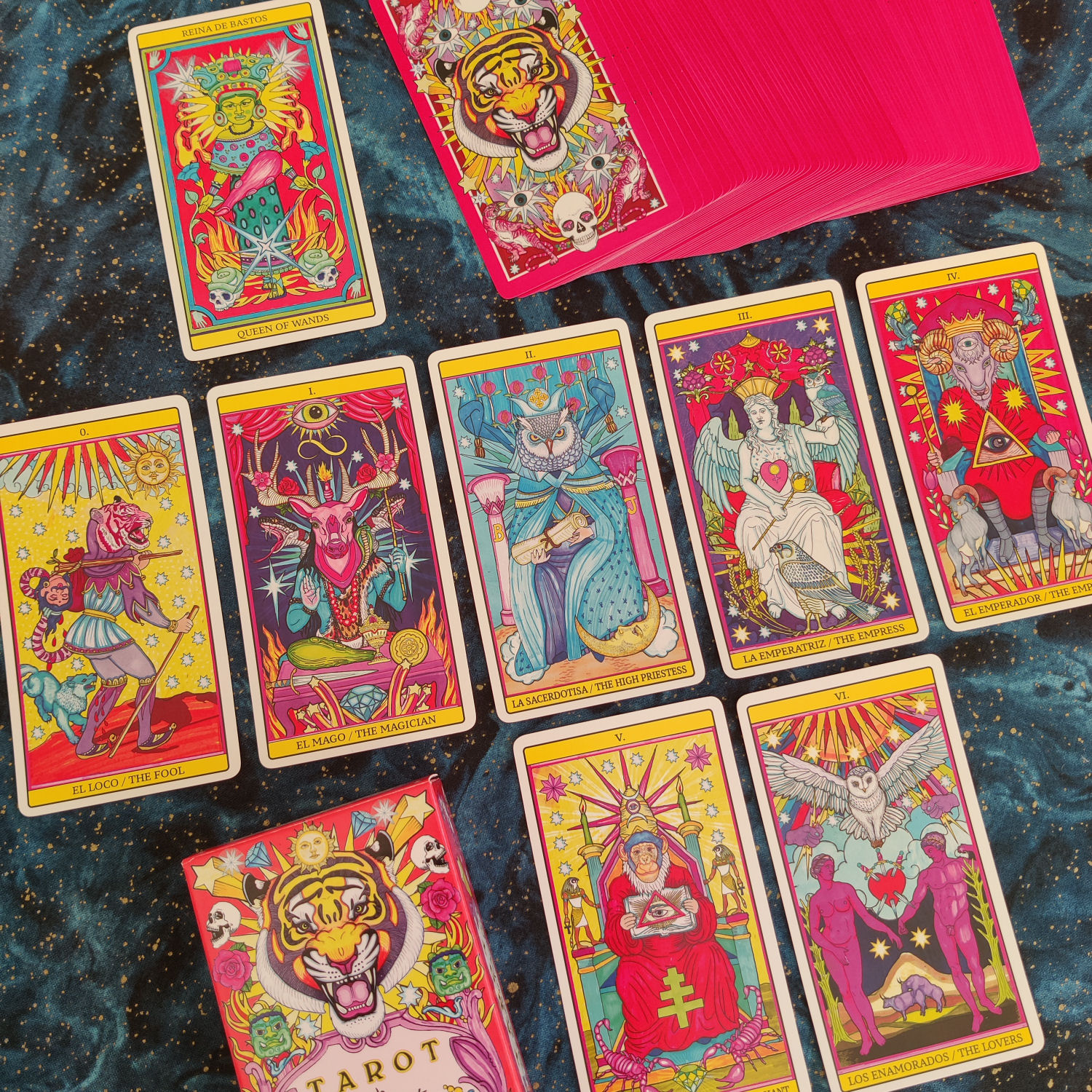
Javier Navarro‘s Tarot de El Dios de los Tres (Tarot of the God of Three) first came out in 2021 and I’ve had my eye on it since. There’s something about it that immediately sets it apart from most tarot decks I’ve come across on the market. It feels counterculture, cheeky, and yet not without depth and substance of thought.
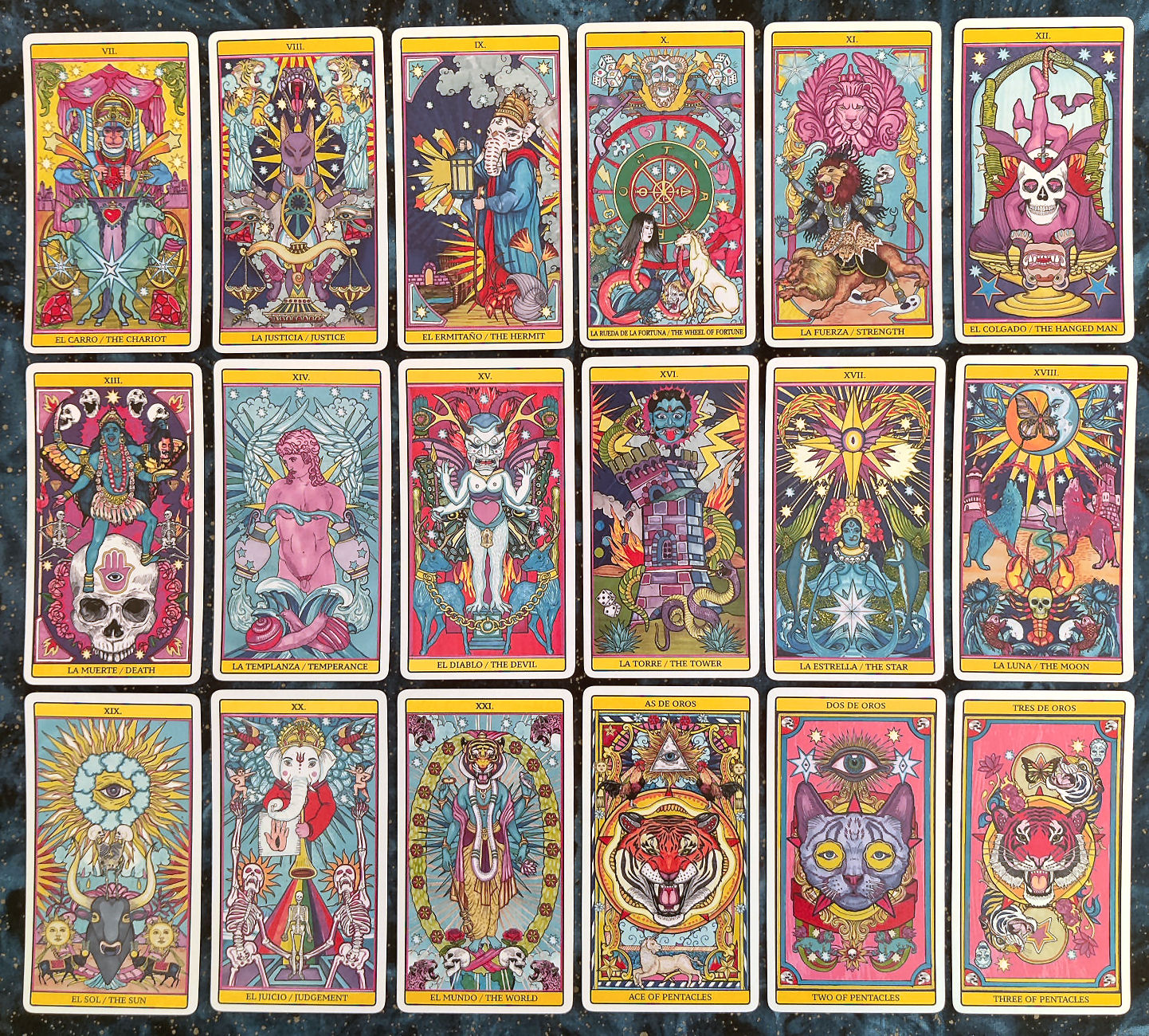
Navarro is an Andalusian born artist and illustrator who blends sacred imagery from world religions and pop iconography to design a universe that is energetic, joyful, and liberating.

This isn’t a deck review, just a walk-through, as I have not done readings with these cards. For me personally, this is a collector’s deck. It’s a deck I’ve acquired for the artwork, to get to hold a gallery of beautiful illustrations in my hands.
The deck art is a fusion of Greco-Roman Hellenistic iconography, Japanese woodblock printing inspirations, rendered in an innovative style that is distinct and engaging. Oh, and oops forgot the nudity warning. There’s nudity and/or suggestive depictions, though I found it quite tastefully done.
Tarot de El Dios de los Tres is marketed as an RWS-based deck, though the compositions in the Minor Arcana suits seem more ornamental and decorative than driven by RWS symbolism. That actually works out in the deck’s favor, though. I really love every one of Navarro’s illustrations here and would not have wanted to see it forced into an RWS template.
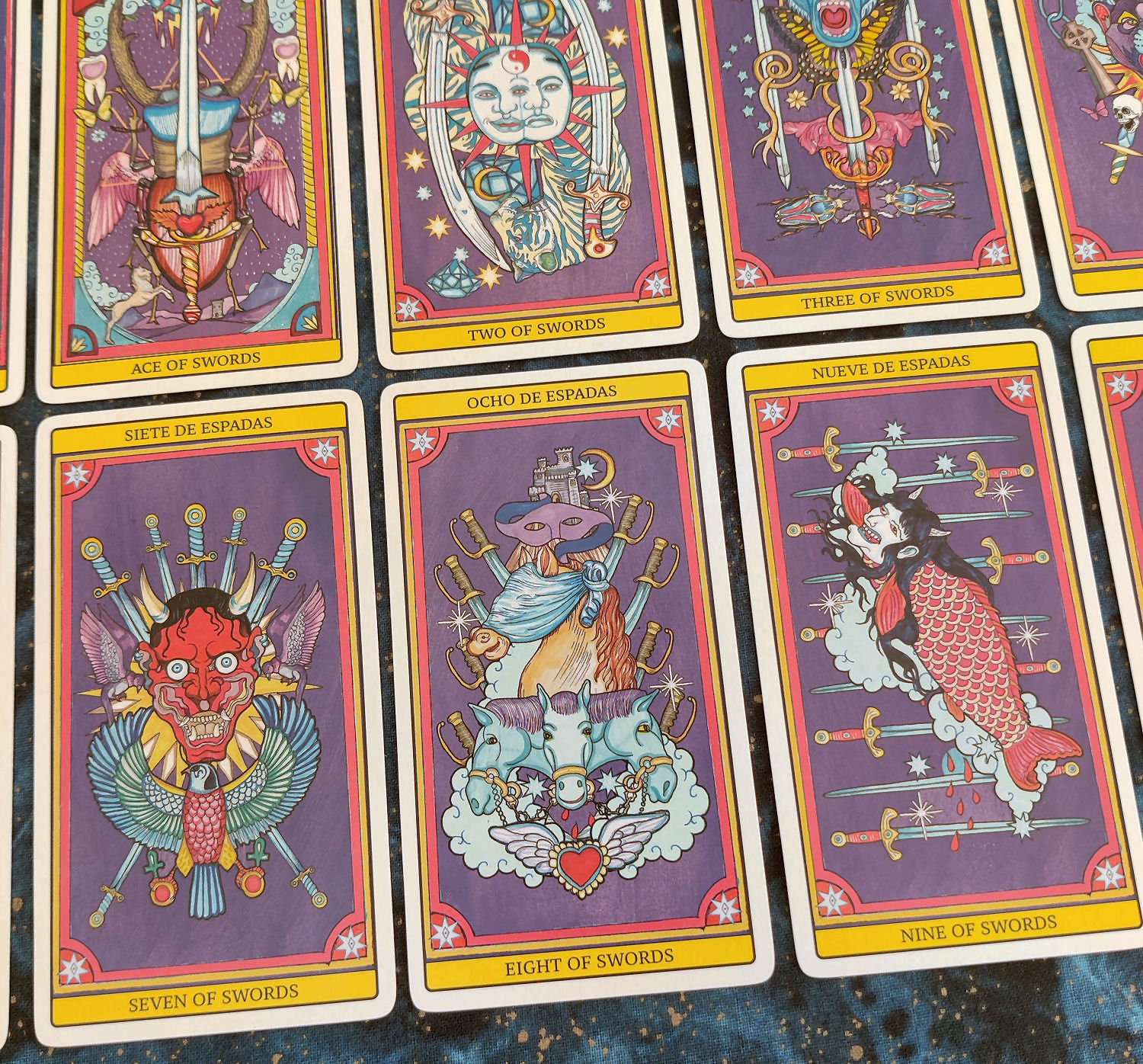
While making my way through each work of art, I heard music in the style of Igor Stravinsky playing in my inner ear. And on that note, there’s something to this deck taken as a whole that’s vibrating somewhere between a frequency of 554.37 and 659.25 Hz. That’s C sharp 5 (C#5) and E (E5) on the keyboard.
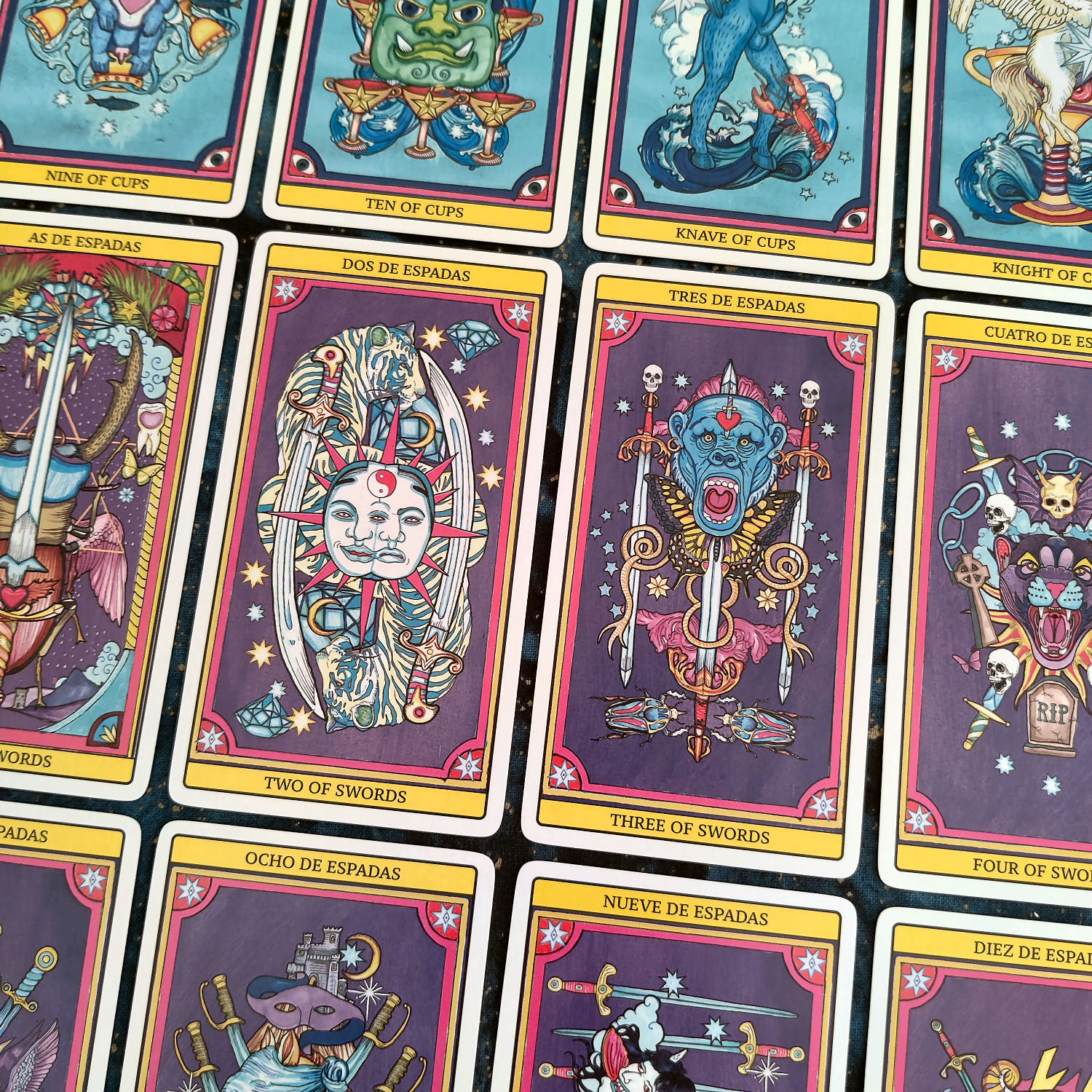
Like Stravinsky, there’s a folk style that’s a pop art play on the neoclassical period, with an upbeat rhythm a la Rite of Spring. It’s complex. It utilizes multiple compositional styles. It’s interesting on every count.

I love the fusion elements of Sanātana Dharma (Hindu) and Shinto traditions. I’m not always a fan of animal heads on human bodies in contemporary illustrations but I am unequivocally and wholeheartedly a fan of it here!
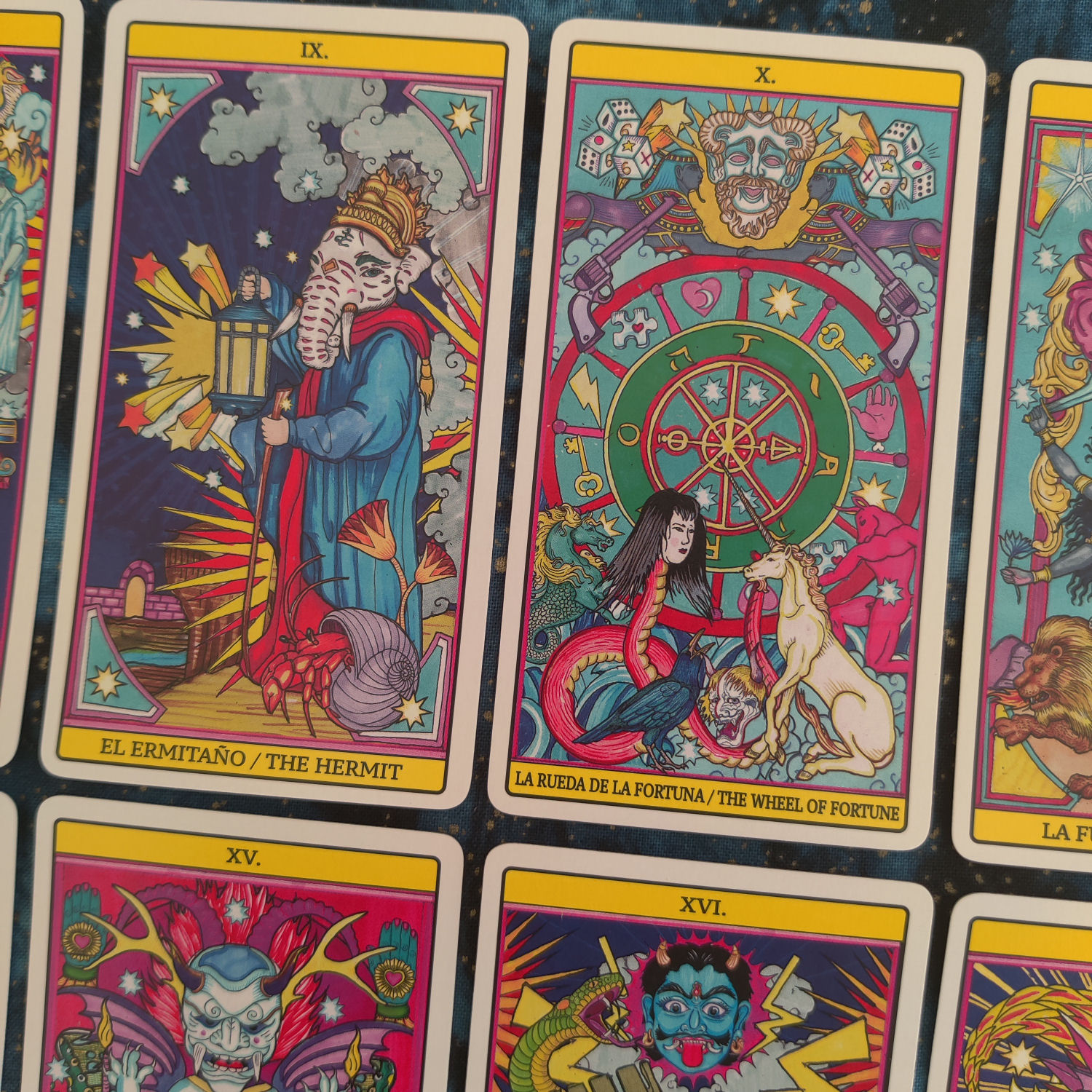
The yaoguai 妖怪 in place of the demon figure in the Wheel of Fortune card plus the unicorn in place of… maybe the sphinx? Plus the pink Anubis-like figure altogether plays off the classical Wheel of Fortune symbolism. Not to mention the hermit crab cameo on The Hermit card.

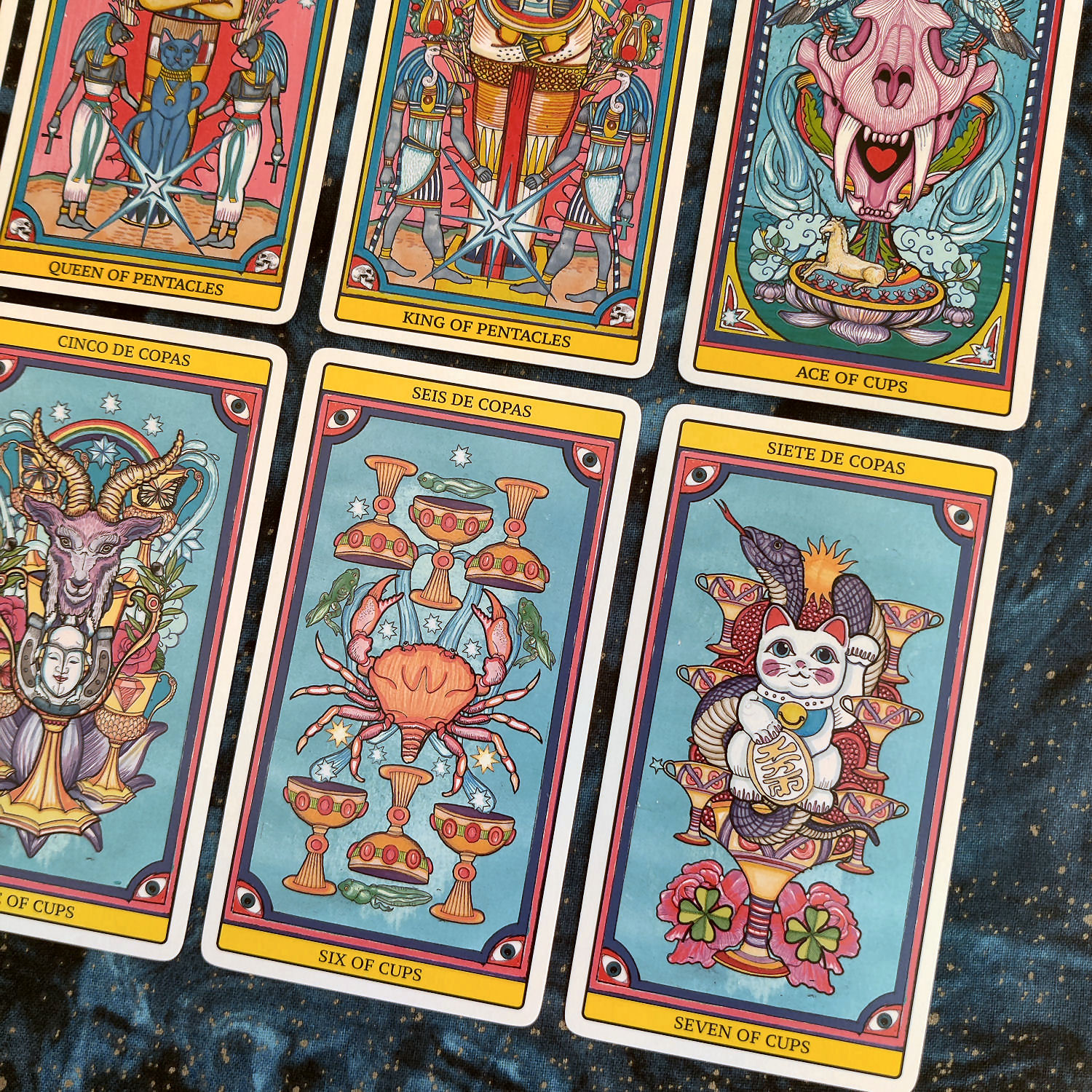
I think that’s Thoth on the Knave of Pentacles, unsure about the main figure in the Queen of Pentacles though the companion figures appear to be Bast, and the King of Pentacles reminds me of the Mask of Tutankhamun. Also, in both instances of the Queen and King of Pentacles, the illustrations appear to be of gold sarcophaguses (what’s the plural of sarcophagus? sarcophagi?) and not intended to be depictions of light-skinned humans.

Here’s a close-up of the Knave of Pentacles and check out that moth on the Ten of Pentacles. The skill with which these illustrations are rendered is phenomenal.

You can’t deny that Navarro is a pretty badass illustrator. His linework is dynamic. Every one of these cards is a starburst of iconography that we feel intuitively connected to through that collective unconscious, transcending culture.
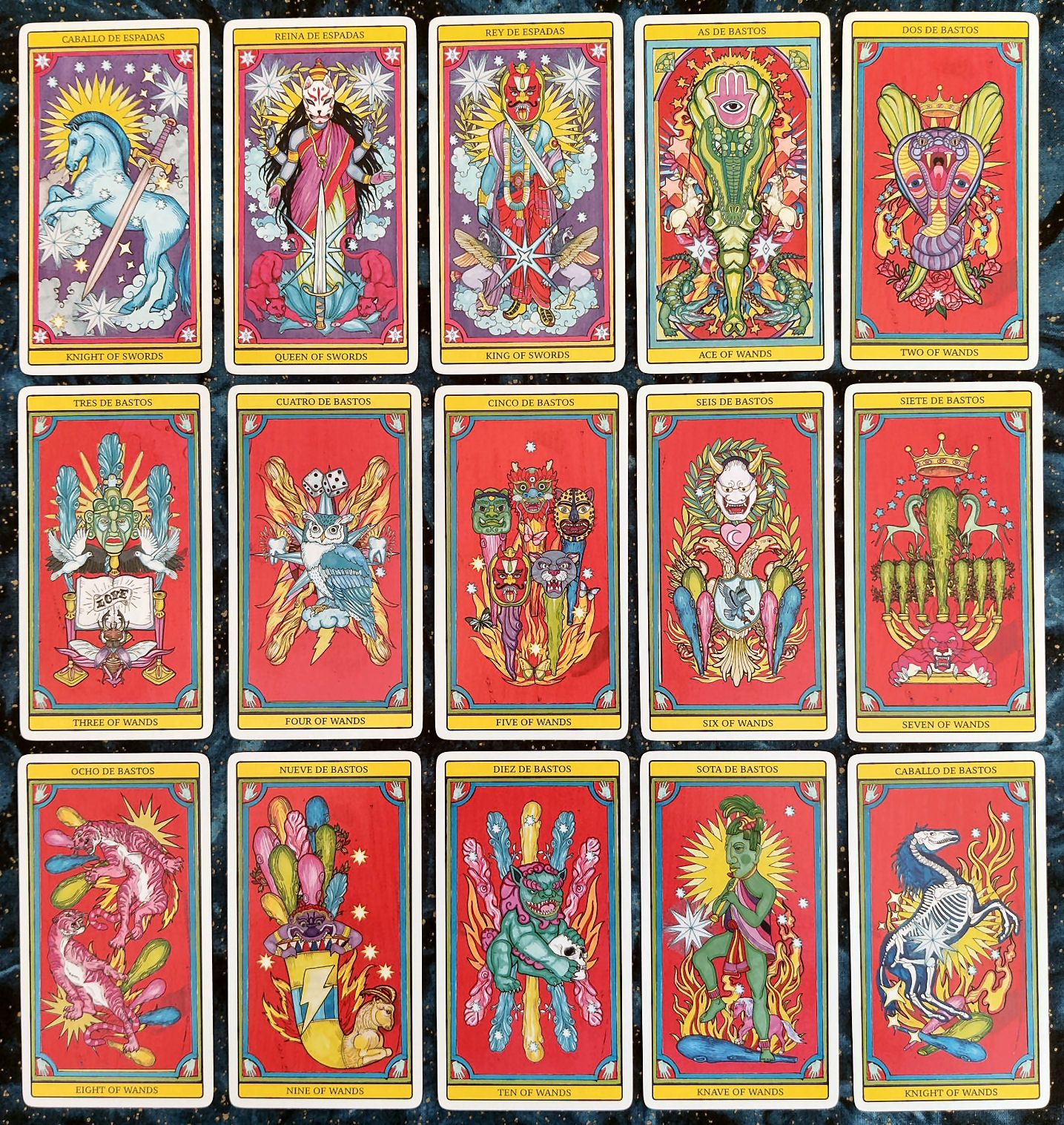
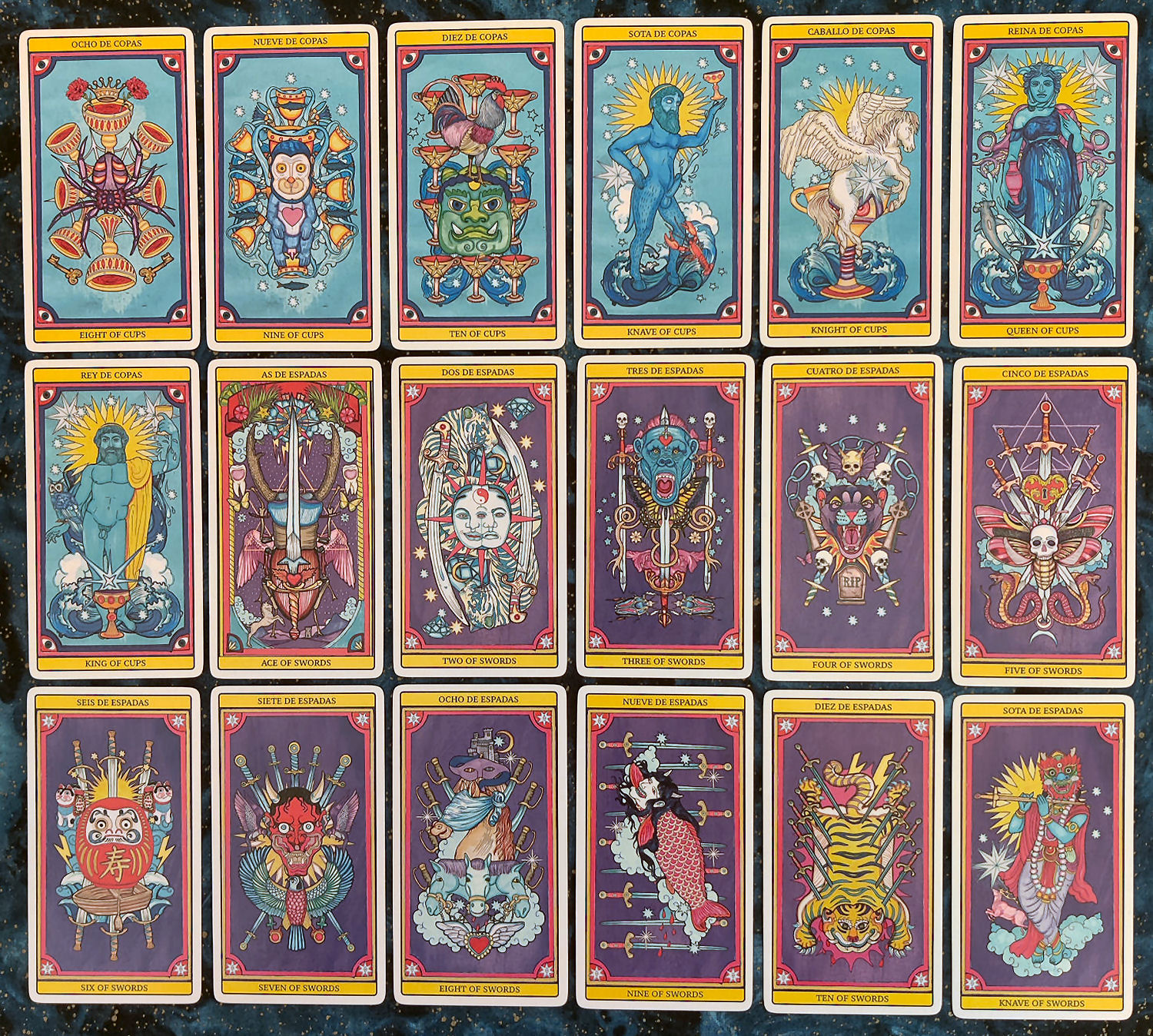
You do see color-coding in the Minor suits, i.e., a bubblegum pink background for the Pentacles, blue for Cups, purple for Swords, and red for Wands.

Loving the mythical connection between water (suit of Cups) and Pegasus here in the Knight of Cups. Earlier the Knight of Wands showed a horse’s skeleton, the horse in flames; the Knight of Pentacles was a unicorn in high gallop; and the Knight of Swords featured a very handsome, elegant bluish horse.

That kitsune-masked maybe-Vishnu maybe-Kali on a blue lotus wearing a Thai makuta headdress guarded by twin panthers with Star card vibes for the Queen of Swords is everything!
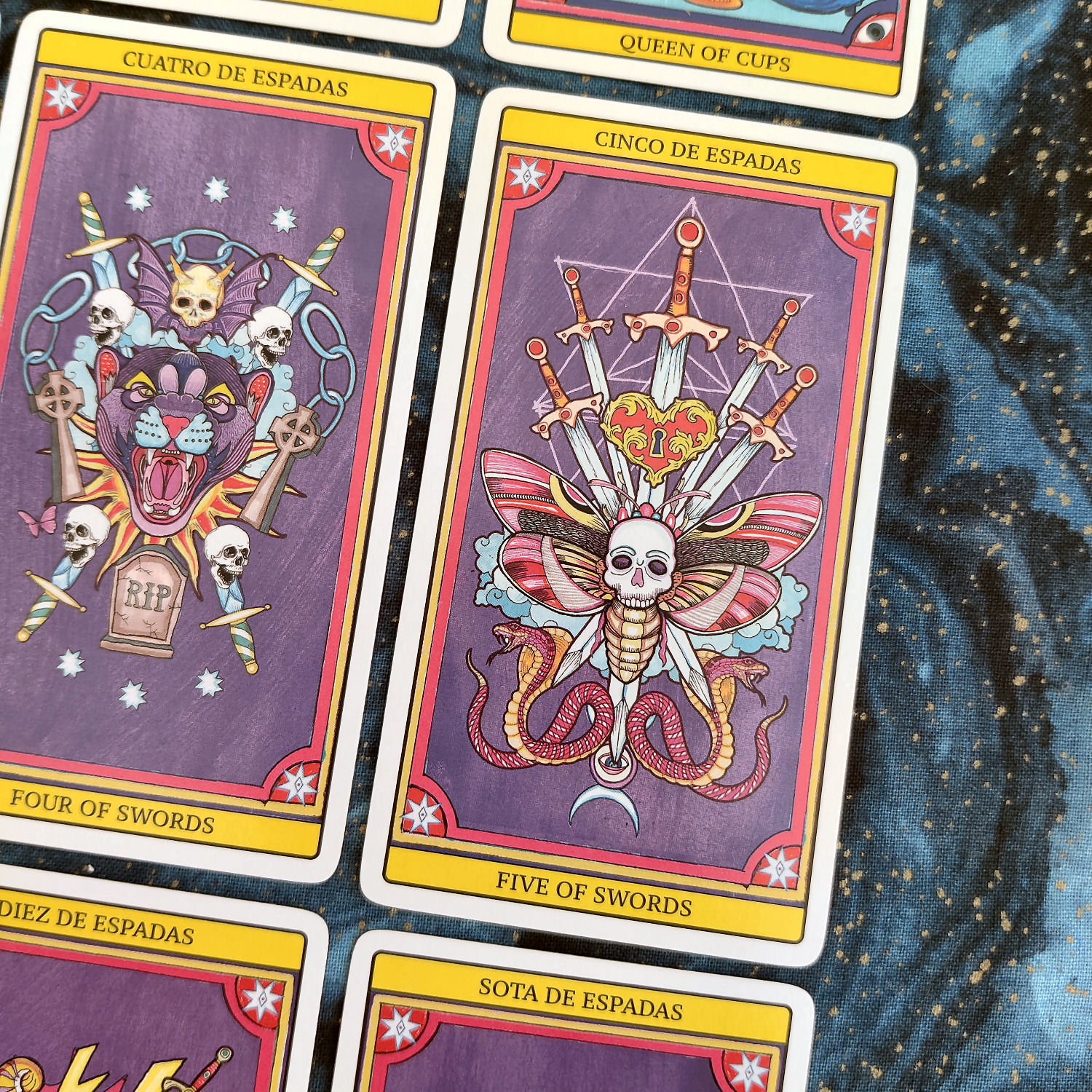
I had really hoped the little white book that came with the deck would have some deck-specific insight into Navarro’s work or the artist himself, but sadly it’s a generic LWB with canned card meanings, nothing at all related to the card illustrations themselves. It even unironically includes pithy instructions to the Celtic Cross spread.
Humorous new add to the standard LWB I haven’t seen before: “It is advisable to work with two Tarot decks: one for meditation purposes, which should be used only by its owner to avoid extraneous vibrations, and the other for fortune telling.” Oh what fun advice! =)

In case I didn’t mention it earlier, there are also strong influences from South American myths and traditions, such as Aztec animal symbolism.
The above photo also shows the card back design, which is non-reversible. That power-invoking tiger head gives off the impression of a carnival deck. You walk past a carousel, music and lights casting an atmosphere of fun, the smell of deep-fried fair food in the air, and you enter a multi-colored tent to be greeted by a fortune-teller who fans out this deck across a reading table.
In terms of production value, it comes in a tuck box with cardstock that was fairly standard in the 90s and early 2000s, but is on the thin side by today’s production standards. I wish the publisher had invested more marketing and PR resources into Navarro’s deck to amp up the hype. I didn’t see it featured much across tarot social media and that’s a shame, because with a bit more exposure, this would have been a hugely popular deck.
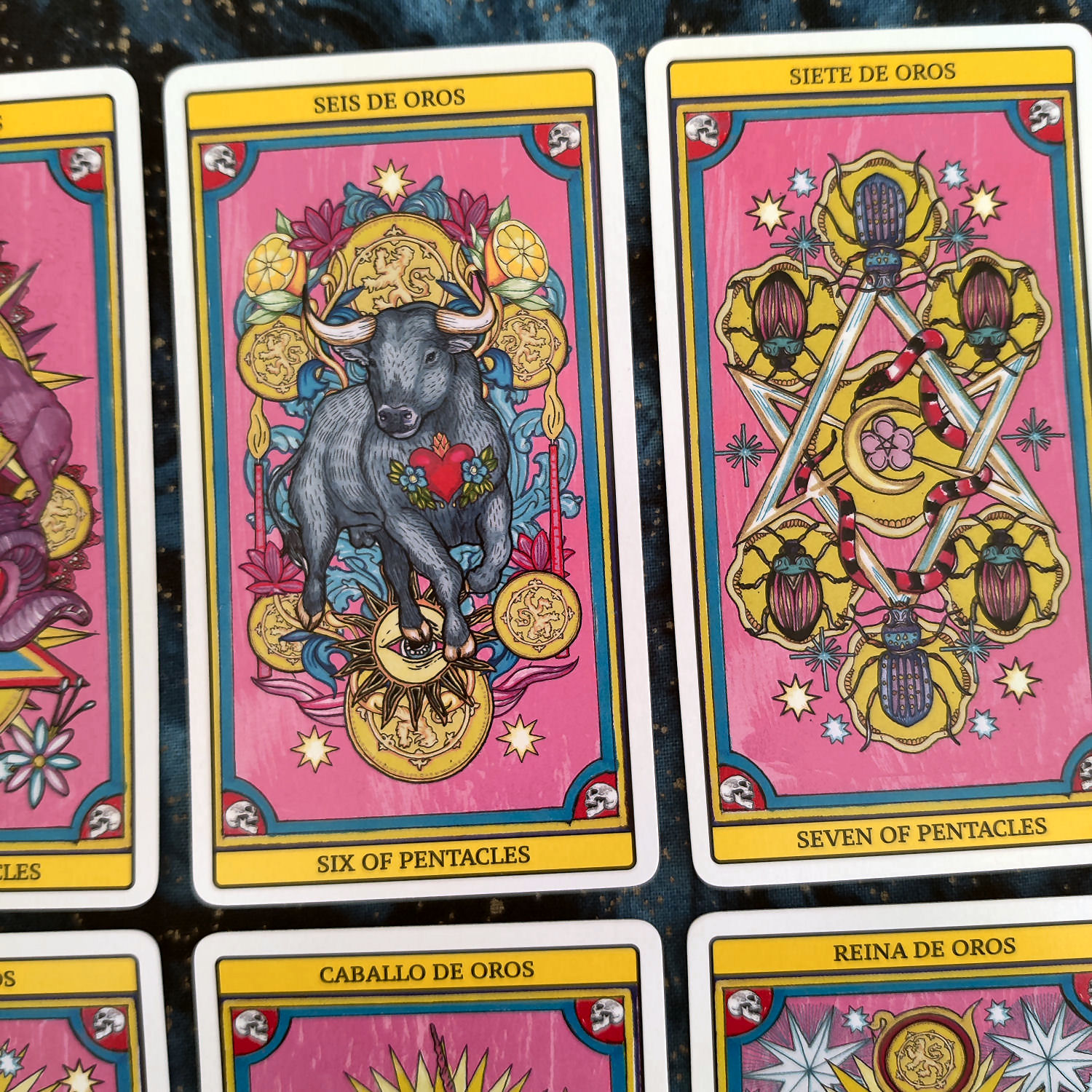
The Tarot de El Dios de los Tres is a thrill of a deck. It’s multicultural. It’s a symphony for the senses, complex with an effortless command of precision. And the artwork on every card is simply extraordinary.
There have been some discussions on whether these illustrations would be considered cultural appropriation. Comfort levels will vary, for sure. As I see it, Navarro is pushing the envelope, but also, isn’t that what progressive artists do? It wasn’t my takeaway that the artist was trying to present these depictions as culturally orthodox or authentic to heritage and tradition; in fact, the irreverent tongue-in-cheek mish-mashing would suggest an artist fully self-aware of intentionally pushing the envelope to come up against people’s comfort levels. So to that end, Tarot de El Dios de los Tres is about presenting an integrated and pluralistic world view. Navarro isn’t trying to imitate established cultural traditions; he’s undertaking new art piecemealed from old that is avant-garde. Foreseeably, that is going to provoke. Some will be excited by what they see, others will be offended by it. Either way, it’s art.

FTC Disclosure: In accordance with Title 16 of the U.S. Code of Federal Regulations Part 255, “Guides Concerning Use of Endorsements and Testimonials in Advertising,” I received the deck from the publisher for prospective review. Everything I’ve said here is sincere and accurately reflects my opinion of the deck.
 benebell wen
Pingback: 哈維爾·納瓦羅 (Javier Navarro) 的 El Dios de los Tres Tarot(三塔羅之神) – benebell wen - FanFare Holistic Blog
I love decks that are multicultural and really weave in a blend of cultures from around the world… this is a wonderful take on that. The only other deck that gives me a mix of cultures in a deck is Tarot of the Devine. This one, in particular, exudes playfulness without losing face on the cards inherent meanings/depictions. Question is… is it still in print? And can we get more artists to fuse various cultural myths and representations into one deck?
LikeLike
Nice one! It really stands apart from other decks. Honestly, I wouldn’t consider it a RWS deck, as well. In terms of striking, vibrant colors it rather feels like Thoth, but actually it doesn’t fit there either. It does its own thing. And that is pretty much great.
LikeLike
STUNNING! I’ve never seen it at all. The colouring is very reminiscent of the Tarot del Fuego but that’s where the similarities seem to end. Oh how i WISH there was a meaty book to go with it walking through all the symbolism within the deck. So many mixed mythologies yet they all seem to speak to each other so well. And the colour theory too!
Thanks for the breakdown, Benebell.
LikeLike
Definitely not sure if it’s cultural appropriation either, I don’t know enough about any of the cultures depicted and what’s considered disrespectful in terms of representation to really weigh on that. But I can say this deck is really beautiful and I’m glad you posted it – it’s definitely on my list to check out more now!
LikeLike
this deck looks like something I would want to add to my collection. Really cool art and super vibrant
LikeLike
Gorgeous.
LikeLike
Pingback: 2024 Deck Reviews in Review – benebell wen
I love this deck.
I wish the guidebook at least had some mentions of the creator’s diety choices and the symbolisms used (like the scarab for example). I also wish the card size was larger to accent the art. It’s a fantastic deck.
LikeLike