

The Gold Lyre Tarot is a feminine spin on the classic RWS, representing the divine feminine of today’s blended American culture and gender-fluid evolution. It is the exquisite creation of two best friends, Lacy Martin and Christine Scanlon, who combined their talents in art and divination to produce this tarot deck that balances the scales between modern and traditional.

The deck’s namesake is attributed to Apollo’s lyre, Apollo being the god of prophecy and music, and the lyre a symbol of wisdom and moderation. Hermes was the creator of the golden lyre. Later merged with the Egyptian god Anubis to create the syncretized Hermanubis, the namesake also calls upon the god of translators, interpretors, and conductors of souls. Likewise, the Gold Lyre Tarot holds songs and messages that only you can hear.

The art features photographs of real people, framed by a layout design that is sleek, chic, and modern. The Majors and each of the four suits are identified by slightly different tones of off-white background coloring. If you want to modify the deck for beginner’s use and write in keywords, there is plenty of space for that.

One recurring compositional theme you see across these cards is the doubling of images, like in the Justice card pictured above, or earlier in the double-headed mirror-image High Priestess, the twin effect in The Lovers, and the contrasting duality and mirroring in The Chariot.

By the way, love what the little white booklet (LWB) has to say about the Justice card– “Justice opposes what is imbalanced. In all encounters she demands fairness and balance. Honor the connections in your life that have an equal give and take. Deplore the social norms of dehumanization.”
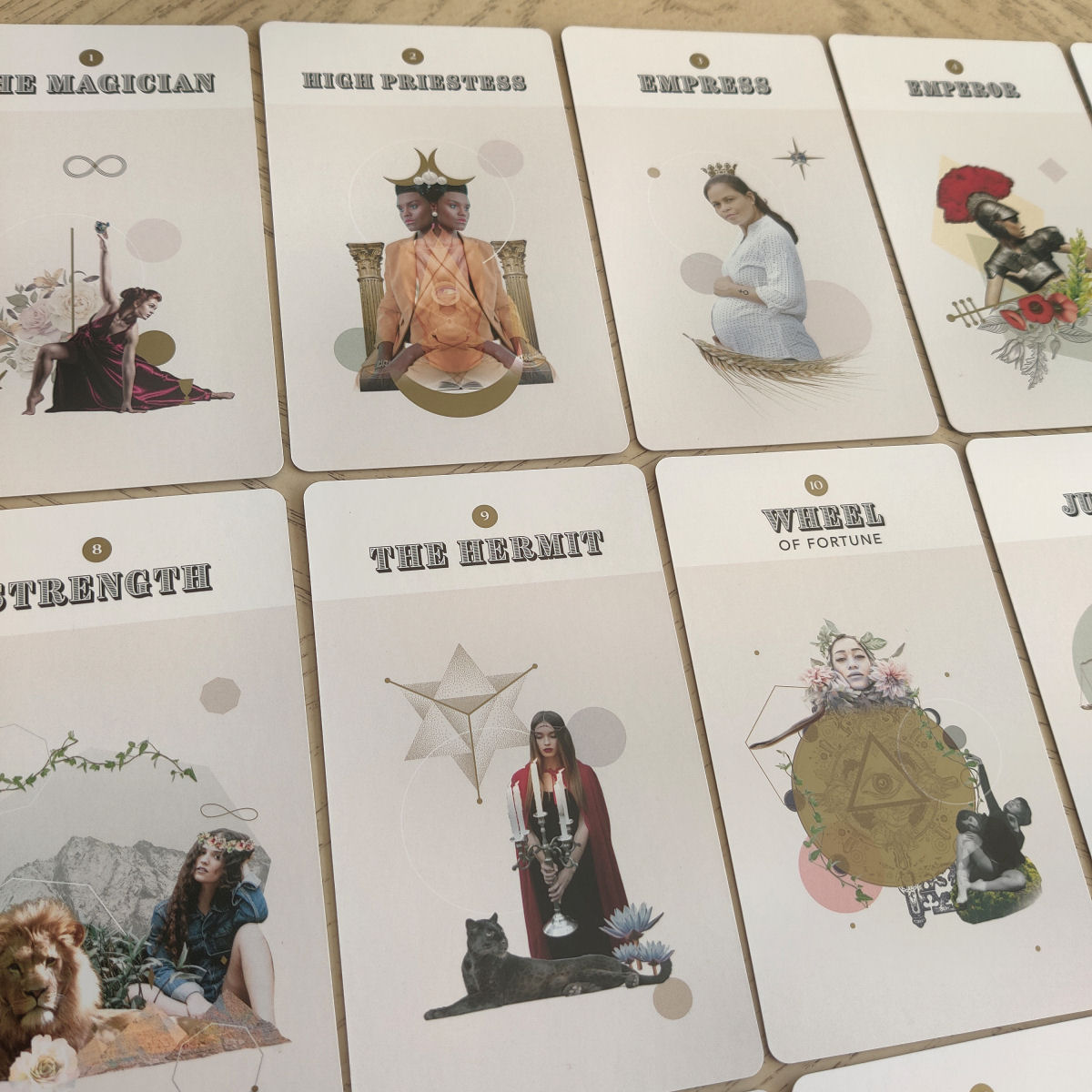
And check out the embossed detailing in the Wheel of Fortune card. This card, notes the LWB, is “the initiation of change. One’s path proceeds to take a new direction. The Kosmos spins the wheel to achieve its own objective.”
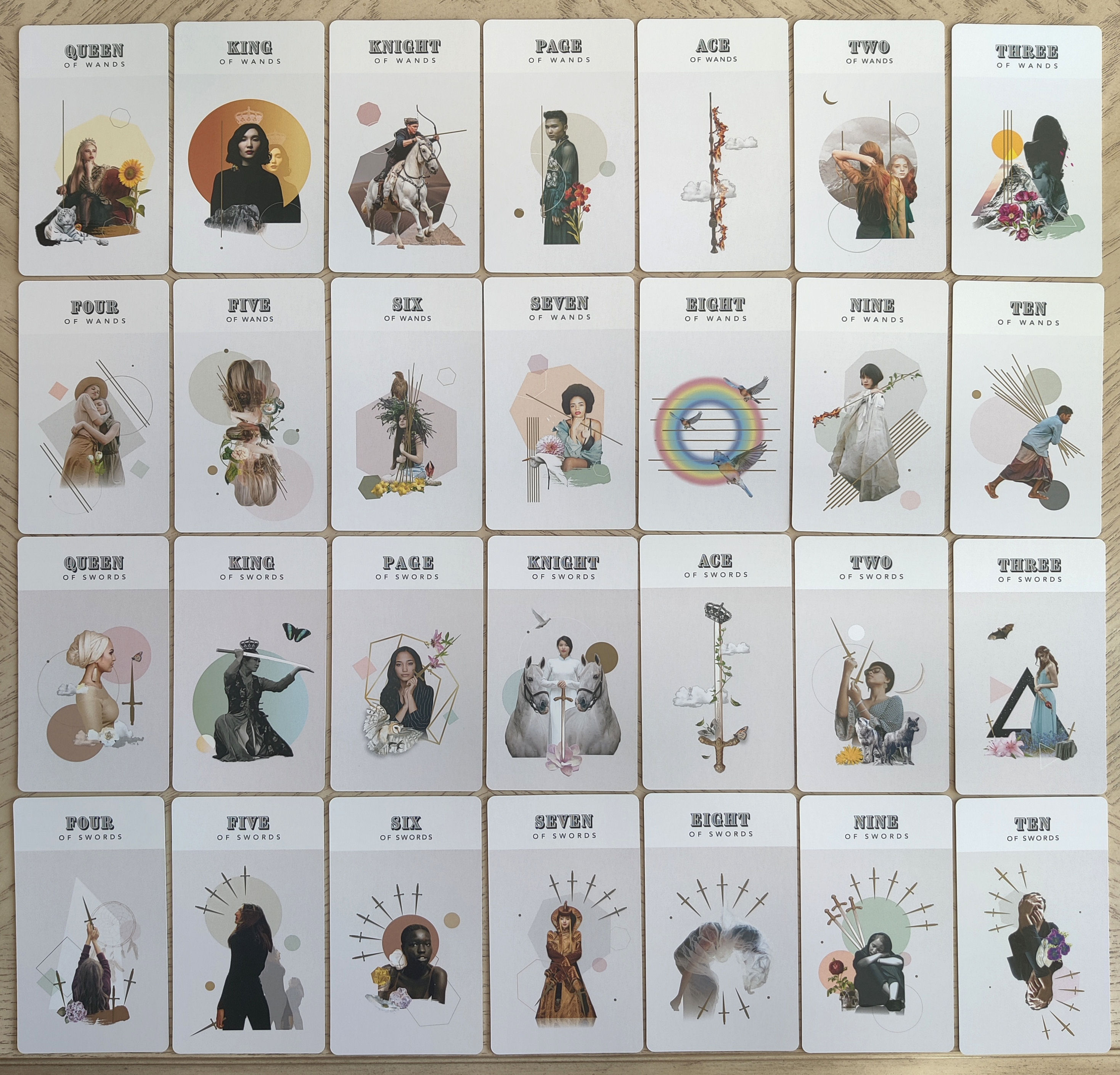
Straight out of the box, the Minors are ordered with the court cards first. In the suit of Wands, it’s in the order of Queen, King, Knight, and Page, and then the pip cards from Ace up to Ten. In the suit of Swords, it’s Queen, King, now Page first, and then Knight, and then Ace up to Ten.

While there are clear nods to the RWS, the artists have also invested a great deal of their own creative approach to the compositions. For those who like story-driven narrative art in their tarot decks, the pips here tend to be more expressive of personality. The Six of Swords here, for instance, considering both the art and the LWB, is one who has collected many lessons and knowledge, and has now evolved to a point of outgrowing the old– it’s a time for change. The Seven of Swords suggests that there is some secrecy, and some things are being hidden from you.
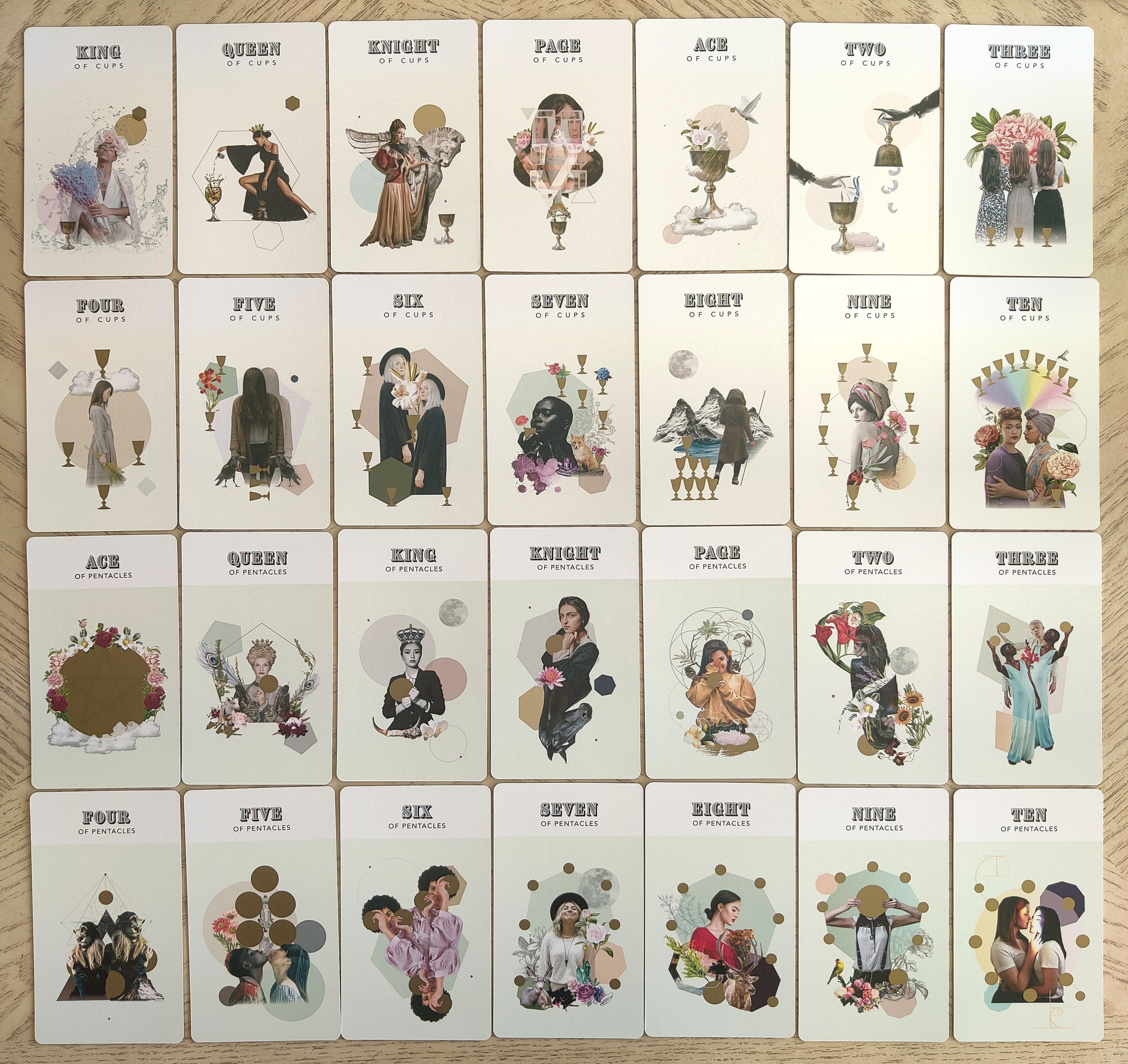
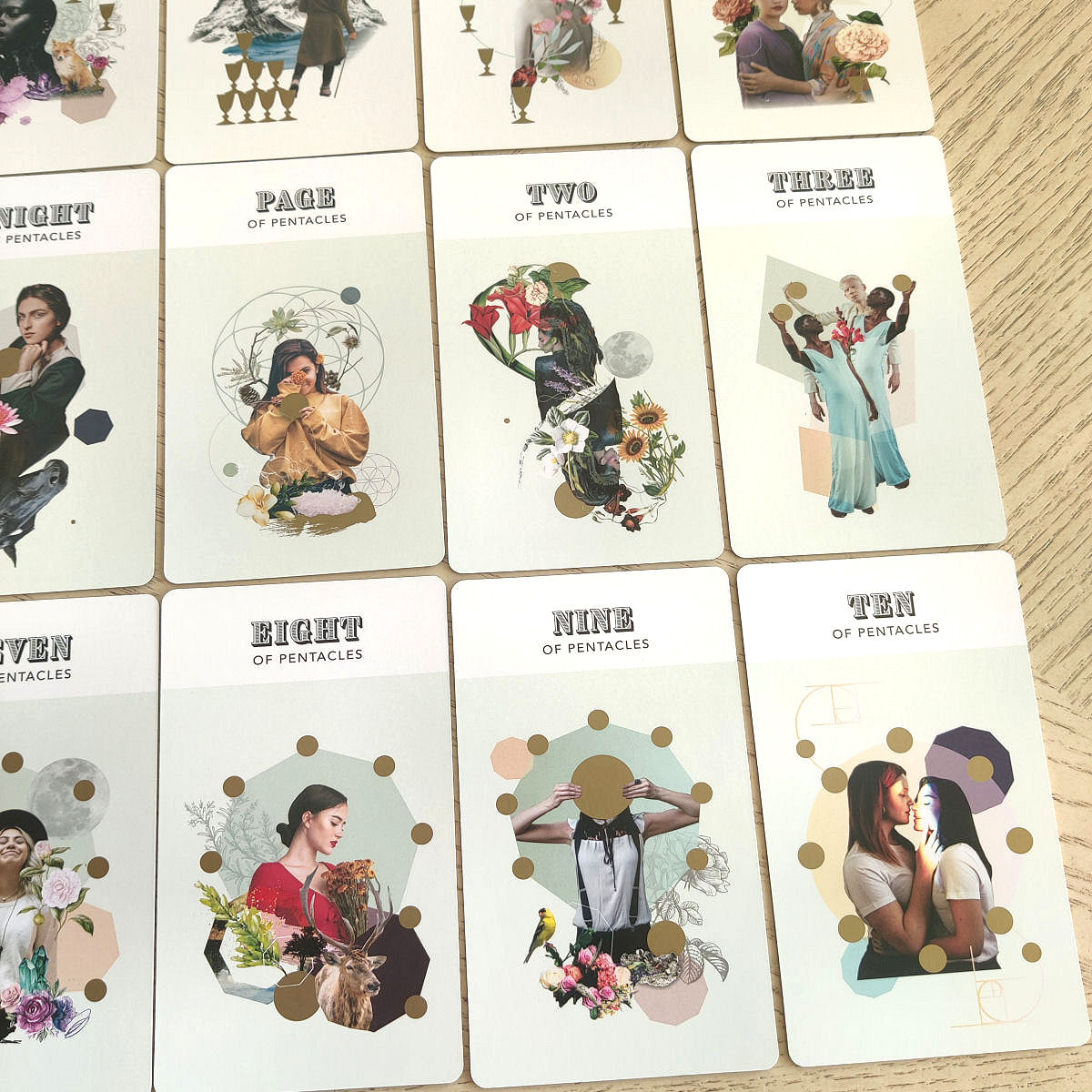
The court order out of the box for the suit of Cups is the same as it was in the suit of Wands, though then for the suit of Pentacles, at least in the copy I received, it started with the Ace — oh wait, somehow my Ace of Pentacles must have slipped out of its original place? Here it’s Queen, King, Knight, and Page again. Here you can also see how the backdrop for the Pentacles cards is just the palest green, and in the Cups, the palest yellow.
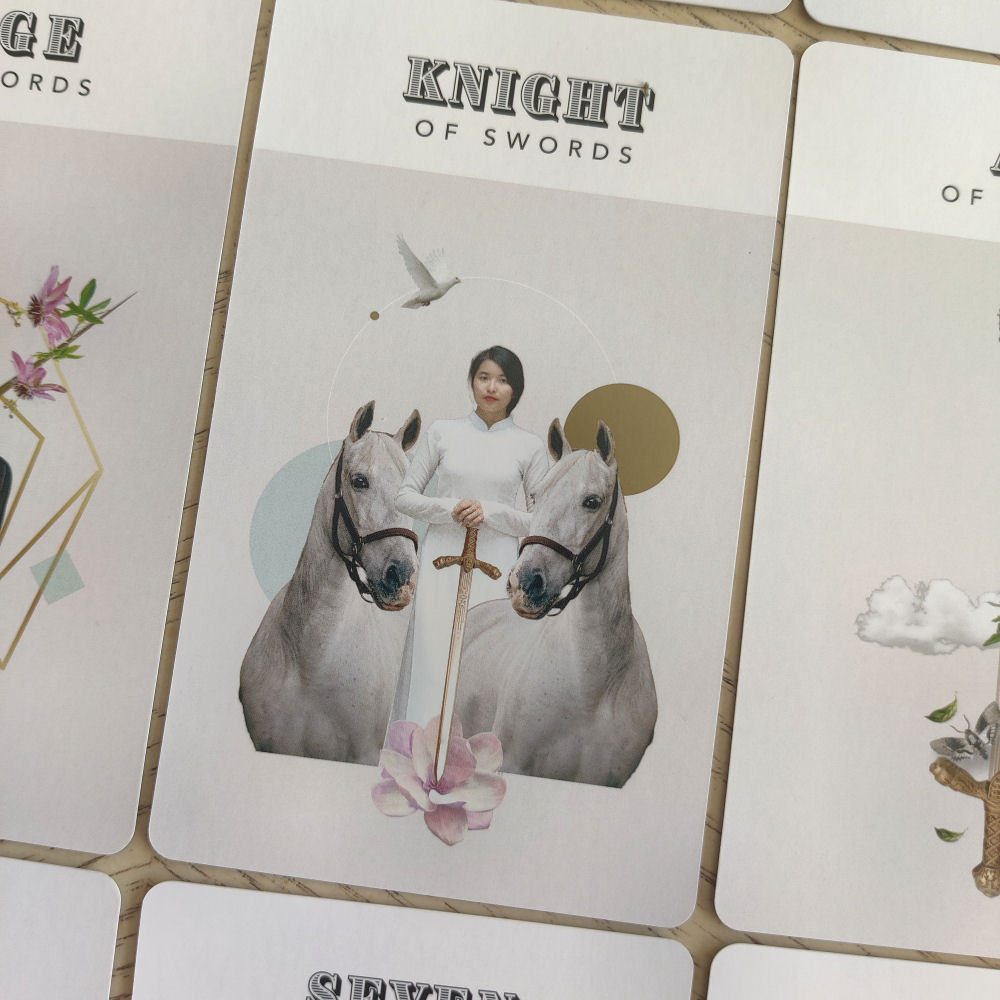
I want to share something I really, really appreciate, on a deeply personal level, with the representation found here. I’ll often say, I don’t need to see a bunch of Asians represented in tarot decks. It’s fine. I’m fine.

But then I come across a deck like the Gold Lyre Tarot that includes generous, beautiful, and elegantly artistic representations of Asians and I get sentimental. I’ve gotten so used to not having representation that I’ve conditioned myself into believing it’s fine. And then when I finally do get to see it, I realize what I had been missing all along.
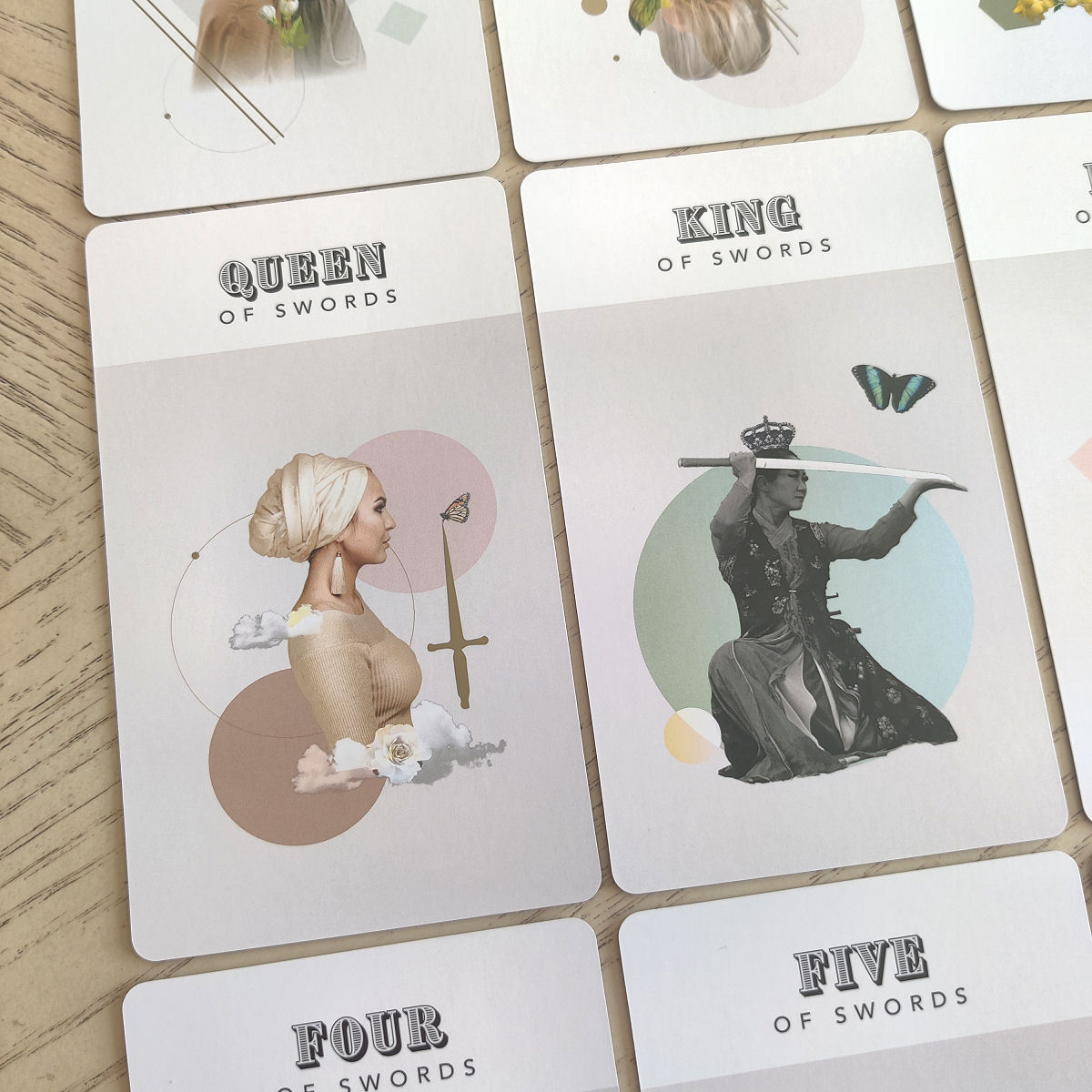
That is all to say that I really love the diverse representation in this deck. Often when deck creators endeavor to focus on representation, they forget about us Asians, or worse yet, the depictions of us they do include are cringe. So when deck creators like Scanlon and Martin come along to give us the Gold Lyre Tarot, it feels important, notable.

Gold Lyre Tarot feels like it’s from the same family of decks as the Starchild Tarot, where the Gold Lyre is a bit more minimalistic, stylistically reminiscent of the Bad Bitches Tarot but in a different medium, and while the Muse Tarot is more vibrant in its color palette, if you love one, then you’re going to love the other.
There’s a great piece of advice in the guidebook that I’m sure you know intuitively already, but Martin and Scanlon put it so well that it’s worth the reminder. There are three degrees to interpreting a tarot card:
- The placement: This helps you assess past, present, or future, and the directionality of the archetypal force at play;
- The symbolic meaning: Consider the historical interpretation guidelines for the card, creator intentions, and the various modalities or systems for assessing symbolism, including correspondences; and
- How the card intuitively speaks to you: Take a pause and listen. What crosses your mind as you look at the images and symbols? What does that card remind you of, in terms of person, place, or encounter?

Grab the closest tarot deck you have on hand, shuffle right now and pull two cards, the first card signifying inner, and the second card signifying outer. The first card is “below” conditions while the second card is “above” conditions; that first card is latent forces pushing to come forth while the second card is active forces that have already peaked.

Follow the three-pronged approach for interpreting these two cards, and take notes, free-writing in your journal what comes to mind as you assess the cards. Journaling helps us organize our thoughts, which is especially helpful when you’re reading tarot for yourself.

In terms of production quality, top notch. The sturdy magnetic clasp keepsake box has a matte finish with metallic gold embossed detailing. The cards themselves are a standard semi-gloss finish and the cardstock itself is just right. It feels heavy enough to be luxe, yet with sufficient slip for fanning the cards and bridge shuffling. Everything about production quality is tailored for an everyday workhorse deck, and will be great in professional tarot reading settings.


FTC Disclosure: In accordance with Title 16 of the U.S. Code of Federal Regulations Part 255, “Guides Concerning Use of Endorsements and Testimonials in Advertising,” I received this deck from the publisher for prospective review. Everything I’ve said here is sincere and accurately reflects my opinion.
 benebell wen
Pingback: 馬丁 (Lacy Martin) 與克莉絲汀‧史坎倫 (Christine Scanlon) 的《黃金七弦琴塔羅牌》 – benebell wen - FanFare Holistic Blog
Wow this is gorgeous. I usually don’t like decks with lots of white space but this is an exception because it’s done so well. This deck looks SO CLASSY! You’re right, I love the Muse Tarot and I love the look of this. And since you’ve described the excellent production quality it looks like I’ll be breaking my rule and buying one more tarot deck this year ✨
LikeLiked by 1 person
As much as I enjoy the original Rider Waite symbolism, when I see other card-designers blatantly copying it I have to say they appear “lost for a theme”. Rider Waite used a variety of sources for its symbolism for example Masonic symbolism, pagan symbolism, astrological symbolism, occult & magical symbolism, mythical symbolism, numerical symbolism etc. There are just as many other sources for symbolic attributes out there if as a card designer you are willing to avail yourself of their intrinsic meanings by analogy, allegory, visual symmetry/asymmetry, numerical 1-10 or chronological, day/night attributions. A lazy designer is one who falls back in despair on RWD symbols when there is so much out there. For example the Arthurian Legend, Chaucer Tarot, Secret Dakini Oracle all of which have departed significantly from RWD symbolism.
LikeLike
Nice pics the creator I gather knows the subject well, https://hai.stanford.edu/news/movement-decolonize-ai-centering-dignity-over-dependency
LikeLike