
I don’t know why or how drawing the First Edition of the SKT was a dream-like experience and even the digital coloring process for the Revelation went along at good momentum and a consistent rate of progress, but then here with the Etteilla art project, it has been SO… @#$%^&… EFFING…. $#$@!!… HAAARRRRD!!!
And I can’t even articulate to you what about the process is harder.
Even though both the SKT and this Etteilla are solo indie projects, the SKT illustrations felt like channeling and downloading, whereas these Etteilla illustrations feel like I’ve been commissioned to do the work and there’s some tension, push and pull between whoever is masterminding the project and me, the commissioned illustrator.
With the SKT, anything and every element that needed to be aligned was aligned. With this Etteilla, I dunno… that’s not how it feels at all.
I use the commissioned art analogy because based on what I’ve heard from artist friends about that experience of being commissioned to create someone else’s vision, that slog is exactly how this effort feels.

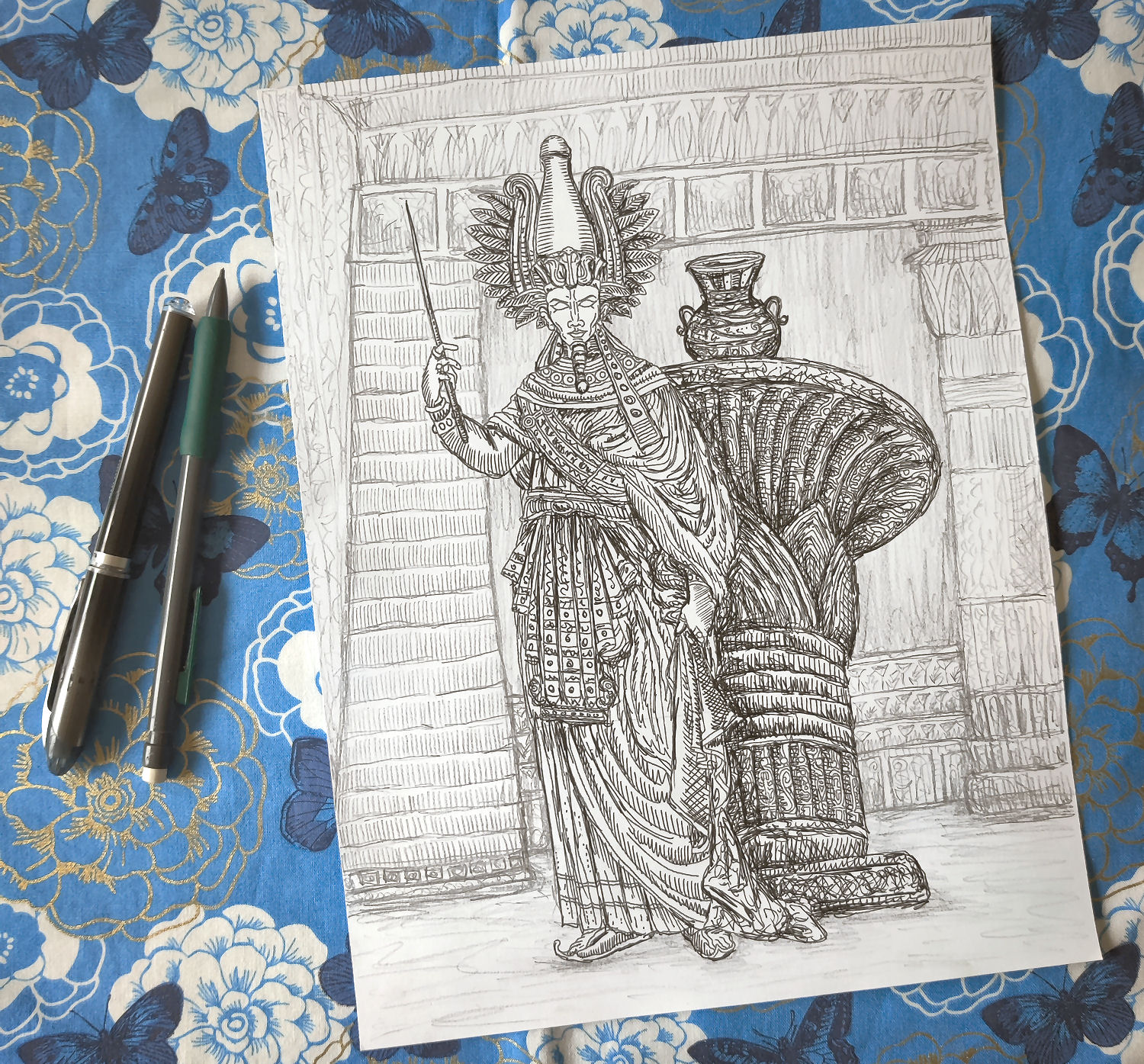
Typically the analog hand-drawn sketch is not taken to this level of detailing, but for some reason I was really liking the sketch on some personal level, so I wanted to “finish” it to some extent so I could frame and hang it.

Here you see why I don’t take the line drawing to any level of detailing, because all of it will get wiped after the digital scan. To clean up the line drawing and prepare it for digital coloring, I erase all stippling, hatching, and extraneous lines so all you’re left with is the outline.
I still do the first outlining of the drawings by hand because it’s easier and faster for me. I got into digital illustration too late in life, I think, so my hand is steadier when it’s holding an actual pen or mechanical pencil.
On a digital screen with a digital pen thing, it’s just still too hard for me. To draw, I need to feel very connected to the tip of the pen or pencil (if that makes any sense). In the same way you can feel complete control over the tip of your fingernail, I need to feel that way over the drawing instrument. Holding a digital pen just isn’t the same for me. I can’t feel complete control over it.

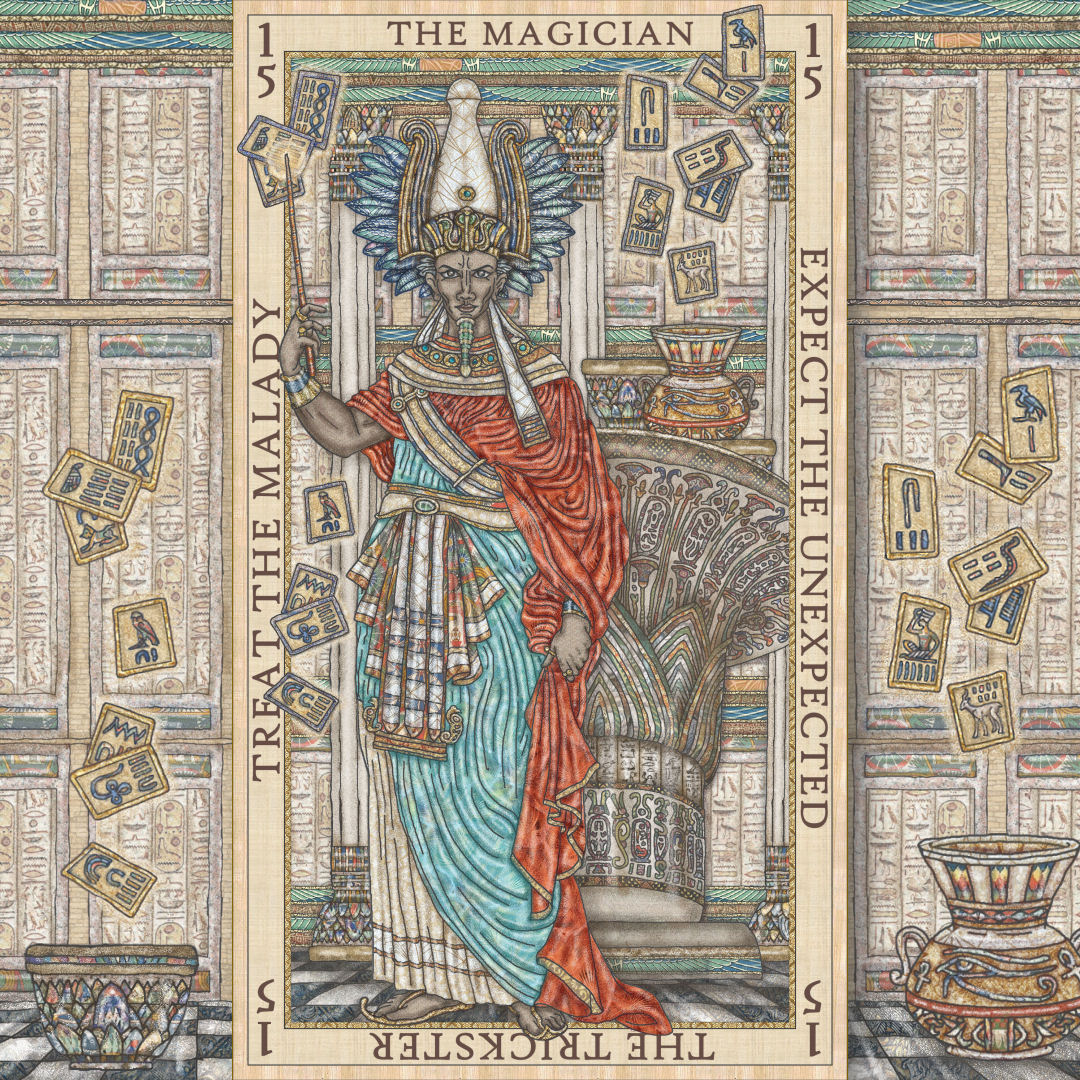
As for the composition, it’s my artistic interpretation of the following quote by P.R.S. Foli about Etteilla’s Magician card (1915):
On a table or altar in the temple of Ptah at Memphis, at the height of the breast of the Egyptian Magus, were, on one side, a book or collection of cards, or plates of gold (the tarots), and on the other a vase.
I just thought it would be fun to play with the tarot-cards-are-from-Egypt mythology by taking it super seriously.
In my illustration there are 14 tarot cards that the magus is “juggling” with his wand (reference to this card also being called The Juggler). And the cards represent the first 14 plates of the Major Arcana with hieroglyph equivalents to the Latin alphabet and the ancient Egyptian numeral system.

Each design element of the final card composition is a separate image layer. That way I can move things around. This is one of the great advantages of going digital– you can very efficiently tinker with different positioning and composition layouts until you get to the right one.

English systems/Golden Dawn tarot readers are going to have quite the time slinging cards with the Etteilla! In this deck system, The Magician card as Key 15 signifies malady, an ill state of health, indicating pain points. Writes J.M. Simon in a 1977 guidebook to the Grand Etteilla III, it counsels to see a doctor.
An alternate meaning for the card, per Miss Lemarchand, is the announcement of an unexpected yet important change in position. The cards neighboring The Magician will offer insight into the nature of that change.
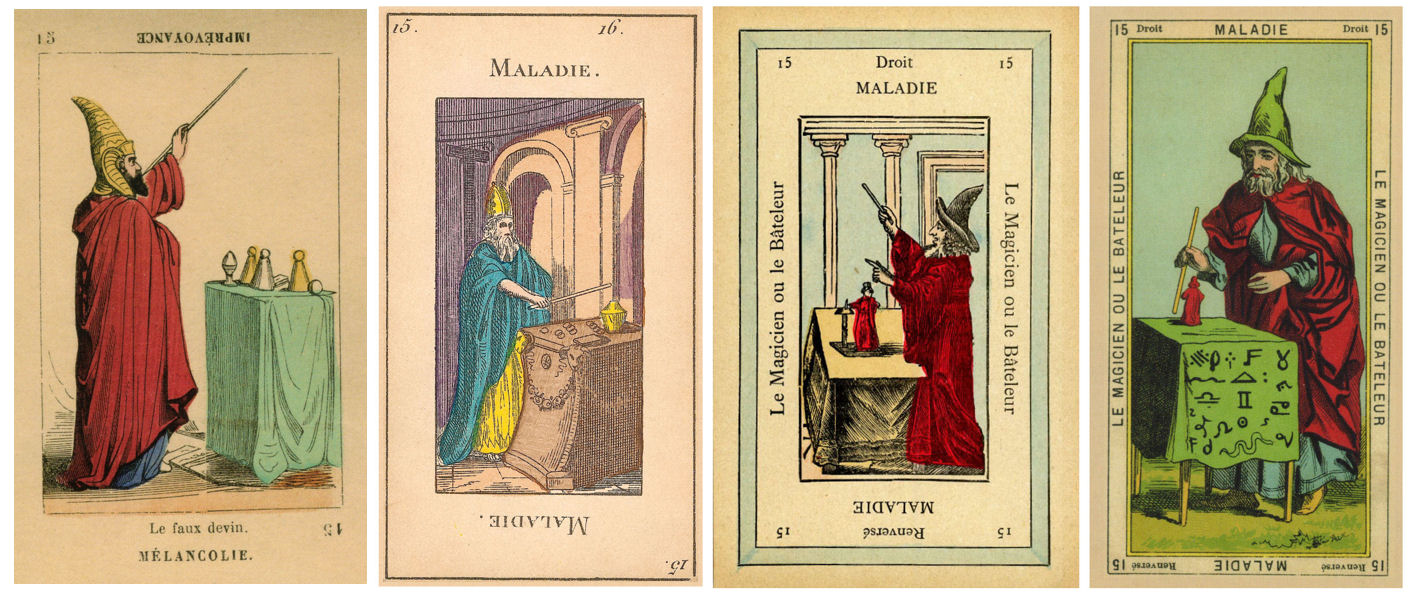
Per Etteilla’s own writings, The Mountebank (Bateleur) holds the rod of the magi and works miracles in order to deceive. Thus in the 1843 Princess Tarot iteration of the Etteilla, this card is called The False Diviner.

The sketch above to the left was completed around March of 2023. But then I could not get into the digital painting process for the deck design until the very end of July 2023.

I don’t know if it’s just my lack of experience as an illustrator or if other artists have experienced this too– but even a hiatus of a few months made me feel like I forgot how to art. It took me a beat to get back into a rhythm, to remind myself where certain digital brushes were in the software program, the sprays of contrasting hues needed to add some impression of depth to the cloth, how dark to go, how light to go, all of it felt a bit awkward.

Not sure if I’m just overthinking it and that’s my problem, but coming up with keywords for each card hurts my brain.
Language translation issues notwithstanding, the way we use words, the social and cultural implications of certain words have all changed so much since the 1700s. The complete list of keywords assigned to the 78 cards represents the spectrum of common life experiences of Europeans in that time period.
To doggedly replicate an 18th century divination deck for a modern audience doesn’t exactly make a whole lot of sense. My complete list of keywords as assigned to the 78 cards need to represent the spectrum of common life experiences of a globalized society in the 21st century.
But changing the keywords too much goes against my starting premise and mission. So what’s a gal to do… sigh…

And to pile on the stack of issues and concerns, after I complete the last card in the deck, I will have to return to the first few cards I drew (Cards 1 and 2 pictured above) and re-do them. I had this problem with the full-color Revelation SKT as well– by the time I finished all 80 cards, my technical skill with digital painting had changed so much between Card 1 and Card 80 that I had to return to the earlier cards to re-do them.
I think my Sun card (Card 2) is okay, but the significator (Card 1) definitely needs an update. My “clouds of chaos” are a bit underwhelming.

As of this update, the above is my current final draft of the card, which differs from the other versions shown previously in this post. I didn’t like how that petal ornamental on the altar behind the magician was so prominent. It was competing as a focal point against both the magician and the floating tarot cards, which it shouldn’t. So I noodled with it a bit more.
For those who have not been keeping track but are curious about my progress, I’m still very far from completion of a full deck. I haven’t even finished all the Majors, and have only a handful of pips done. Haven’t even started on any of the court cards.

I’ll end with my current work-in-progress card, the Two of Wands. The illustration of the grieving woman was very much inspired by this Hillie Bakker oil painting, “Playing with the Energies,” which you can find here on her website.

And for my RWS tarot readers who are really scratching their heads over those keywords, see above for the historical Etteilla references.
This has been my approach to the layout of the companion guidebook:

Each card entry in the guidebook is a synthesis of several French texts on the Etteilla Tarot card meanings and my thoughts on the implications of that synthesis and what these texts are trying to say.

What really helps me to bake the card meanings, upright and reversed, into my memory bank is to see the card images, both upright and reversed printed in a book. So I just make the assumption that having the visual of the card images both upright and reversed in a book would be helpful to you, too. =)
Oops, seeing my own blog write-up now, I realize I forgot to include a key symbol write-up for the stagecoach in the historical lower third of this card. Even though I’ve opted not to go with the stagecoach symbol inclusion for my reconstruction, I still want to talk about it in the guidebook for those using the guidebook to go with any of the historical Etteillas.

Anyway, that’s where I’m at with this tarot art project.
 benebell wen
Maybe you should approach it as if your name was New Llebeneb.
LikeLike
LOL. To be fully immersive in the world of Etteilla I guess I would have to!! 😂😂😂
LikeLike
In any case, so far these images are extremely powerful and compelling, so despite the tooth-pulling aspect this all seems on-point.
…not sure if that helps!
LikeLiked by 1 person
From what one can see in your blog, both your images and the keywords seem great and inspiring. Also, I find inventing a new vocabulary for the deck a better idea than replicating a two hundred years old vocabulary (unless someone intends simply to reconstruct a historical deck but then the whole reinterpretation job rests on the reader, which may be a tedious and time-consumming thing). Keep my fingers crossed for this project!
LikeLiked by 1 person
Oh, I know exactly how you feel. I had the same struggles with many of my own art projects at some point. Unfortunately there is no recipe to follow to get into flow, again.
Anyways, I hope you’ll finish it someday. For this is going to be an amazing deck of cards. I totally agree with stankbeest that those images are powerful and on-point.
LikeLiked by 1 person
I don’t know anything about drawing, so my experience may or may not be relevant here, but the whole situation sounds very familiar. I wrote a short novel once and it totally was a dream-like experience. I liked the characters and readers liked the novel, so I started to work on a sequel. Nightmare. Nothing wanted to connect and the characters constantly fought me and each other … so, after 60 or so pages and several different story arcs I had to shelve it, even though there were many good scenes and some great (if I say so myself) dialogues in it. A couple of short stories I did immediately after that practically wrote themselves. So …. yeah. Awen flows in mysterious ways … Maybe try a divination to see what you need to do differently?
LikeLiked by 1 person
I love that you’re doing this. It looks gorgeous. I have also had the problem of coming back to art after a “break” and having lost muscle memory. Don’t worry, you’ll get it back. As for wrestling against someone, doesn’t it make perfect sense that Etellia himself is doing that? He’s probably grateful but seems a teensy weensy bit of a control freak. The SKT is all you, but now you’ve taken on the challenge to present us with a special Etellia. Again I’m so jazzed your doing this. It’s a whole different process than creating your beautiful SKT, so don’t be too hard on yourself ✨
LikeLiked by 1 person
“ but even a hiatus of a few months made me feel like I forgot how to art. ” Aye, too true, I’m into textiles and a sewist. Any time spent away from the craft there is a void. Try picking up an old project and you’ll see the difference in tension and sometimes I’ve had to toss and start over.
I must confess, your magician, oh my… I closed my eyes, inhaled, open my eyes and focused. Yul Bruner was staring back at me.
LikeLiked by 1 person
Hi Benebell,
I love both black and white and color of your drawings, although I feel the black and white has more details. I’m still studying the SKT book, each time I look up a card description from the book, there is always a new information to learn. Please take your time, little by little, each card you draw will turn out perfectly. From Shelly
LikeLiked by 1 person
I’m starting to think you’re like the professor from hell: I want to learn but there’s so much homework! 🤣🤣🤣 Please take your time. I’m still working on Thoth.
P.S. The artwork is really beautiful so far ❤️
P.P.S. Most intimidating Osiris ever 😱
LikeLiked by 1 person
If you’re every bored, you could try using Camera Obscura & Camera Lucida techniques; perhaps the physical manipulation of light within your art will add the levity you seem to desire.
LikeLiked by 1 person
Pingback: 繼續甲板塗鴉的艱辛…… – benebell wen – FanFare Holistic Blog