
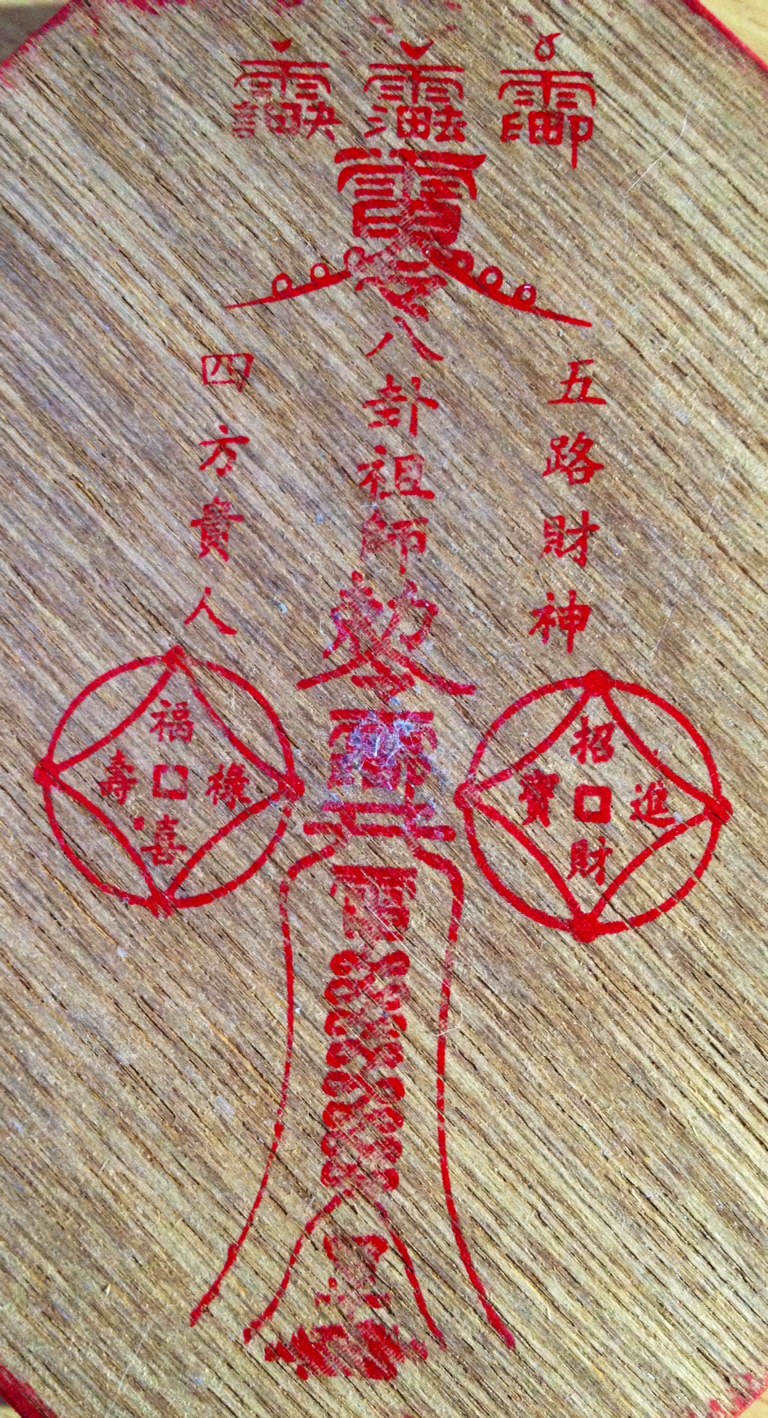
While reorganizing a closet that contained boxes of things I hadn’t touched in years, I came across some of my grandmother’s personal effects and found a trinket box with the above sigil painted underneath, on the bottom of the box. It’s a feng shui talisman of some sort, that much I know.
According to my mother and those who are in the know, it’s “a spell.” Their words, not mine. A blessing spell meant to guard and protect.
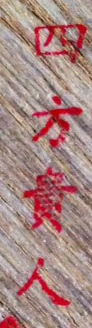
The left-most column of text calls upon the guardians of the four cardinal directions, which in feng shui theory are the Red Phoenix in the South, the Black Tortoise in the North, the Blue Dragon in the East, and the White Tiger in the West.
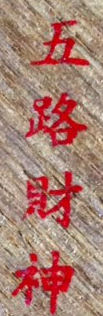
The right-most column of text calls upon the spirit guardians of the five relative directions, or Up, Down, Left, Right, and Center.
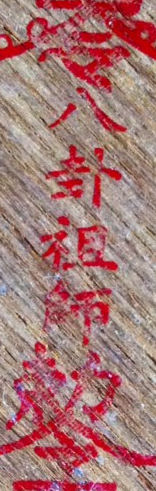
The center column is about the founder of the Ba Gua, or eight trigrams, and calling upon that energetic legacy for protection. I might liken that to praying to a venerated saint and hoping that the saint will come and bail you out of trouble.
Meanwhile the guardians of the four cardinal directions are about the universal, collective Qi energy while the guardians of the five relative directions are about the personal Qi, like a call for summoning up your own inner strength. Then the characters inscribed in the circles with the little squares at the center are just various characters for good luck and fortune, like happiness, prosperity, yada yada.
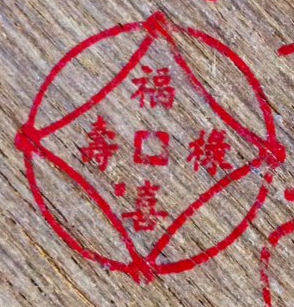
The square within the circle is symbolic of the harmony between heaven and earth. It’s basically a pictorial expression of “heaven is on my side.” The diamond thing forming the four points are representative of the four gates of…something. It’s a mandala thing.
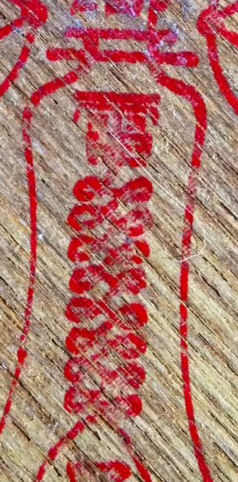
The chain of lemniscates or infinity symbols reinforce the intensity of power or the efficacy of the spell. It’s the insurance policy. I suppose it’s like adding a string of exclamation marks behind a statement to show you really mean what you’re saying!!!!!!!!!!!!!!
Then you have the overall form or structure of the painted sigil, which is meant to represent a bell or wind chime, which is superstitiously believed to ward off evil spirits. Allegedly, evil spirits are afraid of the sound of bells, which is a pretty interesting belief if you consider the cross-cultural employ of bells in religious services. A less abracadabra way of phrasing it (though no more scientific) is to say that the sound of bells or wind chimes can scatter malignant energies or bad Qi.
The discovery of this sigil among my grandmother’s personal effects coincides quite synchronously with recent personal research on sigil crafting. In certain Western esoteric traditions, a pictorial symbol is rendered from the letters of a sentence that expresses the sigil creator’s wish, will, or intent. Some then remove repeating letters from that sentence, and some will go on to also remove the vowels (they’ll disenvowel the sentence… ha.. ha.. sigh, sorry. corny humor. now you know I’m a nerd), but ultimately all will then take the distilled lot of letters and use them to draw a symbol. That symbol is a sigil, which is meant to help along that wish, will, or intent into manifestation. Basically, it’s a spell.
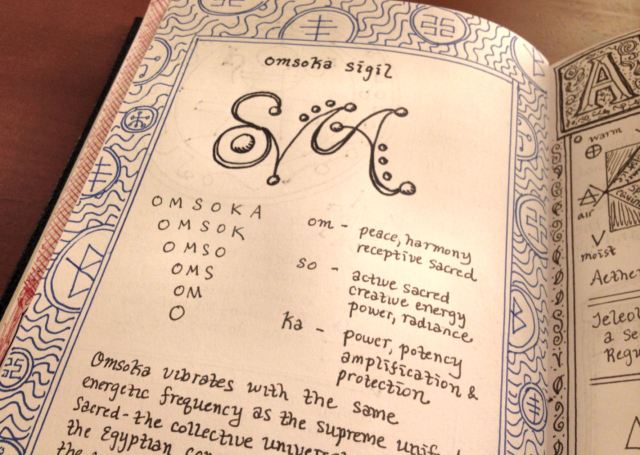
Sigils are like mystical logos. They’re emblems made to recognize or acknowledge the identity of something, much like a logo, except what a sigil acknowledges isn’t a company, but rather an intent or wish. Anyone can design a logo and anyone can craft a sigil, though there will be the erilaz among us, the modern day equivalent to the Iron Age rune masters.
I’ve heard that in the Western esoteric tradition, when a sigil is crafted from a language with an alphabet, you write out the sentence as an affirmation, knock out the repeat letters and heck, maybe throw out the vowels too while you’re at it (disenvowel!), and then with the remaining letters, artistically style it into a symbol, which becomes the sigil. The sigil represents your specific intent, as expressed by the affirmation, and like a spell, through visualization psychology will help manifest that intent.

That method may not work so well with a language like Chinese. In Chinese, I use the Lo Shu square as a grid for drawing the sigil. The sentence is written out just as it is in the Western esoteric tradition, except for each character, the number of strokes is determined and take the theosophic reductions of those numbers, i.e., keep summing up the digits of the sum until you get a number 1 through 9. Each character in the sentence therefore corresponds to a number 1 through 9. Then plot those numbers in the order the corresponding characters appear in the sentence into the Lo Shu square. A pretty hideous looking sigil is thus formed.
I just made up this so-called Chinese method, by the way. After reading about sigil crafting in the Western esoteric tradition, I wondered about how I might craft sigils from sentences written in Chinese and came up with that. As I said, it’s pretty hard to craft swanky sigils with that Lo Shu square grid.
That’s probably why the Chinese go with the elaborate red sigil things.
 benebell wen
Disenvowel! I love it! Sigils are an excellent method of magic. Chaos Magic made it quite well known. There are various methods of creating and launching sigils. The 90’s was all masturbation, death posture, and other somewhat questionable methods. I use methods of trance and visualization. I’m also one of those Runesters you mentioned, although far from a master. Bindrunes make for very powerful sigils. One should have a working knoweldge of the Runic system before slapping them together.
On to the next post in the archive! 🙂
LikeLike
Happy Día de Muertos, Benebell. Just a quick thought: you might want to close circuit this post before it gets picked up by the Journal of Zany Sages. Do you really want to wake up and read a Headline like this? “Grandma’s magic misleads dangerous adept into a completion of the water-wood zodiac cycle during two consecutive snake years.” Of course, that’s just a headline. The article itself would likely be a Sancho Panza piece about Don Quixote’s latest realizations into the investigation of a trans-national ancestor conspiracy operating in the cryptomantic underworld of four or five different Asian countries, including China, Taiwan, Korea, Japan, and India. After celebrating the Japanese holiday お盆 on Nov. 2 at a Benedictine monastery, Quixote commandeered one of the Shogun’s ships and sailed out in the direction of 蓐收 to find out more about 玄冥 because the pair of them represented a hyper-sensual perception mode in which it might be possible to understand the cracked mirror phenomena in terms of the inner pattern of a jade stone. It turns out, somewhere in one of these countries (or possibly somewhere in the united states), a psycho-psychotic Indian inspired turtle-transmission failed to pass its final combat test by confusing patriarchy and ancestry. Due to mirror cruise being in its active phase in the South China Sea, ancestral memories showed our ingenioso hidalgo deeper into the dark enigma, where it was revealed that the nagasattva’s also recently had a failed transmission where one of their many, many girlfriends had mistaken the Matriarchy for True Ancestor Religion. By the time that Quixote had arrived at the Peruvian restaurant, the entire scene had devolved into shouting, one persons over here “KHO-HAAA!” another person’s over there “KHO-HAA!”, and then Placid-Land re-incarnats directly into the restaurant where all the meat eating is happening, and he says “Your head is full of stolen emptiness!”. Not missing a beat, Quixote then replies: 閑 = 門 + 木 + 木, according to the idempotent property of the 門 operator. Peruvian 行 was there too, and she said claimed that she was studying Russian and guitar at the same time, so that she could get a Russian husband instead of having to marry a Don. Unaffected by the woman’s disinterest, Quixote continued to lecture about his reading of the mystical signs, that unfortunately the idempotent property of the gate operator is obviously limited by the natural surroundings. So you could have 閑 = 門 + 木 + 木 + 木 + 木 + 木 + … but eventually you would exhaust the entire forest in some sort of climatalogical emergency. This finicky feature is more obviously apparent from other definition of idleness 閒 = 門 + 月, for which 閒 = 門 + 月+ 月 seems, at first, not to make any sense. Then the article concludes, with Quixote is sitting around the Peruvian bar with a bunch of his friends drinking Suntory this, Suntory that, and instead of a Spanish galleon, they have an air craft carrier and flying cars equipped with Kaleidoscopes. The barber from the barbershop next door, used to be cop and now he works for seven signs, everyone’s debating what to do, the barber comes in, and he says: “Get off your lazy asses and load up the treasure ship! We’re going to Mars to watch the moonrise”. What I’m really trying to say is that, if you put your grandma’s magic out there for everyone to see, you might want to be careful about how you allow stranger tarot weirdos to respond to that in the comments. Why are we still talking about the 90’s?
LikeLike